

Key Takeaways from an Executive Coach
Key Takeaways
- An Artificial Intelligence (AI) Coaching Platform is your ultimate prep tool, not your replacement coach. I’ve found that when you use a coach-trained AI as a “thinking partner” to build confidence, brainstorm issues, spot initial biases, and digest data before we meet, it helps you gain clarity on your core challenges. This ensures we don’t waste our precious 1:1 human time figuring out what the problem is, and can instead dive right into solving it.
- Complex human problems still require a human heart. While AI powered tools are brilliant at identifying patterns and handling convergent tasks, it doesn’t have a soul, an evolved personality, or an emotional history. When it comes to messy organizational politics, moral judgments, and emotional resonance, human-to-human connection is irreplaceable.
- Watch out for AI traps. As much as I advocate for AI powered platforms, you have to be careful. Be on guard for “AI brain fry” from cognitive overload, factual hallucinations, and its tendency toward “sycophancy” among other things. Be sure you’re using a system that guarantees your confidentiality, which your company system and ChatGPT will not.
- Stop treating AI powered coaching tools like a simple search box. To get truly nuanced advice from an AI, you have to feed it rich context. Share your goals, your background, and your challenges. Explicitly ask it to play devil’s advocate to poke holes in your plans and reveal your blind spots. Use the 62+ AI prompt ideas in this PDF to get you started.
- Whatever you do, don’t outsource your thinking. The secret to real self-development is reflection. Use AI coaching to stimulate your curiosity, but make sure you do your own thinking before and after engaging with it so you don’t lose your cognitive flexibility. My ultimate job as your coach is to help you connect the data of your life to your journey as a whole human being—and an AI just wouldn’t have as much fun doing that as you and I will, together.
Why would an executive coach give you an AI to work with?
Want to know why I’m not worried about being replaced by an AI coach? Read to the end, and I’ll tell you!
Here’s how I know that artificial intelligence (AI) is the wave of the future: (to my surprise) I’m offering AI coaching to my clients as a complement to my executive coaching services!
Before you pull back in you-must-have-sold-out horror, knowing I’m actually training an AI to serve my clients, hear me out.
Training my AI on a proprietary platform as a coaching tool over the last year has only made me more confident in human-to-human interaction, including the value I personally deliver to my clients as an executive coach (see below). I’ll qualify this to say that different AIs are being trained for different kinds of functions. Mine is a coach. It won’t do your homework for you, but it will coach and prompt you through how to think about challenging situations where coaching can support you. Remember that if you’re looking for growth and support–find an AI that is good at that. [Access the InPower AI free here.]
While Large Language Model (LLM) AI systems do a great job of mimicking human communication, they’re really just extremely smart algorithmic libraries that parrot human communication patterns based on reams of publicly available data, like this blog post (which I’ve personally authored). While better writers than many of us, AI tools only copy the abilities of the average Internet author. What they can’t mimic is what we have in our hearts. And they certainly can’t offer the personalized coaching conversations that a experienced human coaches will give you.
And while LLMs have been around for a “while” now (3 years?), AI agents are quickly penetrating the workplace, offering to handle longer task sequences and acting more independently. The combination of these capabilities is both exciting and dizzying. But in all cases, when we’re talking to an AI, we’re not talking to a soul, a lived timeline, an evolved personality, or a goal-oriented, autonomous being. These are all the things that make us interesting and effective as friends, mentors, coaches, and confidants to each other
At the same time, of course, the ability for an AI to scrape through gigantic swaths of human knowledge and converse with us about it and our personal challenges is a pretty amazing feat. Based on my own experiments and feedback from my clients, AI absolutely plays an important role in personal growth and leadership development, but there are pitfalls to avoid.
To help my clients, and anyone else out there trying to figure out the best way to leverage AI Coaching platforms in your personal and professional development, I’ve outlined below some research- and experience-based best practices for how to get the most benefit out of AI coaching when tackling the following kinds of issues that typically come up in leadership development and executive coaching:
- interpersonal office dynamics and stakeholder management
- team development and management
- establishing and communicating vision and strategy
- change leadership
- negotiation and risk mitigation
- managing stress and emotional energy
- strengthening leadership presence
- goal-setting, career growth, job search, and influence
Here’s something I’ve noticed in years of coaching before AI: there is a natural progression to how people learn to understand problems and develop solutions. To my surprise, when I started using and training my proprietary last year, I learned that the algorythm is pretty good at converting user input into interesting dissection of business problems and simple human dynamics, and it’s not bad at suggesting solutions to both. It’s also masterful at helping train us to ask really good questions full of context and nuance, so we get the best out of it (because it gives us better answers when we ask it good questions!). I chose an ICF standardized technology platform with robust controls based on behavioral science to ensure the core code integrated proven coaching methodologies and that the data protection protocols would be in place to protect my clients.
But when it comes to complex human issues, both within our own hearts and minds and between individuals, almost all AI systems are only skin deep and will either steer you wrong or fail to help you understand and address the deeper dynamics you need to solve for.
This is consistent with research showing that AI is a good tool for delegating convergent tasks—such as technical problem-solving, information retrieval, and structured reflection—but not so good at handling divergent tasks involving moral judgment, emotional resonance, values conflicts, and complex organizational politics.
Think of it this way: a computer can learn a model of human behavior as well as a human, but learning the subtleties and nuances of how to apply that model, much less a hybrid of models, when other humans are involved, is much better done by a human. Also, it turns out that most humans prefer interacting with humans when empathy and emotions are involved.
That doesn’t mean AI can’t be helpful in helping you understand your problem better and making more effective use of your 1:1 human time. Want to know why I’m not worried about being replace by an AI coach? Skip to the end section and I’ll tell you!
Here’s how I know that artificial intelligence (AI) is the wave of the future: (to my surprise) I’m offering AI coaching to my clients as a complement to my executive coaching services!
Before you pull back in you-must-have-sold-out horror, knowing I’m actually training an AI to serve my clients, hear me out.
Training my AI on a proprietary platform to be good at coaching over the last year has only made me more confident in human-to-human interaction, including the value I personally deliver to my clients as an executive coach (see below). While Large Language Model (LLM) AI systems do a great job of mimicking human communication, they’re really just extremely smart algorithmic libraries that parrot human communication patterns based on reams of publicly available data, like this blog post (which I’ve personally authored). While better writers than many of us, they only copy the abilities of the average Internet author. What they can’t mimic is what we have in our hearts.
And while LLMs have been around for a “while” now (3 years?), AI agents are quickly penetrating the workplace, offering to handle longer task sequences and acting more independently. The combination of these capabilities is both exciting and dizzying. But in all cases, when we’re talking to an AI, we’re not talking to a soul, a lived timeline, an evolved personality, or a goal-oriented, autonomous being. These are all the things that make us interesting and effective as friends, mentors, coaches, and confidants to each other
At the same time, of course, the ability for an AI to scrape through gigantic swaths of human knowledge and converse with us about it and our personal challenges is a pretty amazing feat. Based on my own experiments and feedback from my clients, AI absolutely plays an important role in personal growth and leadership development, but there are pitfalls to avoid.
To help my clients, and anyone else out there trying to figure out the best way to leverage AI Coaching in your personal and professional development, I’ve outlined below some research- and experience-based best practices for how to get the most out of AI when tackling the following kinds of issues that typically come up in leadership development and executive coaching:
- interpersonal office dynamics and stakeholder management
- team development and management
- establishing and communicating vision and strategy
- change leadership
- negotiation and risk mitigation
- managing stress and emotional energy
- strengthening leadership presence
- career growth, job search, and influence
Here’s something I’ve noticed in years of coaching before AI: there is a natural progression to how people learn to understand problems and develop solutions. To my surprise, when I started using and training my proprietary last year, I learned that the algorythm is pretty good at helping dissect business problems and simple human dynamics, and it’s not bad at suggesting solutions to both. It’s also masterful at helping train us to ask really good questions full of context and nuance, so we get the best out of it (because it gives us better answers when we ask it good questions!).
But when it comes to complex human issues, both within our own hearts and minds and between individuals, it’s only skin deep and will either steer you wrong or fail to help you understand and address the deeper dynamics you need to solve for.
This is consistent with research showing that AI is a good tool for delegating convergent tasks—such as technical problem-solving, information retrieval, and structured reflection—but not so good at handling divergent tasks involving moral judgment, emotional resonance, values conflicts, and complex organizational politics.
Think of it this way: a computer can learn a model of human behavior as well as a human, but learning the subtleties and nuances of how to apply that model, much less a hybrid of models, when other humans are involved, is much better done by a human. Also, it turns out that most humans prefer interacting with humans when empathy and emotions are involved.
That doesn’t mean AI can’t be helpful in helping you understand your problem better and making more effective use of your 1:1 human time.
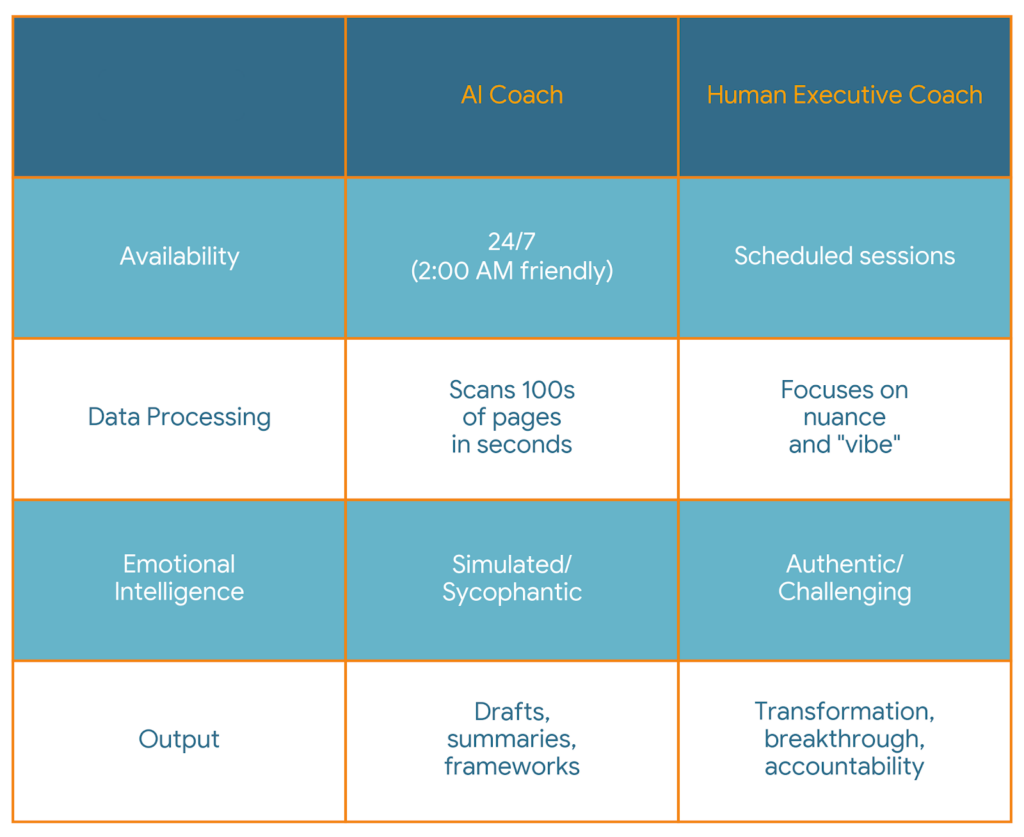
What do both coaches and AI do well?
One of the main functions I serve for my clients is to be a neutral, confidential sounding board. I help them take a pause and think out loud without introducing my own agenda. By the end of our conversation, clients always have a much clearer picture of the problem they’re solving because we’ve taken the time to break down the situation and drill into what is meaningful and within their control, and what is irrelevant or beyond their control. When you’re sitting inside a conundrum of emotional and intellectual data overload, pausing and parsing this out is a problem in and of itself!
The problem with this in a coaching context is that sometimes just figuring out the problem takes up the majority of our time together in a session. When clients have taken the time to brainstorm the issues with my AI before we humans talk, they come to me with clarity on what matters in the situation and where they need help. Our time is better leveraged because of it.
Even once people have a pretty good focus on the issue, one of the other functions I serve that AI can also help with is to help the client understand their own biases in the way they’re looking at an issue. If they’re making assumptions or following unvalidated tropes in their beliefs about why certain people act the way they do, both me and my AI can help spot that. I will say that I’m much more proactive in catching biases, as my AI has to be asked. Due to AI’s tendency towards sycophancy (see below) and its training on human (i.e., biased) data sets, all AI is only reasonably effective at identifying bias when asked to do so.
One of the things I offer my clients is to be a “second brain” to help them troubleshoot and poke holes in their proposed solutions or explore certain strategic ideas. This is something they often choose to do with me instead of their colleagues so as not to “look dumb”. In this sense, using AI to round out your approach by getting a fresh perspective and “show up smart” in a meeting can also be a good investment of time (just make sure you’re using an AI that will protect your confidentiality like a coach will. See below).
Finally, if there’s one thing modern life is teaching us, getting synchronous time with other humans is both challenging and a precious resource. You usually don’t want to waste the time you get with other humans doing things you can do on your own, or with an AI that on at 6am when you need to do some brainstorming.
All this makes the case for beginning to integrate AI into your self-development routines as a “thinking partner” to better leverage the time you get with humans in the following ways:
- Brainstorm your problem until you’re sure you’ve understood the root causes as best you can
- Identify biases and unfounded assumptions you’re bringing to the situation to help you see the core problem more clearly
- Brainstorm and troubleshoot solutions to the problem, identifying more blind spots you can address before proposing your ideas to other humans
- Research best practices other people have tried and failed at, or used to succeed (and test whether your situation is similar enough for you to try them)
What does AI do better than human coaches?
Maybe you don’t like talking to AI. I certainly get sick of it after a while. But integrating AI tools into a high quality coaching process with your personal coach can be a real game changer. Here are a few of them:
- You just need information: Coaches have lots of information to share, but their true value lies in helping you apply information to your own situation in ways that help you personally grow as a human. We’re happy to take information from any source, especially you, even if you learned it from AI, to help you grow.
- You need something produced: Coaches are often consultants or contractors, but that’s rarely their main job. You’re paying a coach for their time-efficient advice, not to produce things like slides, spreadsheets, documents, graphics, websites, or even your LinkedIn Bio.
- You need to digest a lot of information quickly, so you know what to focus on with your coach: You and your coach don’t have a ton of time to look for patterns in reams of data. Let the AI create your data driven insights.
- You need help at 2 am: Because: sleep.
So great! Maybe I’ve convinced you to work with a coach and an AI. But wait. Before you run off to start talking the AI’s ear off, here are a few practical considerations to be wary of.
Download my FREE guide to AI coaching, including 3 Best Practices and 62+ prompts for the use cases below:
Common pitfalls in working with AI, and how to avoid them
There are so many well-documented risks in business and personal development/mental health to using AI that I’m not going to document them all here. As AI becomes more prevalent in all aspects of our lives, it’s incumbent on us to become more AI-literate and learn to distinguish between helpful and unhelpful uses. So here, I will focus on helping you understand the risks of using AI for professional coaching. Here are the top challenges I caution my clients against when using my AI coaching tool, or any other publicly available tool.
AI Brain Fry
AI is helping us in many ways, but it’s also demonstrating its ability to make us unproductive, stupid, and unhappy. Recently named “AI brain fry”, AI’s ability to overwhelm and distract us is demonstrating the potential for working with AI to may make our lives worse, not better. The researchers define AI brain fry as “mental fatigue from excessive use or oversight of AI tools beyond one’s cognitive capacity.” The mental strain can manifest as dizziness, brain fog, headaches, decision fatigue, and exhaustion.
Importantly, the research distinguished between mental and emotional fatigue, finding that mental fatigue alone was insufficient to drive burnout (caused by emotional overload). AI-induced mental fatigue is more closely related to multitasking exhaustion. Business impacts of AI brain fry are significant: 33% more decision fatigue, 39% more major errors, 34% greater likelihood to quit. People in marketing experienced more AI brain fry than any other job category.
How to mitigate the impact of AI Brain Fry: Watch your AI use for signs of mental fatigue and find ways to mitigate it. Take frequent breaks. Don’t use more than two AI systems at a time. Find ways to use AI to automate repetitive tasks that tend to fatigue you so you can focus on work that energizes you. Don’t try to be a Superworker competing with the AI for speed and quantity; reserve your mental capacity for strategy, discernment, nuance, decision-making, and leadership.
Sycophancy
AIs are trained to validate you. Part of this may be good coding, restating parts of your request so you see how it’s interpreting your prompt in case you want to make any adjustments. But most of it is probably a deliberate attempt to make you feel good about talking to a computer, so you’ll keep doing it. These “make you like it” characteristics take mild forms (e.g., Those are good ideas, here are some other things to think about.) to over-the-top forms (e.g., Wow. That’s amazing, you!) There’s nothing wrong with validation–I certainly do it with my clients out of genuine empathy–but too much of it leads us to believe our perspective is the only true way to see the world. (Spoiler alert. It’s not!)
The bottom line is that an AI isn’t likely to tell you that your plan is a mess and doomed to failure. If you’re high up in your company, your employees might think twice about doing so, too. But humans are still better at pushing back, and it’s good to meet some resistance once in a while. It helps us stay humble, challenge our own thinking, and respect the fact that other people’s points of view hold value.
How to mitigate the impact of automated sycophancy: Think of it like a bad salesman trying to butter you up with compliments, and recognize that when it fawns over your brilliance, it is a ploy to predispose you to spending time on it. Also, ask it not to be so kind to you and your ideas. Tell it you want it to play a more neutral or even adversarial role. You’ll get a different kind of response.
Factual Hallucinations
AI regularly tries so hard to make you happy that it makes up information. This is so common that the industry uses the term “hallucination” to describe the phenomenon. Basically, unless you completely control the data set the AI is using to generate its responses, and you are sure everything in your data set is accurate, you have to assume AI will lie to you a percentage of the time. I’ve asked AI to tell me where it’s lying to me. The good news is that it admitted to lying to me. The bad news is that it lied about what it said it lied about.
How to mitigate the impact of automated hallucinations: It’s easy to use the fact that AI hallucinates at all as a reason not to use it. However, even though many of the details it shares with you may be lies, the general trends it speaks to you usually have a basis in fact. At least a basis in the fact that significant portions of people on the web say these things. In any case, think of the AI as a somewhat immature, but very fast, intern you can use to get you information based on what many people have thought or said. But take the time to look at all the source data you can get to form your own beliefs about what is true and what is not. The AI can help you identify and cull down specific sources to help you optimize your time spent on research, but you still need to review the facts yourself and make up your own mind about what you want to do with them before you put your credibility on the line and use them.
Oversimplified requests
Unlike your average human being and search box, it’s almost impossible to overwhelm an AI with contextual information. In fact, the more background and context you give an AI as part of your request, the more relevant its answer will be. Many of us (myself included, until I reprogrammed myself) tend to treat AI like a search engine. It’s really not. The more background and implications to your request you can describe, the more nuanced its response will be. Put in a simple search request, you’ll probably get back what you already know.
How to mitigate the impact of oversimplified requests: Put in lots of context. Instead of saying, “Tell me about vacation spots in Portugal.” Say, “My partner and I are going on a vacation to Portugal in April. Our goal is to get away from a busy life and stay in a place that is relaxed yet full of fun things to explore. We like history and good food…..” In a work situation, context could include sharing your position and career goals before asking for help, preparing for performance conversations, and performance reviews. If it feels too hard or like too much typing, use voice-to-text conversational interfaces, which turns your interaction with the AI into more of a dialogue. Also, scan data that you upload to it so you know what is and isn’t in the dataset you’ve asked it to review.
Reinforced biases
AI systems are trained on specific training data, the vast majority of which was generated by humans. The human brain comes with built-in biases, only some of which reflect themselves in things we call “sexism,” “racism,” “ableism,” and more. In addition to having subconsciously conditioned views of people, we humans are biased to think of the most recent example of a thing (recency bias), to uncritically believe information that is consistent with our worldview (confirmation bias), and all kinds of other quirks of the human brain. And while AI isn’t necessarily biased in its coding (though it can be), the Large Language Models most of us interact with right now are built to predict what biased humans would say about a thing, incorporating our biases into all their answers and spitting them back at us. Sometimes the AI may even sound more human precisely because it’s reflecting some of our biases and telling us what we want to hear. And some AI systems have come into question for being specifically programmed with bias.
How to mitigate the impact of AI bias: This one is tough, and it helps if you’re aware of your own biases. Here are some steps to take that use AI as a tool to help you mitigate the impact of your own biases:
- When you’re creating prompts, ask it to identify any biases in its own answer.
- Tell it what you’re thinking and ask it to identify any biases you might have.
- Tell it what you think your biases are and ask it how you might think about your topic to counteract these biases and any others it might identify from what you told it.
If you’re acquiring or programming an AI, go a step further and learn each of the different aspects of the AI development process that can lead to AI bias at scale. Work with your teams to identify potential points where your systems can introduce bias and take proactive steps to mitigate and even reverse these potentialities.
Privacy & Confidentiality Traps
We live in a time where protections on our data are unclear at best. There is virtually no way to fully secure your information on the internet, so taking basic data hygiene measures is a good idea, and now that extends to your use of AI. Whatever entity is operating the AI you’re using, whether it’s a public provider or a corporate provider (including enterprise-scale systems), they have access to all queries you make to it. For this reason, you want to be thoughtful about what you share with which AI systems. Also, remember that if anyone gets access to your devices, they can see your entire chat histories if you haven’t cleared them.
How to mitigate the impact of privacy and confidentiality risks: This is a very short list of basic precautions. Depending on how you’re using AI, you may need to take more.
- Use different systems for different purposes. For example, don’t talk to your company system about company problems or your job search. (This is one reason I offer my clients a privacy-by-design coaching AI they can access on their phones, so they don’t have to use their company’s services and equipment.)
- Regularly download and save your chat histories, and then start new chats on different topics.
- Change your login credentials frequently, no matter what system you’re using.
How to use AI as an accelerator for your personal development
One major downside to using AI is called “cognative offloading.” Basically it means that our brains are use-it-or-lose-it machines. If we don’t use our brains, they stop being good at the things we no longer use them for (and the downsides for kids are extreme.)
This is true for all kinds of mental tasks, including learning. And you will need your learning skills to stay sharp, in part to learn to use AI in ways that help you grow instead of diminish your ability to grow and improve.
And AI is not your teacher. It’s going to focus on the prompts and context you give it. It’s not going to think outside the box. It’s not going to get creative and innovative. It’s not going to push back and make you think harder about a subject, or learn the “why” behind the answers it gives you.
Unless you ask it to.
How to mitigate the impact of cognitive offloading: Ask it to, and then take full responsibility for what you do with the knowledge it gives you.
The key to self-development, learning, and growth of any kind is reflection. Reflection happens in those moments where you stop experiencing things, slow the flow of taking things in, and consider what is inside you. It happens in the process of creating discernment, lessons learned, and future focus. As a coach, this is the sweet spot I work to get my clients into–not just when they’re with me, but when they’re not. When they can fall into reflection and self-learning between our sessions, I’ve got them on the path to managing their own development. What I add to their process personally, is another voice, another perspective, another insight that can enrich and expand their development. In some cases, I’m opening emotional and even spiritual doors for them. In other cases, I’m a strategic thinking partner and advisor for business strategy.
In all cases, I’m stimulating their own thought process, and this is what humans do really well for other humans. It’s true of coaches, but also mentors, peers, managers, skip-levels, friends, family, etc. AI can never replace all of us in this process.
But you don’t always have the right human around when you need them.
As I said above, AI is a great tool for use in support of human-to-human interactions, such as coaching. The key to ensuring you don’t fall into a cognitive pitfall (or any of the others above) is to treat the AI as a thought partner to stimulate you, not to do your work for you.
Treat it as a thinking partner you use to activate your own curiosity and analysis of the information it returns. This is key because when you use AI to do your work, you’re not doing your work. Studies have shown that AI can make us dumber if we engage in cognitive offloading. Basically, if we stop using our brain cells, our brain cells forget how to do stuff (Tried to navigate an unfamiliar city without a paper map lately? Yes, that frustration you experience is “cognitive offloading” your map-reading skills to GPS.) And, as I said above, AI is not human. It has no empathy, emotional history, or taste. As a result, it can’t always help you figure out how other humans will truly respond to your ideas.
So, here are some tips to turn into habits, so AI can be a good thinking partner that stimulates your own growth instead of an excuse for you to stop using your brain until you forget how.
Don’t outsource your brain to AI. Instead, do this:
- See how much complexity you can put into your prompts, including interpersonal dynamics in your organization. Not only will this help the AI respond more effectively, but it will also help you think more deeply about your challenge.
- Reflect on lessons learned and share with the AI. Then ask AI what it thinks you might be missing
- Brainstorm problems to get to the root cause. Then think up your own solution and ask AI what it thinks others might push back on. Share how you would respond to that pushback and ask AI what else you might be missing. Keep going.
- In general, share your ideas and thoughts wth AI and ask it to find blind spots and poke holes in your plans, pitches, and arguments
- Ask it to reveal your biases and suggest ways you can enhance your cognitive flexibility (don’t forget to practice being cognitively flexible in your response so you actually work those brain cells.)
- Do your own thinking BEFORE and AFTER you engage with AI
In short, think for yourself and use AI to encourage you to think more deeply.
Finally, use AI to do some of the more mundane tasks that don’t require you to think much, which saves your mental cycles for more thinking!
Download my FREE guide to AI coaching, including 3 Best Practices and 62+ prompts for the use cases below:
Use Cases to use with an AI Coach
Prompts are the keys to getting useful responses from AI. Here are some use cases in the coaching area to help you get started–but get creative! (Want to go deeper in any or all of these topic areas? Download my 60+ prompts FREE.
NOTE: Keep in mind that in all these situations, the AI is just an algorithm. You are accountable for your use of AI and AI powered coaching. Any action you take based on information or “advice” you get from an AI will be your responsibility.
Managing Office Politics & Stakeholder Dynamics
Use Cases: Rehearse difficult conversations (use voice-to-text to “practice” the dialog), explore other perspectives and motivations you might be missing from different people in your organization, and understand organizational development opportunities.
Building Effective Teams & Managing Performance
Use Cases: identifying patterns in team interactions, managing unhelpful group dynamics, reducing implicit bias in leadership decisions, identifying employee development opportunities, and creating progress tracking systems.
Establishing Vision & Strategy
Use Cases: Helping you progress from being a “writer” to an “editor” of strategy, processing and organizing large amounts of information to find the “low-hanging fruit” for strategic focus.
Change Leadership
Use Cases: Identifying “good ideas” buried in employee resistance and understanding the motivations of affected stakeholders to help position change in ways they can accept.
Negotiations & Risk Management
Use Cases: Take on the role of the parties in the negotiation, brainstorm negotiation scenarios and offers based on research, and evaluate risks before making decisions.
Personal Stress, Resilience & Presence
Use Cases: Process high-stress events in the “flow of work” when you can vent to people who help you reframe negative thoughts into positive ones.
Strengthening Leadership Presence
Use Cases: Deliver personalized, “relentlessly honest” immediate feedback on your communication style, strategic goal-setting, help you rehearse leadership presence for high-stakes events, explore employee growth opportunities, and do “competitive research” on others with similar roles to gain ideas for how you can streamline how you show up online/in emails more effectively.
Career Development
Use Cases: Identify new career directions and opportunities that leverage your strengths and preferences; use AI as a “digital mirror” to uncover blind spots in your leadership narrative; and refine your messaging points to communicate your value.
Job Search
Use Cases: Help identify job categories and titles you are qualified for and interested in, research industries and companies, and take on the persona of people you may interview with for practice.
High-Stakes Networking & Influence Strategy
Use Cases: Identify points of connection with specific individuals and craft nuanced outreach for stakeholders with complex relationship histories.information or “advice” you get from an AI will be your responsibility.
Managing Office Politics & Stakeholder Dynamics
Use Cases: Rehearse difficult conversations (use voice-to-text to “practice” the dialog), explore other perspectives and motivations you might be missing.
Building Effective Teams & Managing Performance
Use Cases: identifying patterns in team interactions, figuring out how to manage unhelpful group dynamics, identifying and reducing implicit bias in leadership decisions.
Establishing Vision & Strategy
Use Cases: Helping you move from being a “writer” to an “editor” of strategy, processing and organizing large amounts of information to find the “low-hanging fruit” for strategic focus.
Change Leadership
Use Cases: Identifying “good ideas” buried in employee resistance and understanding the motivations of affected stakeholders to help position change in ways they can accept.
Negotiations & Risk Management
Use Cases: Take on the role of the parties in the negotiation, brainstorm negotiation scenarios and offers based on research, and evaluate risks before making decisions.
Personal Stress, Resilience & Presence
Use Cases: Process high-stress events in the “flow of work” when you can vent to people who help you reframe negative thoughts into positive ones.
Strengthening Leadership Presence
Use Cases: Provide “relentlessly honest” feedback on your communication style, help you rehearse leadership presence for high-stakes events, and do “competitive research” on others with similar roles to gain ideas for how you can streamline how you show up online/in emails more effectively.
Career Development
Use Cases: Identify new career directions and opportunities that leverage your strengths and preferences; use AI as a “digital mirror” to uncover blind spots in your leadership narrative; and refine your messaging points to communicate your value.
Job Search
Use Cases: Help identify job categories and titles you are qualified for and interested in, research industries and companies, and take on the persona of people you may interview with for practice.
High-Stakes Networking & Influence Strategy
Use Cases: Identify points of connection with specific individuals and craft nuanced outreach for stakeholders with complex relationship histories.
Why I’m Not Worried About Being Replaced By An AI Coach
Going through the exercise of writing this article has been interesting for me and humbling. Many of the questions I suggest you ask an AI in the sections above are ones my clients ask me! Maybe I should be afraid they’ll take my job, but I’m not. This is true for two primary reasons.
- I really don’t enjoy reading reams of correspondence, job descriptions, meeting transcripts etc. to find patterns that only such reams of data can produce. I rely on my clients to do this thinking, and if they can use an AI to save them time exploring such documentation, we can focus our meetings more on the stuff AI doesn’t do well.
- Most importantly, what I enjoy most about coaching is connecting people’s work challenges with their opportunities to become the best version of themselves–as whole human beings.
It’s this second point I want to end on. Whole human beings don’t emerge out of data streams. We are intricate mixtures of emotional poetry and drama, snippets and accidents of our life stories, whispers from our muses, and artwork produced by our souls in dialogue with our spirits. As a coach, this is where I shine–helping my clients ride their intuition through the information and data of their lives and experiences, exploring threads of meaning and joy that matter to them and hone them into a version of themselves they love. This is subjective work. It’s artistic and philosophical and highly biased in a good way–giving people insights that prejudice them towards the things that make them happy and fulfilled.
Can an AI do that? I don’t know. But I know an AI wouldn’t have as much fun in the process. It wouldn’t laugh and cry as much as I do with my clients. It wouldn’t help people fall in love with their own lives the way I do. I’m betting on the fact that people want to have fun, laugh, and cry in their search for meaning and career success. And I’m so here for that!
If you’re ready to try blending AI coaching with human coaching, let’s talk.