
👉👉👉 Download the full PDF with graphics, over 100 links to research, and resources 👈👈👈
While women have been critical to the workforce since the beginning of time, in recent years, women in leadership have become a holy grail for organizations that want to be seen as open and welcoming places to work.
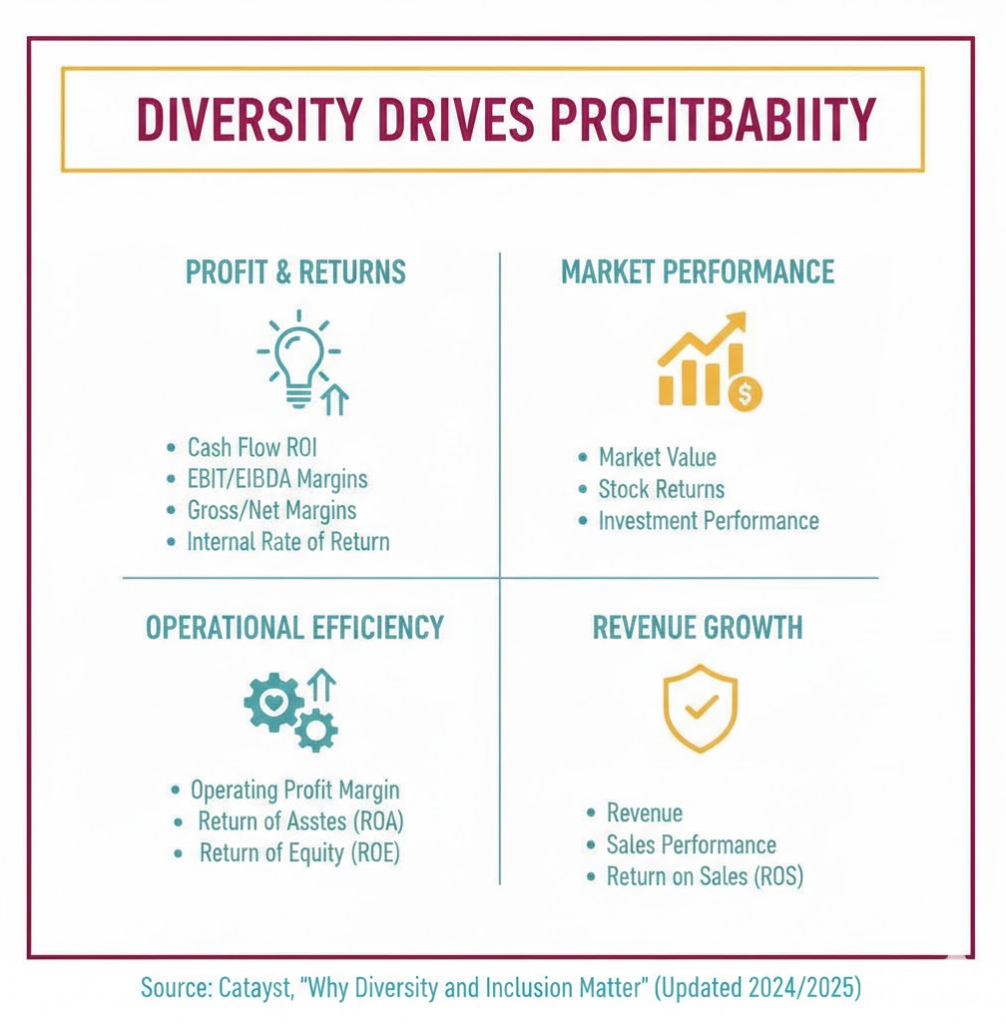
Though the push for diversity in leadership has weakened in recent years, the data remain clear: organizations with significant representation of women (and other diverse leaders) on their boards and in their executive suites regularly outperform those with more homogeneous leadership. Despite overwhelming data demonstrating that women are good for business, organizations, as well as the women themselves, continue to face systemic and cultural barriers to promoting women into authority.
And yet, many women succeed despite these barriers. What are they doing right? How are their mentors helping them? What are their companies doing to change historically discriminatory dynamics? What are best practices to create gender equality? In this recent version of the guide, you’ll find a comprehensive look at the hard facts as well as the soft skills that help women become powerful contributors at the most senior levels of any organization.
This post shares graphic highlights from the full guide.
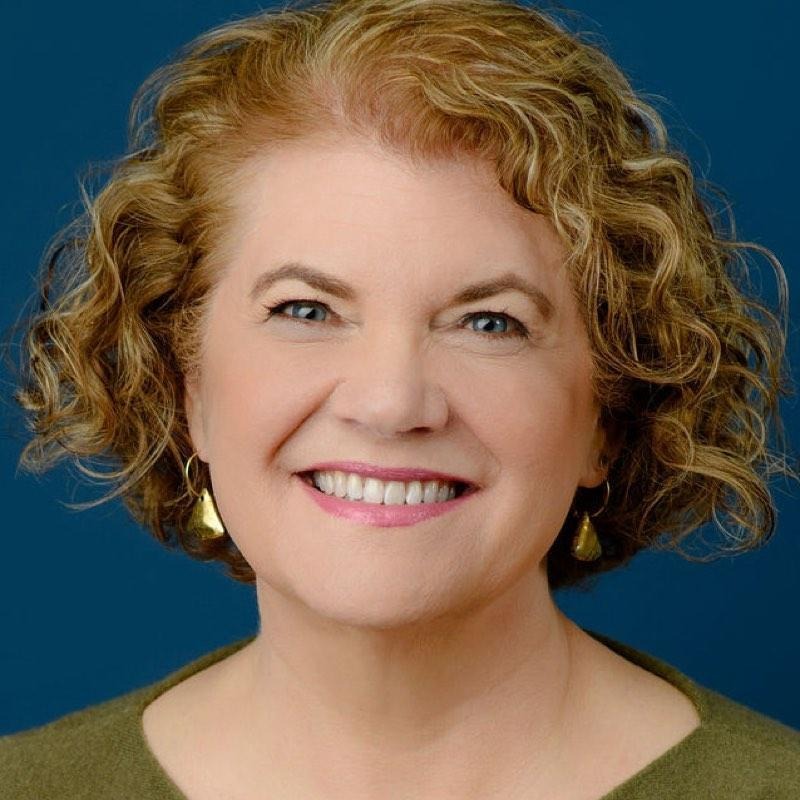
Dana Theus
Executive Coach
InPowerCoaching.com
Table of Contents


The Facts on Women in Leadership
The data on women in leadership often flips the script on what we think we know, so we use it in this document to put our cultural norms (often shaped by unconscious bias) under a bright light.
The stats below aren’t exhaustive, but they provide a fresh, evidence-based starting point to evaluate our “gut feelings”. We update the text and references here as new insights emerge—and if you see a gap, we’d love to hear from you! Contact us.
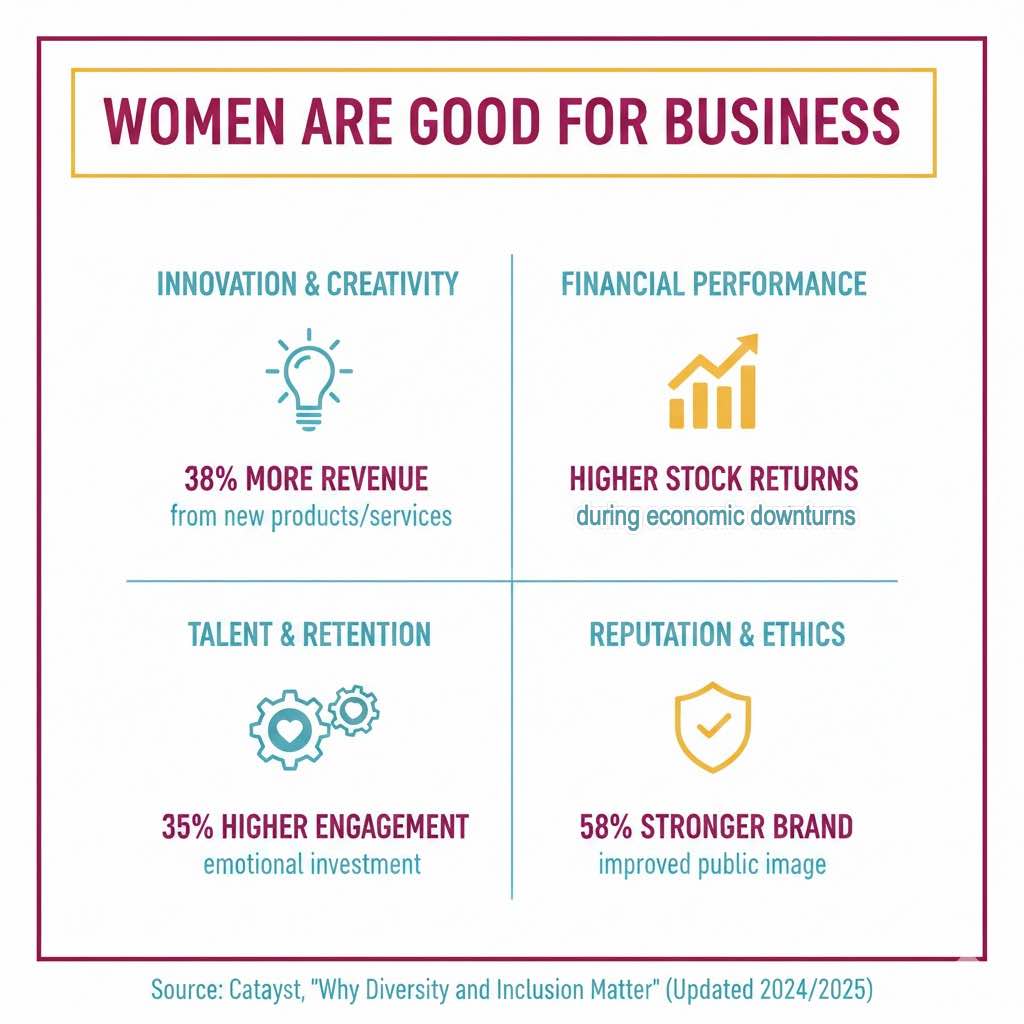
Women are Good for Business
Despite being historically underrepresented in leadership, companies with gender-diverse boards and executive teams consistently achieve superior financial and reputational results, even during economic crises.
👉👉👉 Download the full PDF with graphics, over 100 links to research, and resources 👈👈👈
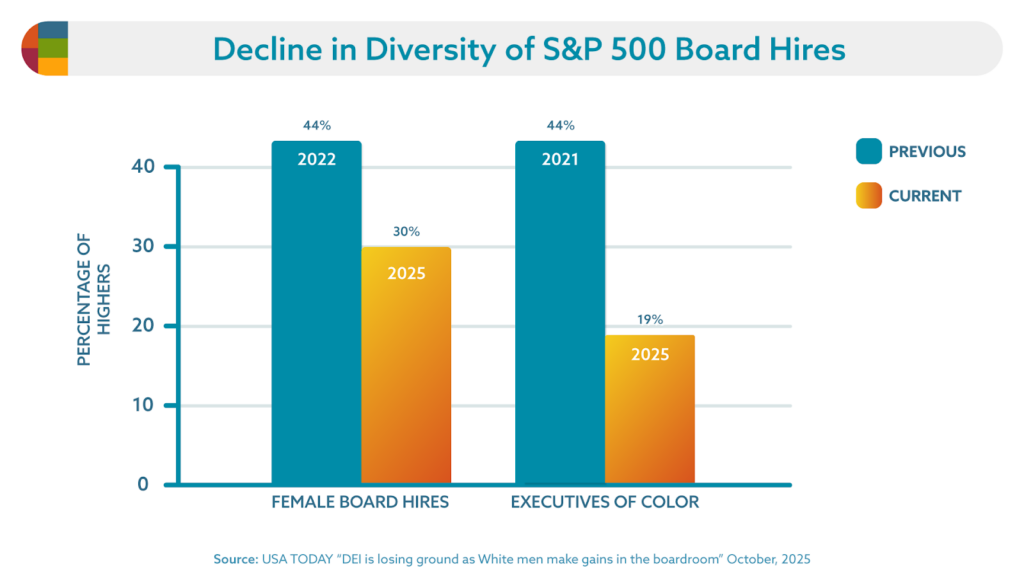
Recent progress in corporate diversity has stalled or even reversed as pandemic-driven caregiving burdens and mounting political pushback against DEI initiatives led to a 2025 milestone where White men once again secured the majority of new board appointments for the first time in nearly a decade.
The Glass Ceiling and the Broken Rung
While women are making incremental progress against the “glass ceiling,” their representation in leadership continues to dwindle as their careers progress, primarily due to unconscious bias and a significant drop-off in promotions at the first-time manager level.
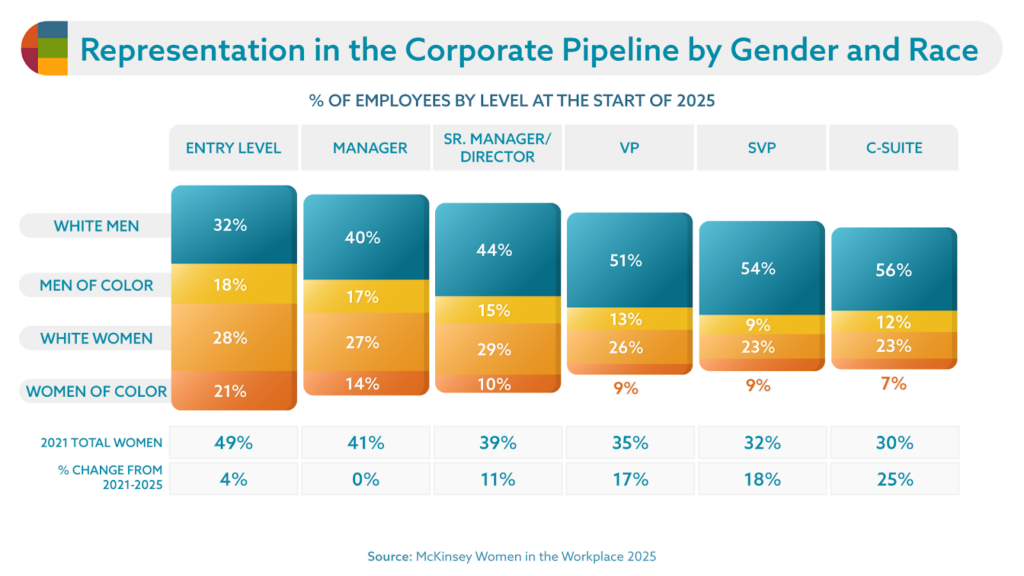
The “Broken Rung” represents the most significant systemic barrier to equity because it prematurely shrinks the pipeline of qualified female candidates at the very first promotion to manager, creating a leadership deficit that persists throughout the rest of the corporate hierarchy.
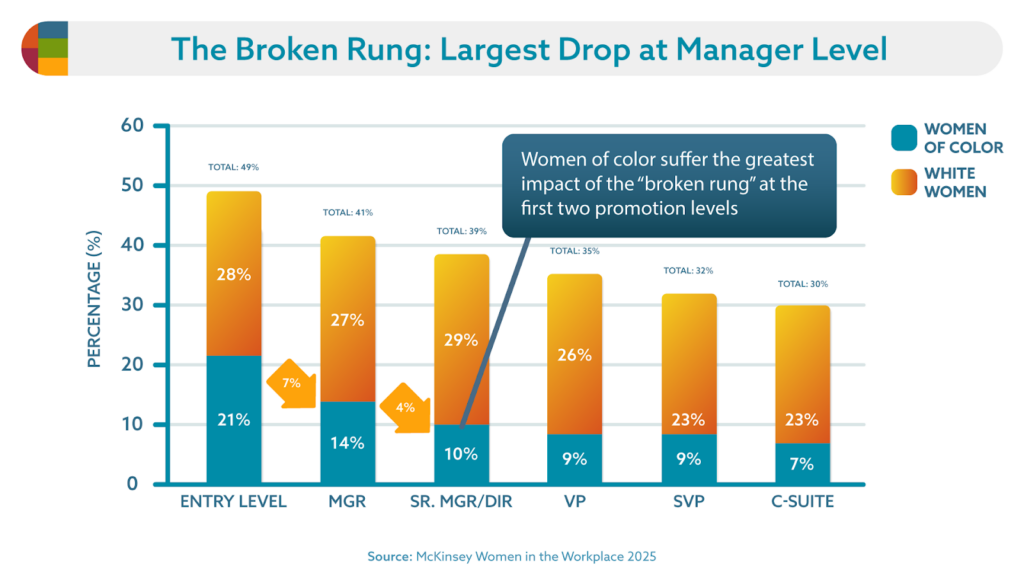
Source: McKinsey Women in the Workplace 2025
👉👉👉 Download the full PDF with graphics, over 100 links to research, and resources 👈👈👈
The widespread lack of support in career development and workload management has left over 60% of women in middle management feeling discouraged from pursuing executive roles, even before the 2025 shift in corporate diversity initiatives.
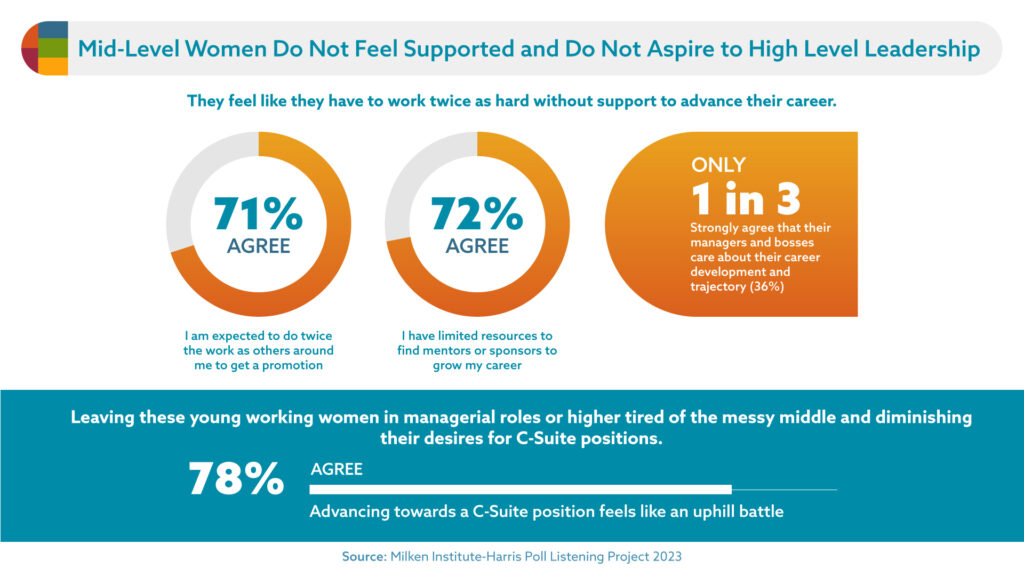
Source: Milken Institute-Harris Poll Listening Project 2023
Despite a brief post-pandemic recovery, women’s workforce participation—particularly for mothers and Black women—has plummeted since 2025 due to a “perfect storm” of rising childcare costs and the dismantling of DEI initiatives, creating a downward trend unlikely to reverse without significant systemic change.
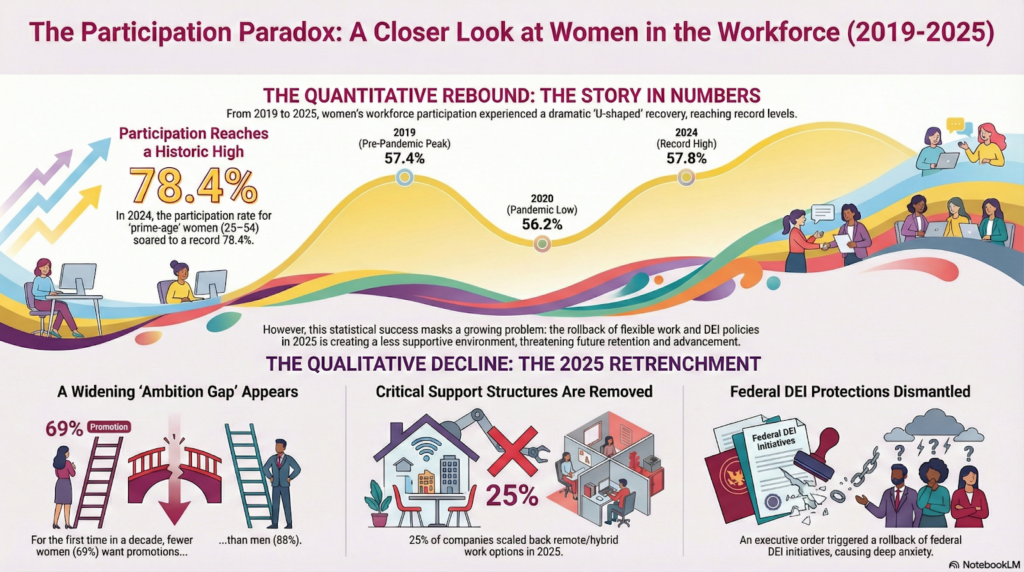
Sources: AI-generated referencing McKinsey Women in the Workplace, 2025, and Labor Force Participation Rate (LFPR) (updated 1.9.26), and other sources
The Gender Pay Gap and Wealth Gap
Despite proving their effectiveness as leaders in times of crisis, women continue to face a widening pay gap that intensifies with age and seniority, with earnings regressing to just 81% of men’s in 2024. This gap began receding to 81% in 2024 from its “high” of 84% in 2022.
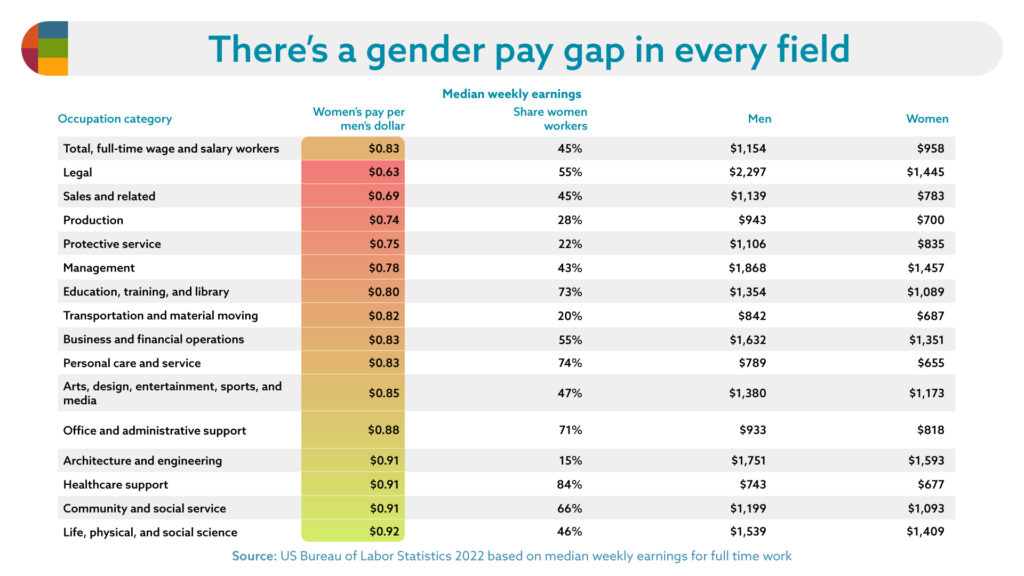
Source: 19th News
The intersectional pay gap for women of color is closing so slowly that parity isn’t expected until 2451, a timeline further threatened by a “policy-driven recession” in 2025 where the rollback of DEI oversight has left Black women uniquely vulnerable to “last in, first out” layoffs.
👉👉👉 Download the full PDF with graphics, over 100 links to research, and resources 👈👈👈
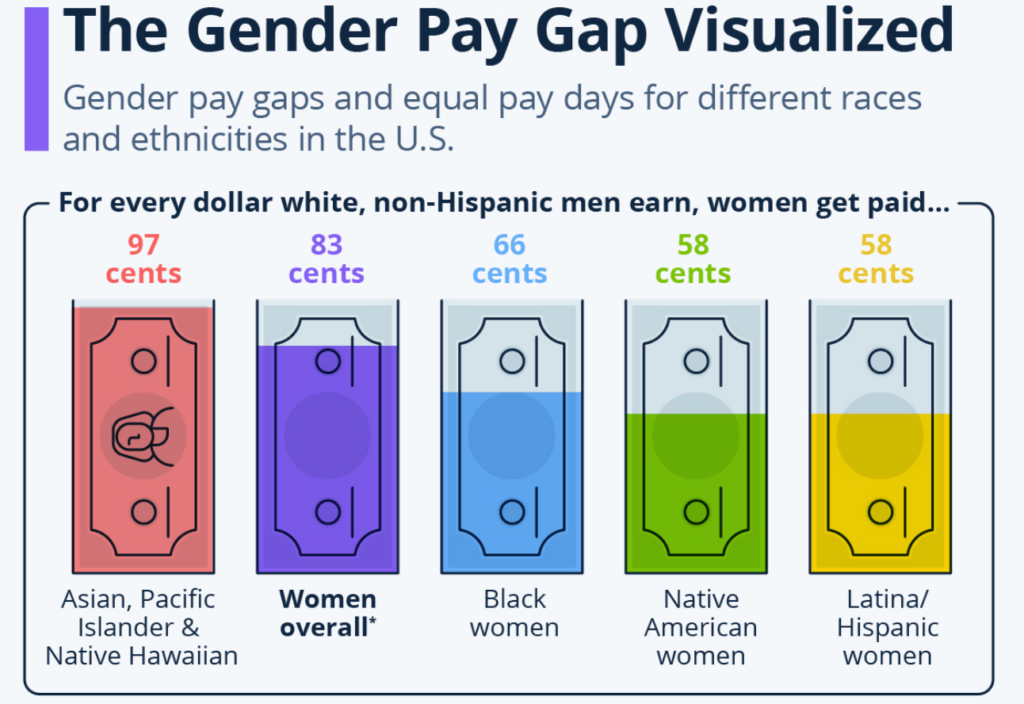
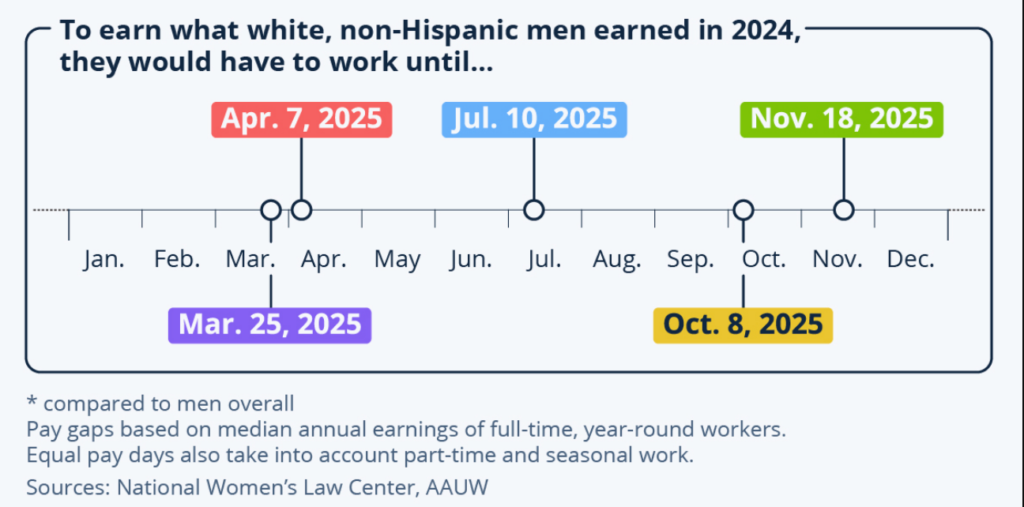
Source: Statista 2025
Beyond immediate pay disparities, career interruptions for caregiving and social pressures create a cascading “wealth gap” that can easily cost a woman over half a million dollars (or much more!) in lifetime income, impacting her long-term financial well-being regardless of marital status.
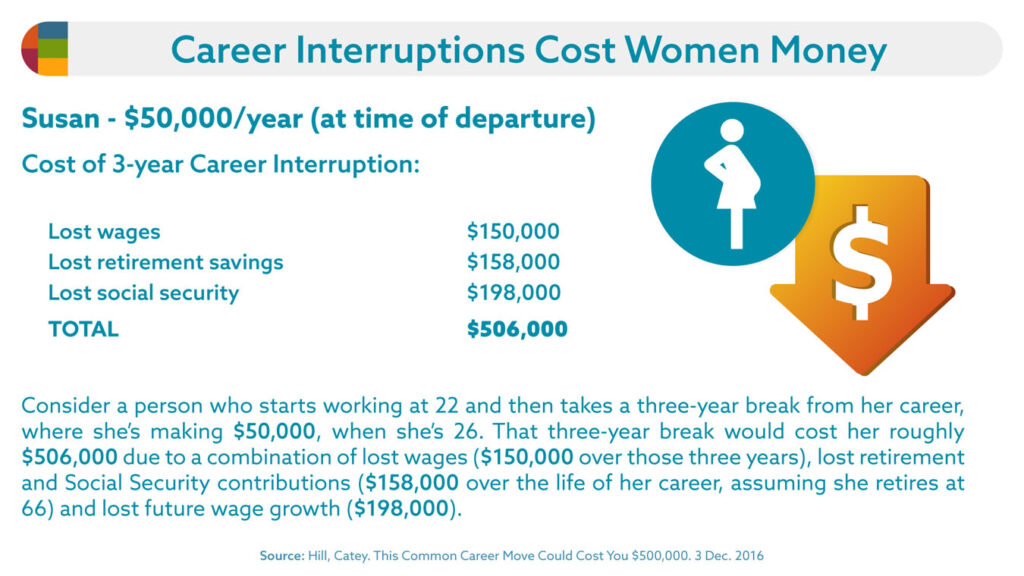
Fueled by cultural myths, lack of pay transparency, and systematic “othering,” the global wealth gap disproportionately favors white men, leaving women—especially those in senior roles—with significantly less lifetime accumulation than their male counterparts.
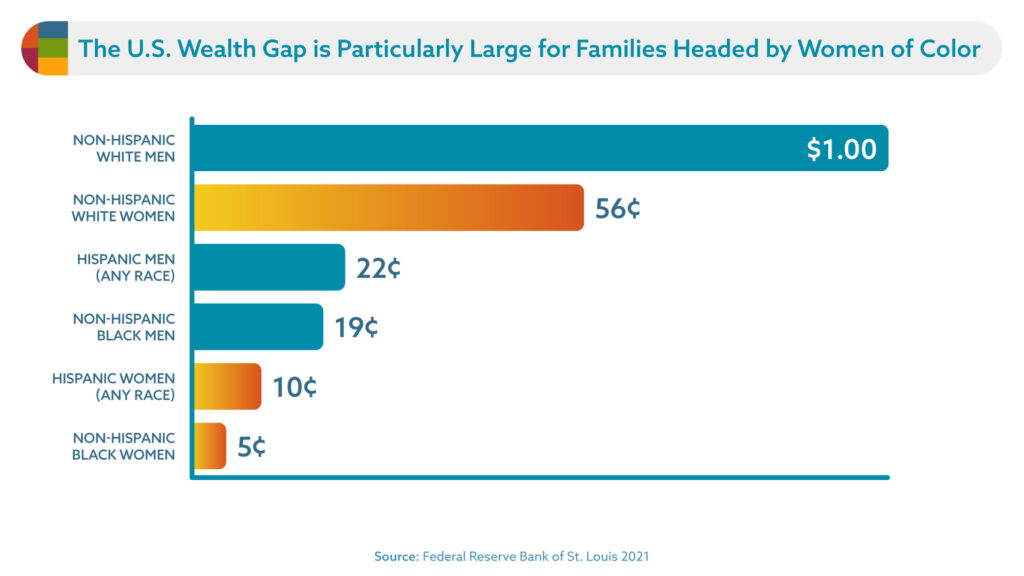
Although there are legal protections for women that prohibit wage suppression based on gender, it’s more often likely that discrimination is a function of unconscious bias (see below). Any woman who suspects she’s facing wage discrimination based on her gender should consult with an employment attorney to review her options.
👉👉👉 Download the full PDF with graphics, over 100 links to research, and resources 👈👈👈
Systemic Unconscious and Gender Bias
While many organizations aspire to be meritocracies, deep-seated unconscious biases—held by 90% of people globally—prevent a truly level playing field, often causing women’s contributions to be dismissed as luck rather than skill. This systemic bias manifests as a “double bind” where women are penalized for both failing to meet masculine leadership standards and for lacking “feminine” warmth, leaving them in a no-win scenario where they are 41% more likely than men to experience their workplace as toxic. Because corporate cultures often treat male behavior as the default standard, simply increasing female representation is insufficient; without active interventions like pay transparency and cultural shifts, women remain trapped by contradictory expectations, “glass cliffs,” and a persistent lack of actionable feedback.
Because men and women perceive workplace culture so differently, many well-intentioned leadership initiatives fail by focusing on “fixing the women” rather than addressing the systemic biases or holding men accountable for shifting the culture.
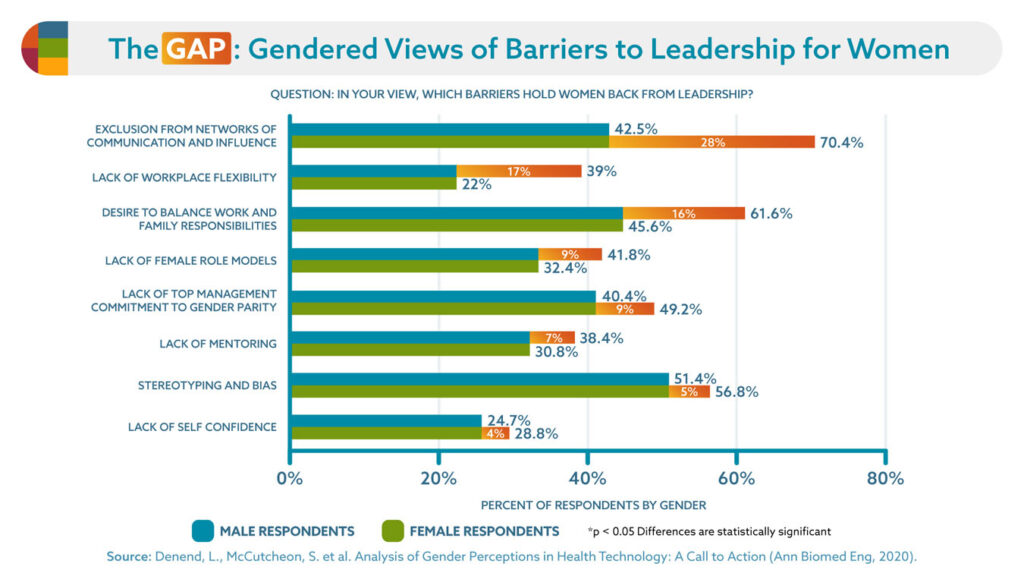
While the impact of subtle microaggressions—like being interrupted or having expertise “simplified”—is often dismissed by well-intentioned speakers as harmless, the cumulative burden of these everyday slights effectively undermines a woman’s professional authority and creates a heavy mental fatigue that destroys her sense of belonging.
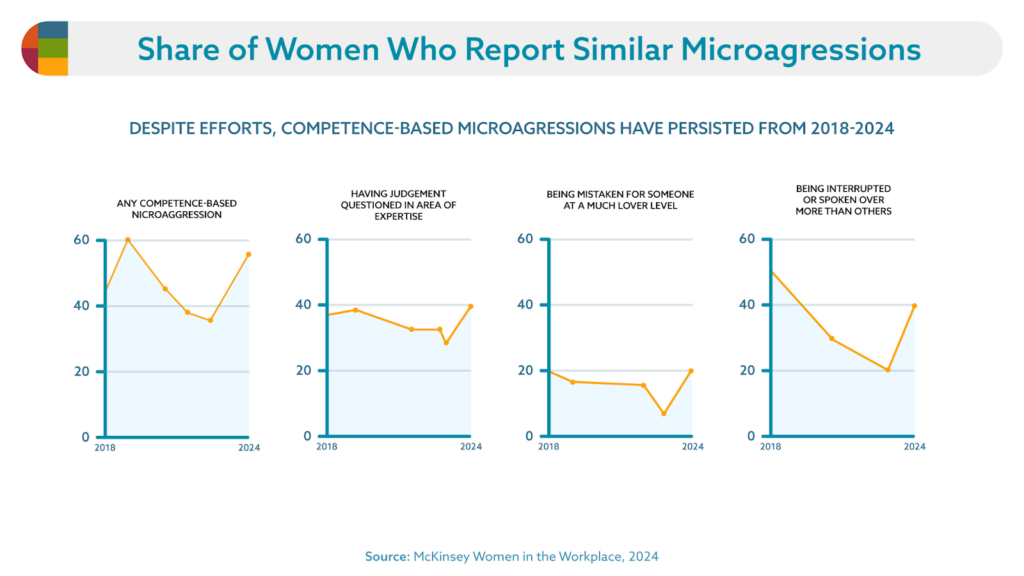
Source: McKinsey Women in the Workplace 2024
👉👉👉 Download the full PDF with graphics, over 100 links to research, and resources 👈👈👈
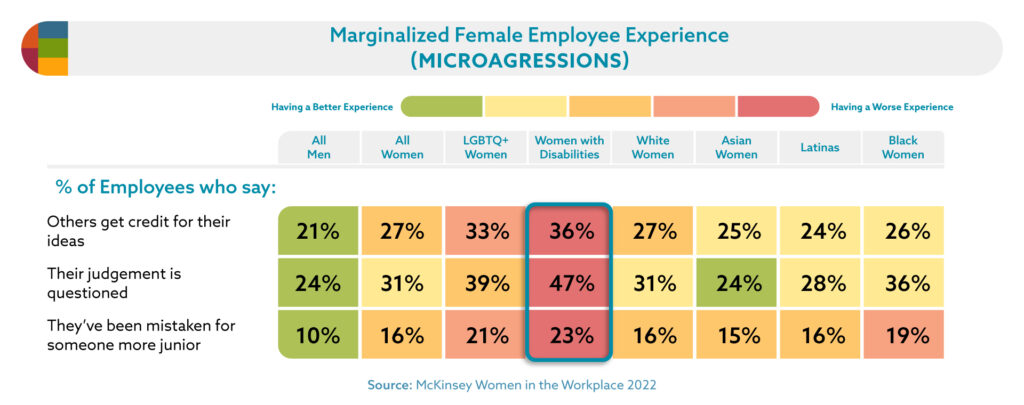
While unconscious bias is a universal human phenomenon that affects all genders, its cultural reinforcement of a “male standard” creates systemic barriers for women, leading to higher scrutiny for female leaders and a diminished sense of psychological safety for marginalized groups.
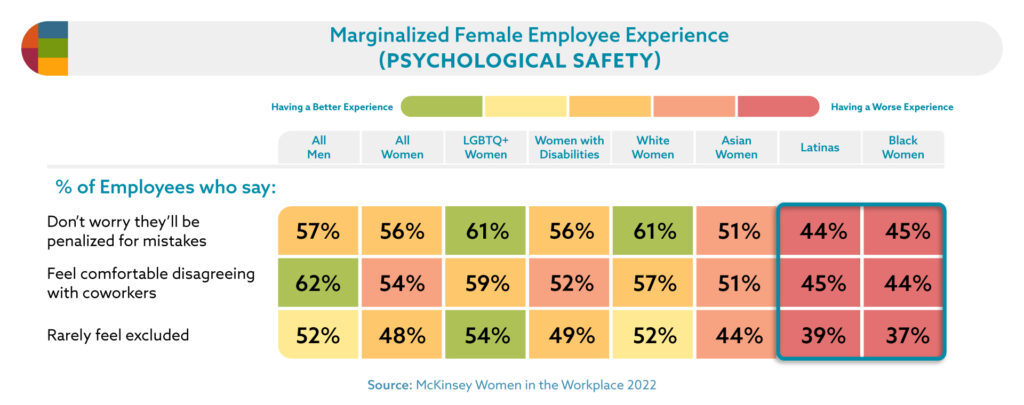
Unchecked gender bias fuels harmful cultural myths that blame women’s perceived “deficiencies” for systemic inequities—such as the debunked claim that women simply don’t ask for raises—placing a heavier burden of proof on female leaders and distorting the path to a true meritocracy.
👉👉👉 Download the full PDF with graphics, over 100 links to research, and resources 👈👈👈
Intersectional Bias: The Affect of Gender, Race And Other Factors Combined
Unconscious bias is highly nuanced and intersectional, creating compounded workplace challenges for women of color and those with disabilities while subjecting all women to additional penalties based on age, life stage, and body type.
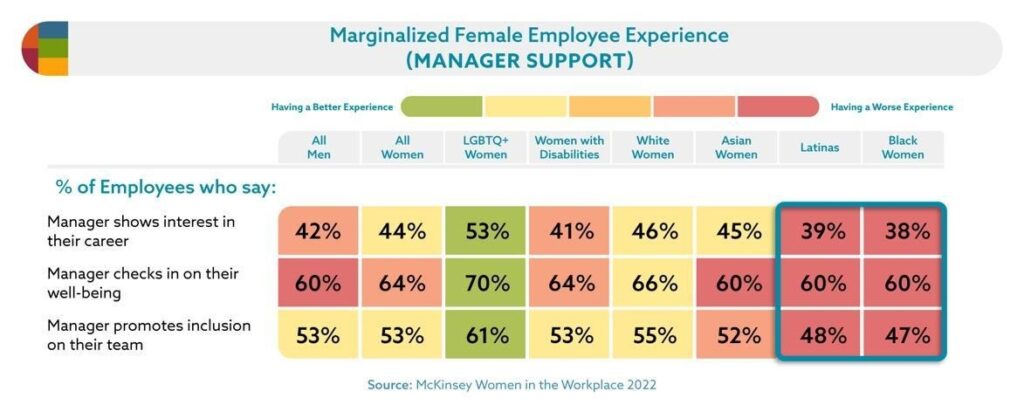
Source: McKinsey Women in the Workplace 2022
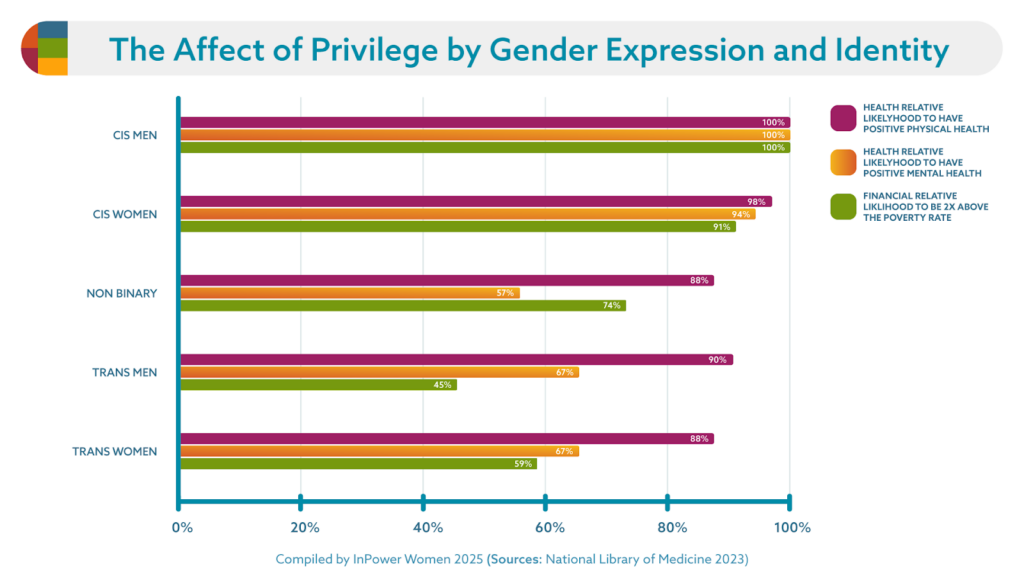
By layering various forms of “othering” onto gender and race, a clear power hierarchy emerges where white men occupy the top of the ladder, enjoying the highest levels of “attributed power” measured through superior financial and health outcomes.
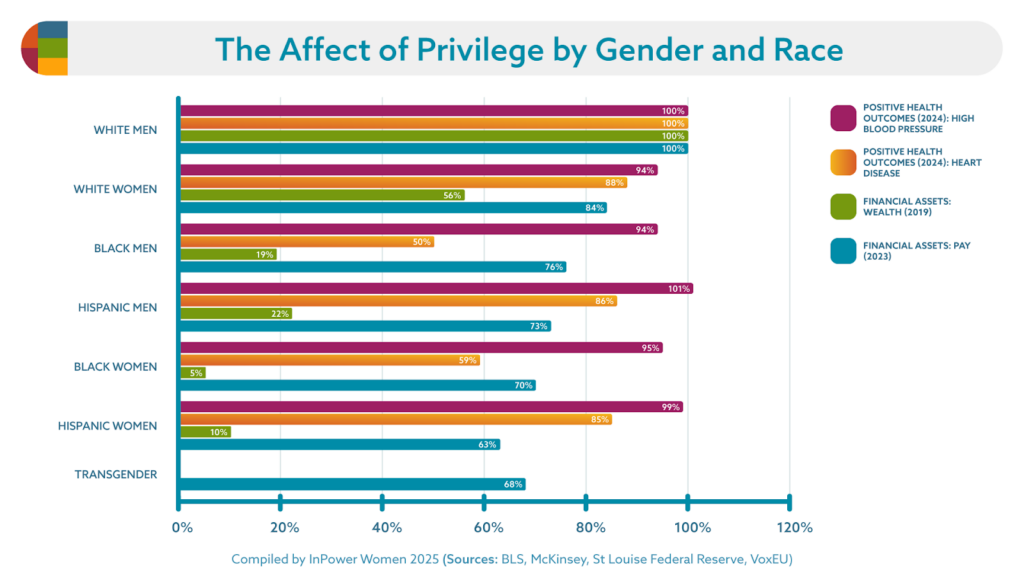
While race is the strongest overall predictor of social power, gender serves as a consistent secondary indicator of privilege, showing that women are regularly disadvantaged compared to men in their same racial category, and that transgender individuals—particularly transmen—face even lower financial outcomes.
👉👉👉 Download the full PDF with graphics, over 100 links to research, and resources 👈👈👈
Parenthood, Pandemic Hangovers and Mothers in the Workforce
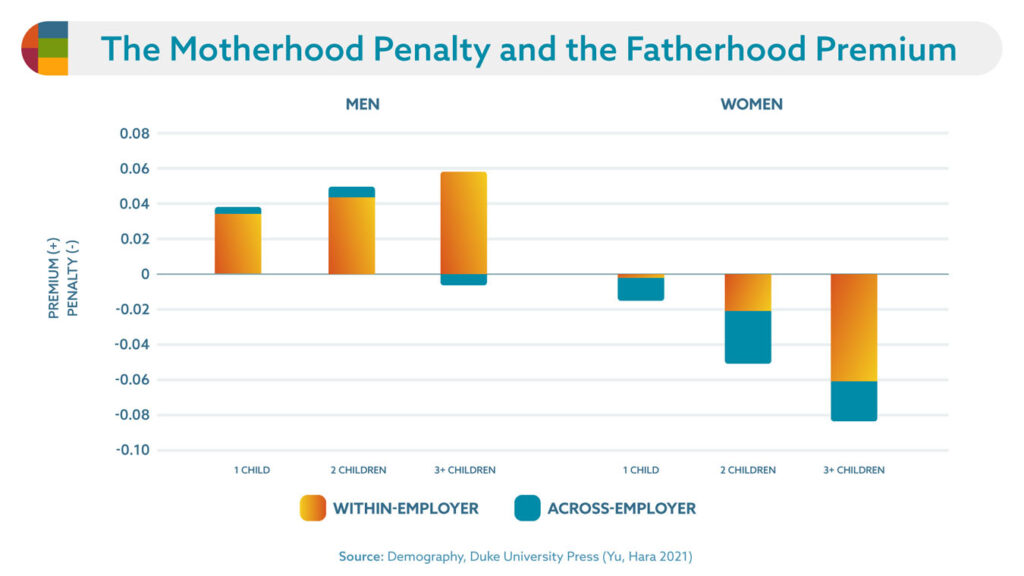
In the US workforce, parenthood triggers a stark gender divide where mothers face a “penalty” of reduced pay and diminished promotion opportunities, while fathers receive a “premium” of preferential treatment and tangible benefits—even as they are culturally pressured to sacrifice family time for longer hours.
The COVID-19 pandemic exposed a deep-seated inequity where women, regardless of their income level, perform significantly more “invisible work” at home and are asked to handle 44% more non-promotable tasks at the office, creating a double-bind that makes overwork and burnout a rational response to these lopsided social and professional expectations.
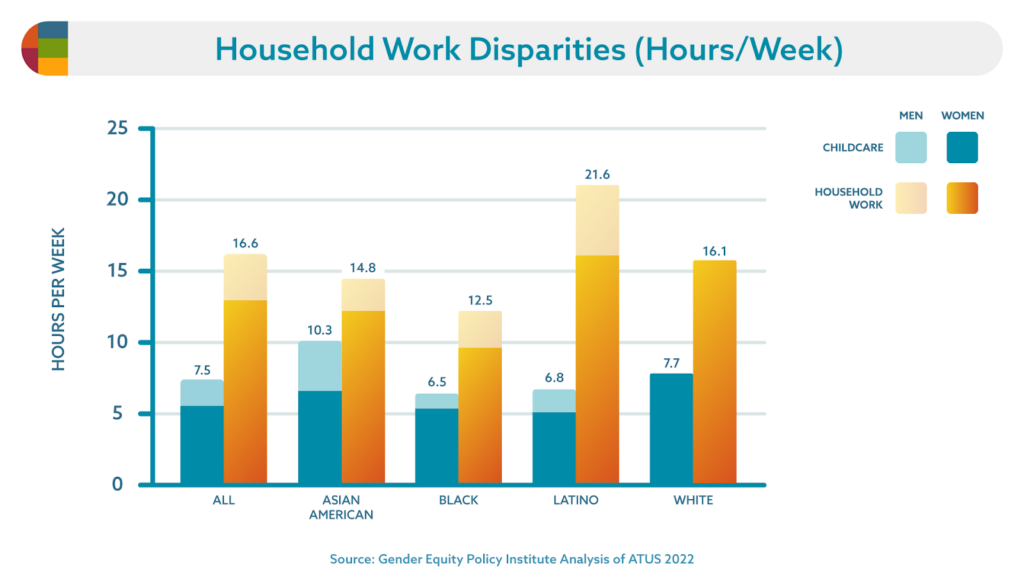
Source: Gender Equity Policy Institute, 2022
Societal norms cast women as the “default fixers” of personal and domestic crises while men are prioritized as fixers of business, creating a grueling double-standard that leaves women—regardless of maternal status—facing higher rates of burnout and professional scrutiny.
👉👉👉 Download the full PDF with graphics, over 100 links to research, and resources 👈👈👈
Despite myths that mothers are deserting the workforce, data shows they remain highly committed, yet they continue to bear a disproportionate burden of pandemic-related stress and career volatility compared to men.
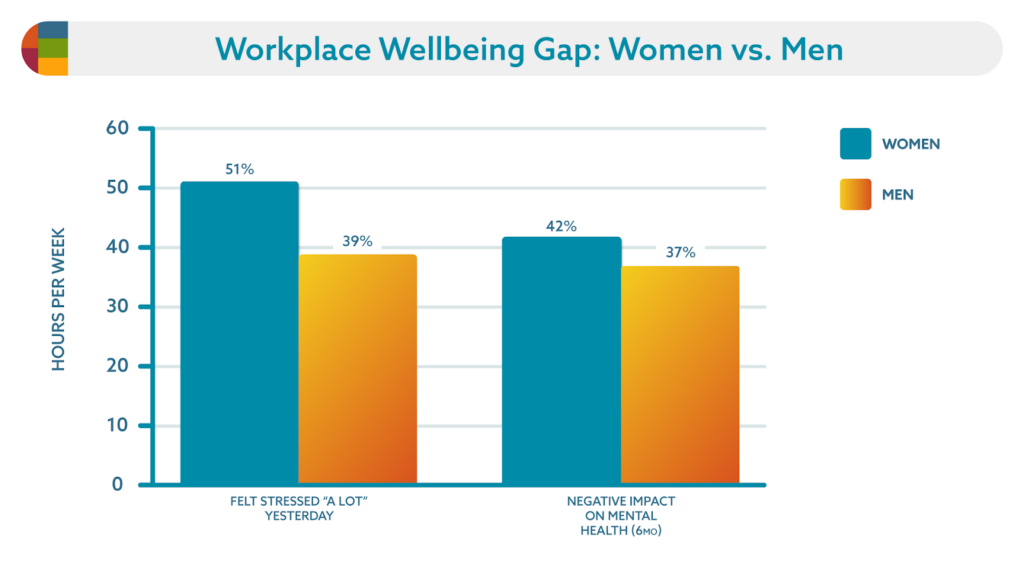
Source: Gallup, 2024
The struggle to keep women in the workforce in recent years reveals that whenever social or financial stressors arise, the lack of systemic support and affordable childcare forces mothers out of the workforce at three times the rate of men, reinforcing a cycle where women sacrifice career advantages for domestic responsibilities while men receive professional “fatherhood bonuses.” This all takes a toll on women’s career planning, motivation, and aspirations.
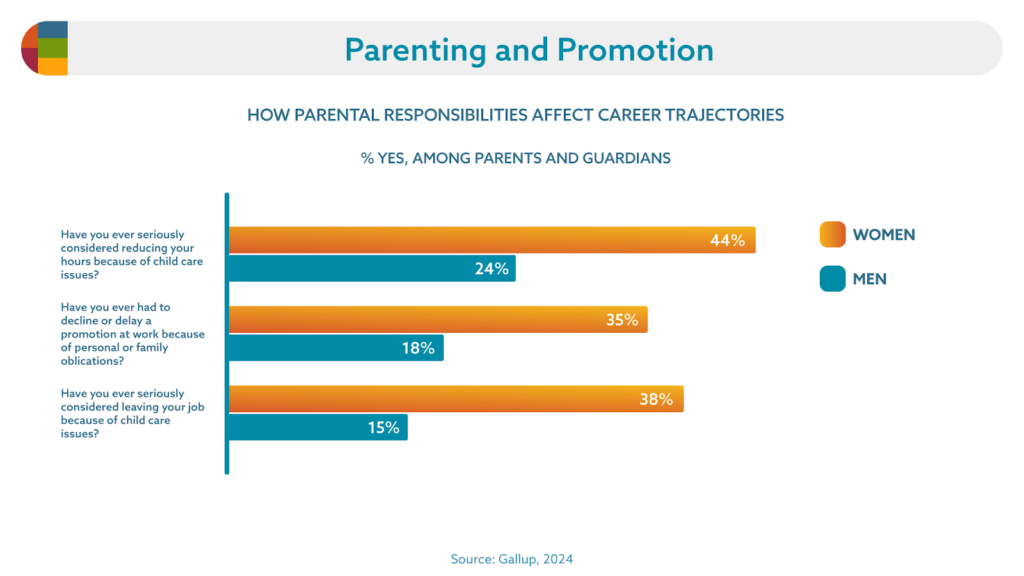
Source: Gallup, 2024
Sexual Abuse, Harassment and the #METOO Movement
Despite the #MeToo movement bringing workplace harassment into the mainstream, over 80% of women still report experiencing it, while nearly three-quarters stay silent for fear of professional retaliation. This culture of silence is further complicated by a “backlash” where senior men avoid mentoring women to minimize perceived risk, a trend that only top-tier leadership can reverse by enforcing meaningful consequences for predators and protectors alike.
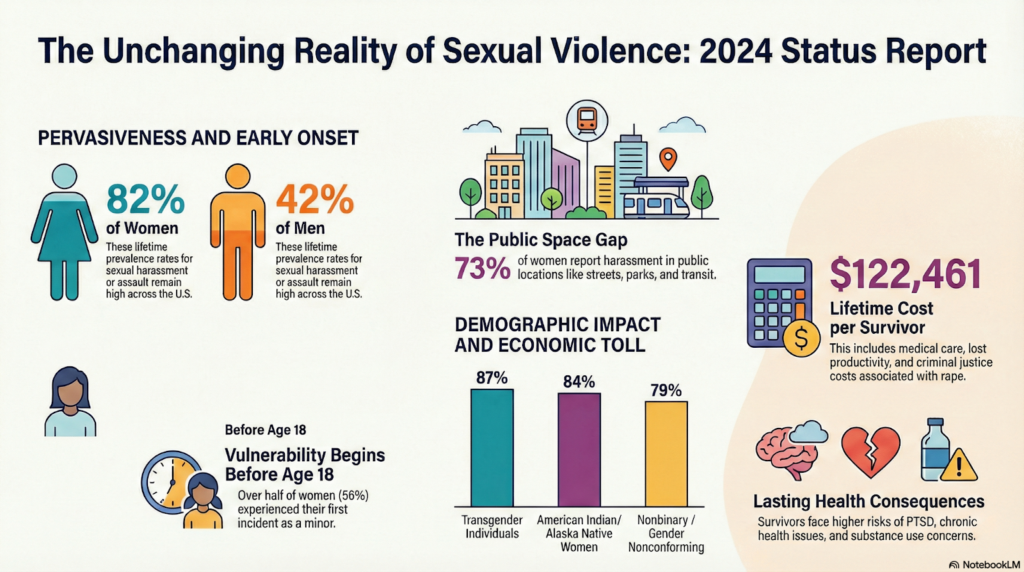
Sources: CDC, Tulane University
Gender Equity Practices that Work
While U.S. companies often lag behind public perception in gender equity, organizations can drive real progress by moving beyond simple representation and implementing systemic shifts like anonymous hiring, intentional sponsorship, and objective benchmarking.
👉👉👉 Download the full PDFwith graphics, over 100 links to research, and resources 👈👈👈
Real success requires a multi-pronged approach that pairs flexible work policies with leadership-led culture changes, proving that dismantling bias creates a higher-performing environment that benefits everyone, including white men.
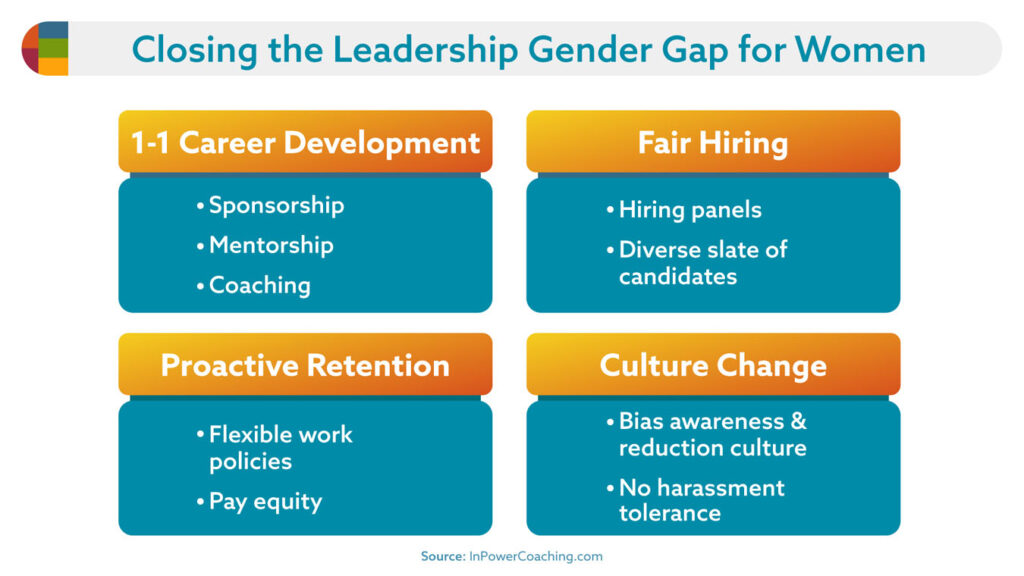
Mentoring Advice to Help Get Women Into Leadership
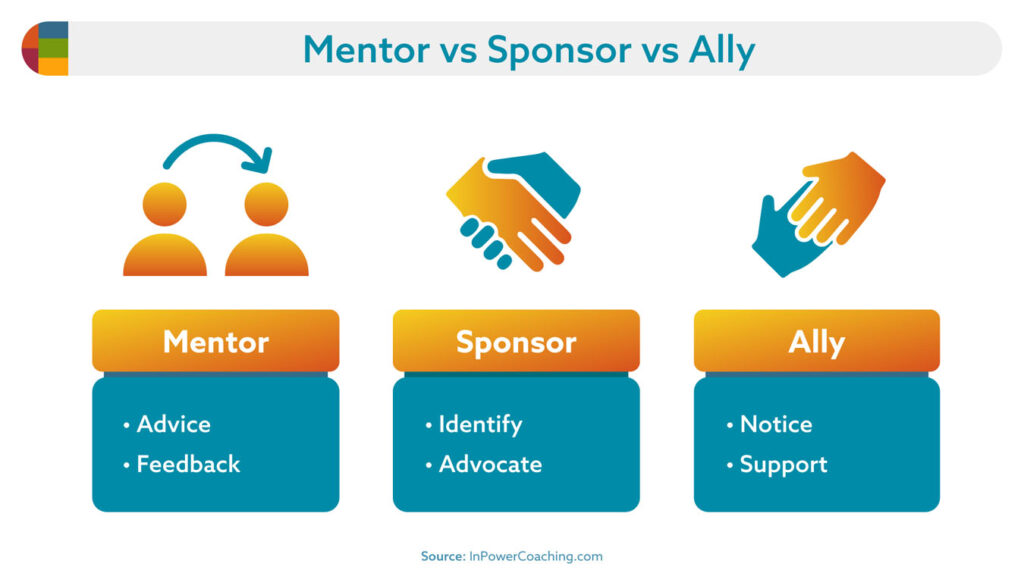
Mentor vs Sponsor vs Ally and the Importance of Visibility
Mentorship
Mentors have always been important to anyone’s success in business (and life!) It’s through mentorship we learn the While mentorship is essential for decoding the unwritten rules of business and closing knowledge gaps, data shows that providing women with advice alone has failed to close the leadership and pay gaps. To truly advance, high-potential women need more than a sounding board; they require the shift from mentorship to sponsorship, where advocates use their personal influence to open doors to executive roles.
Sponsorship
Unlike mentors who provide advice, sponsors use their organizational influence to advocate for talent behind closed doors, putting their own reputations on the line to secure high-profile assignments for their protégés.
👉👉👉 Download the full PDFwith graphics, over 100 links to research, and resources 👈👈👈
To bridge the leadership gap, women must cultivate high-impact visibility to get on a sponsor’s radar, while organizations must actively dismantle the biases that prevent leaders from sponsoring women as readily as they do men. This will help companies address the gap between women’s and men’s motivation and ambition to make it into leadership.
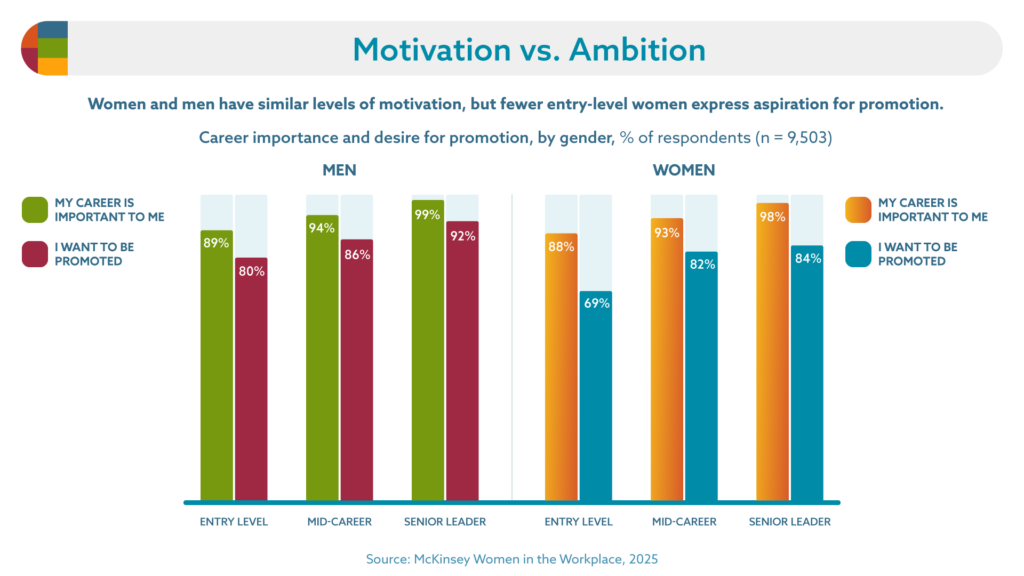
Source: McKinsey Women in the Workplace 2025
Allies
Allies support women’s leadership by using their daily professional influence to counter bias and amplify visibility, often proving most effective when they normalize anti-stereotypical behaviors in the flow of business. Because men in power face fewer penalties for speaking up, they are uniquely positioned to serve as high-impact advocates, provided they bridge the gap between their perceived allyship and the actual needs of the women they support.
Career Planning for Women Seeking Leadership Roles
Women often stall their ascent to the C-suite by self-selecting or being mentored into “soft” functional roles like HR or Marketing, which statistically offer fewer paths to the CEO position than Profit & Loss (P&L) roles in Finance, Sales, or Operations. To overcome this, aspiring female leaders must consider including “hard” discipline experience and strategic assignments in their career plans to build the P&L acumen essential for top-tier executive influence.
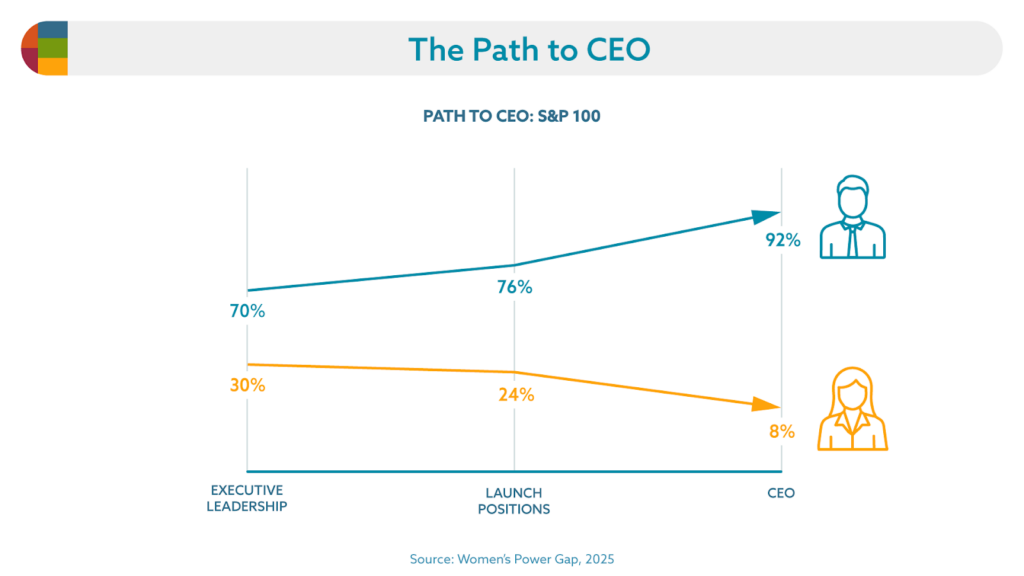
Source: Women’s Power Gap 2025
Career-Defining Accomplishments and Future Potential
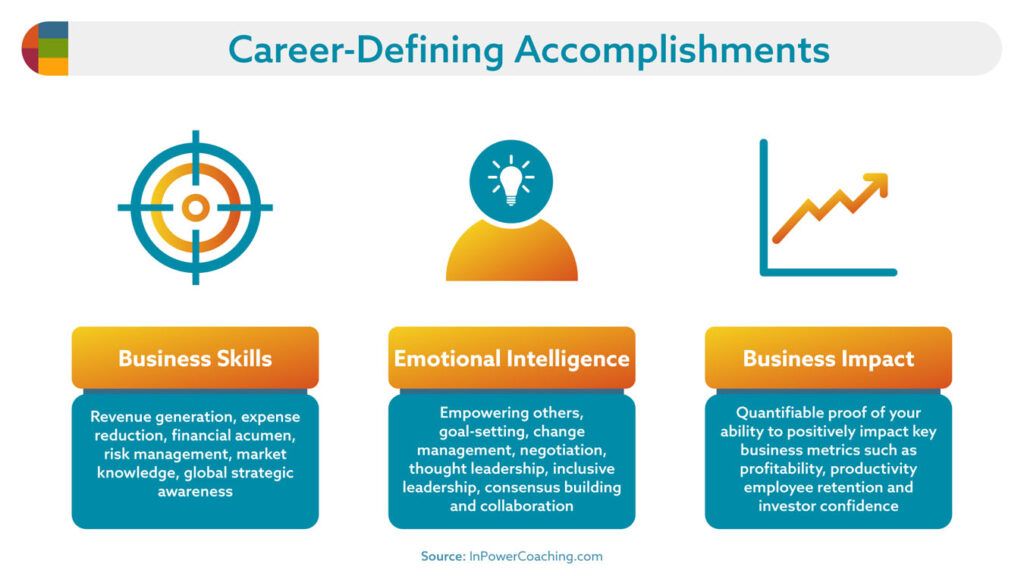
To reach senior leadership, women must cultivate a track record of high-impact accomplishments that blend “hard” financial acumen with “soft” emotional intelligence, providing the quantifiable proof necessary for sponsors to pivot the conversation from their past performance to their future potential.
Executive Mindset
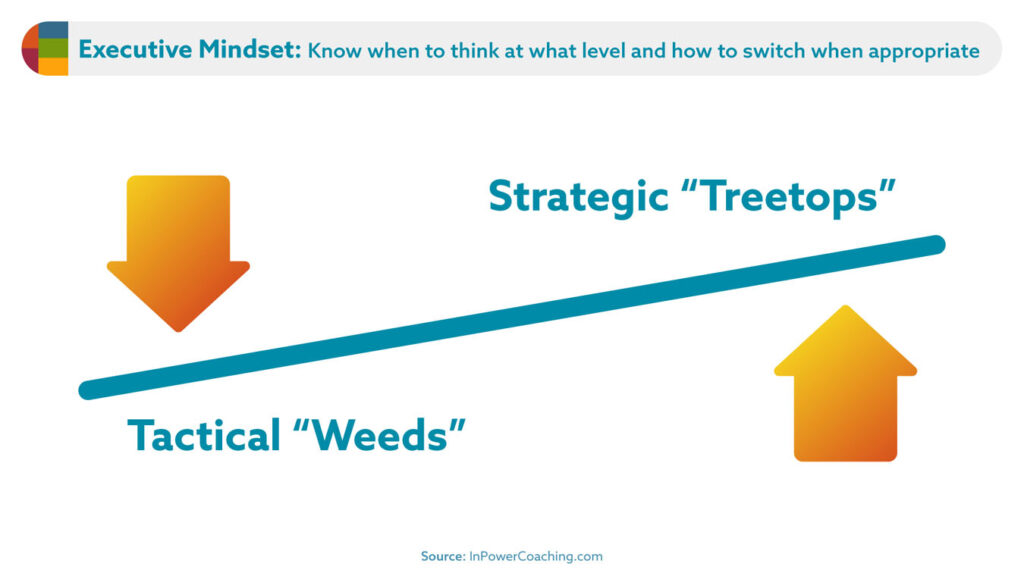
Developing an “executive mindset” requires moving beyond a detail-oriented “hard work” ethic to master the ability to pivot between tactical problem-solving and high-level strategic thinking.
👉👉👉 Download the full PDFwith graphics, over 100 links to research, and resources 👈👈👈
Because women are often culturally conditioned toward humility and “working in the weeds,” mentors must intentionally coach them to balance their workload against true business priorities and embrace self-advocacy as a necessary tool for leadership visibility.
Thought Leadership for Influence and Visibility
When women’s ideas are consistently ignored or co-opted by men, it creates a demotivating cycle of self-silencing that limits their visibility, making it essential for mentors to encourage women to lead with their ideas so they can gain access to the executive forums and speaking platforms where leadership potential is recognized.
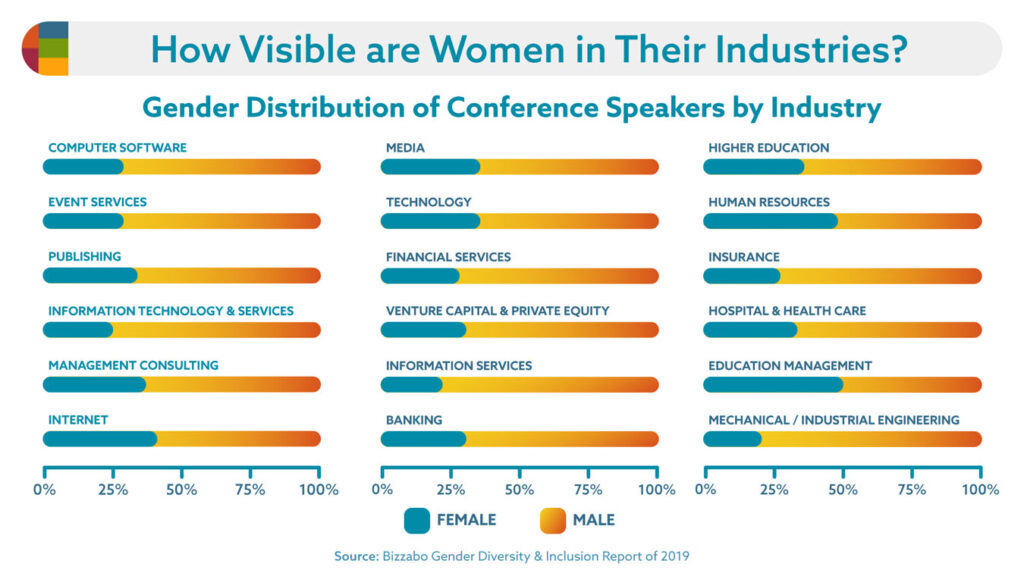
When a woman learns to champion her own ideas and build a personal brand around her insights, she gains the visibility necessary for thought leadership, a process that is significantly accelerated when allies actively solicit, credit, and connect her contributions to broader business goals.
Office Politics and Group Dynamics
To ascend to higher leadership, women must reframe “office politics” from a rigged game into a strategic understanding of group dynamics, mastering the ability to navigate—rather than avoid—the unwritten cultural rules that have historically been shaped by and for men.
👉👉👉 Download the full PDFwith graphics, over 100 links to research, and resources 👈👈👈
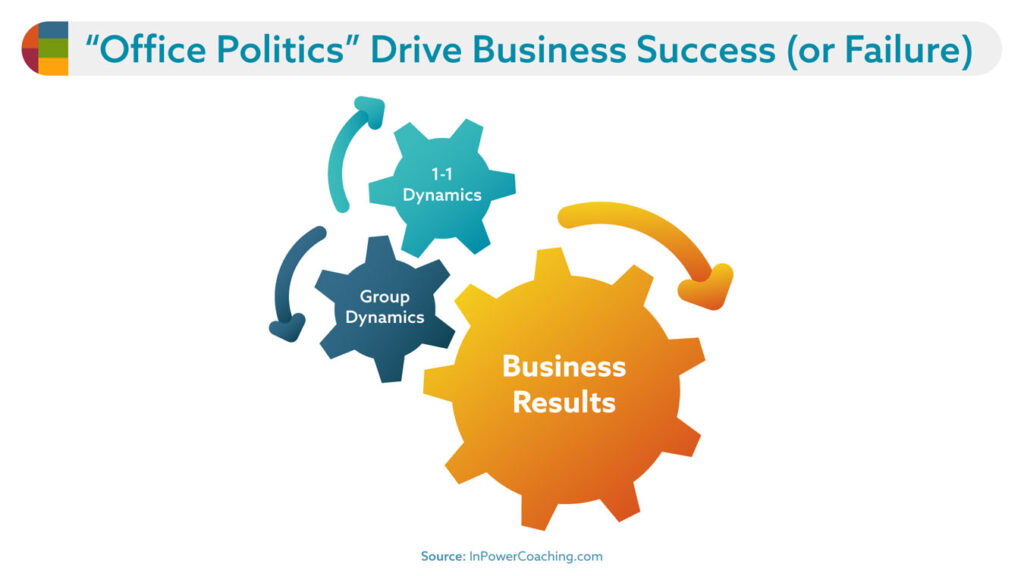
Coaching Advice for Women Seeking Leadership Roles
While mentors decode cultural norms, professional coaches provide the essential intrapersonal tools for women to develop an authentic leadership style that navigates the unique systemic challenges they face as a group.
Find Your Authentic Feminine Leadership Style
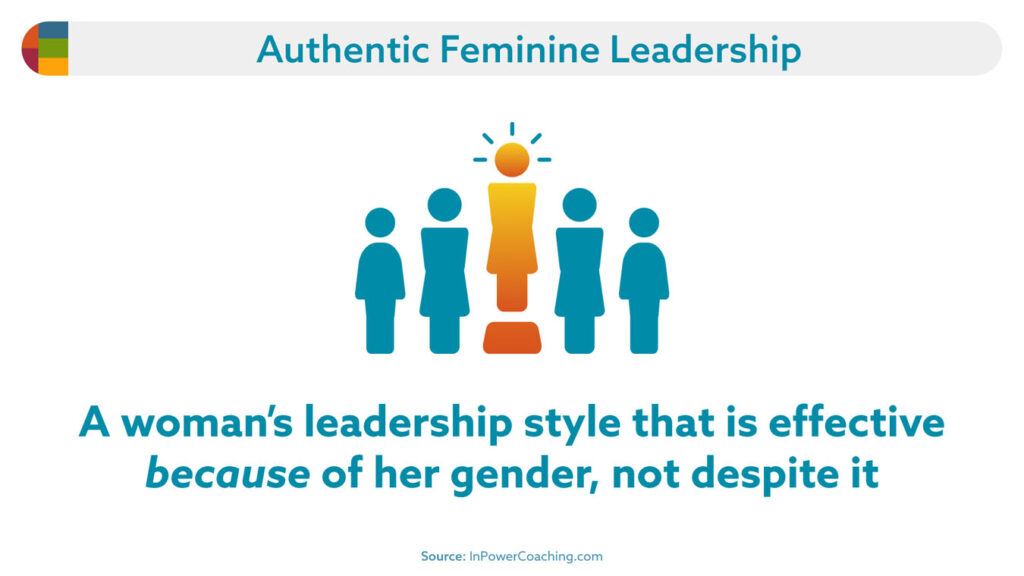
To lead effectively, women should move away from emulating male styles and instead embrace their authentic strengths, as research shows that the relational and systems-thinking traits often socialized in women are precisely the “feminine” competencies that correlate with higher leadership effectiveness and global demand.
👉👉👉 Download the full PDFwith graphics, over 100 links to research, and resources 👈👈👈
.
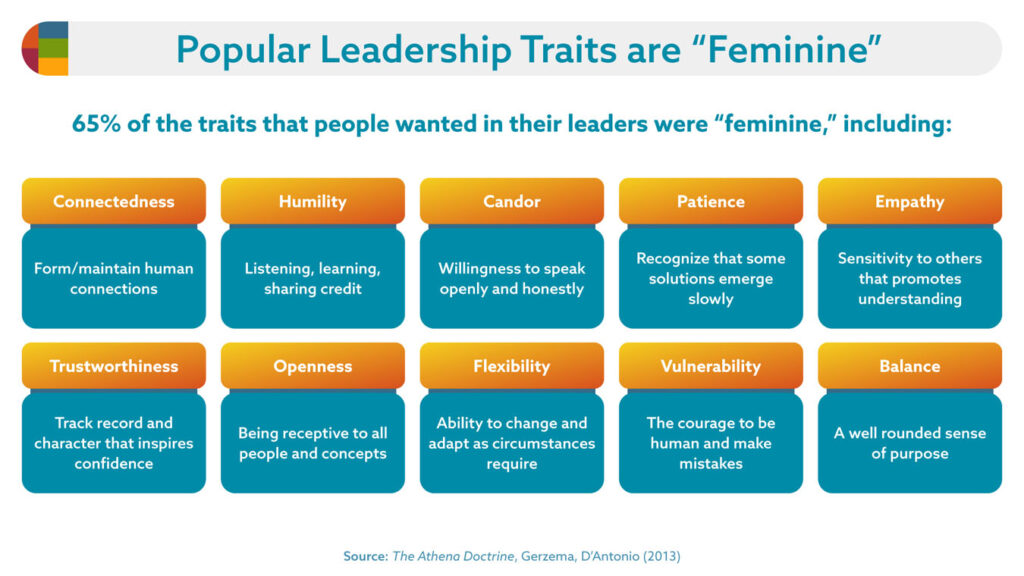
Source: The Athena Doctrine
The gender paradox in leadership creates a grueling cycle where women are penalized for failing to meet masculine “norms” and told to be tougher, yet are simultaneously denied rewards for the highly effective relational and empathetic traits that research shows are actually most desired in modern leaders.
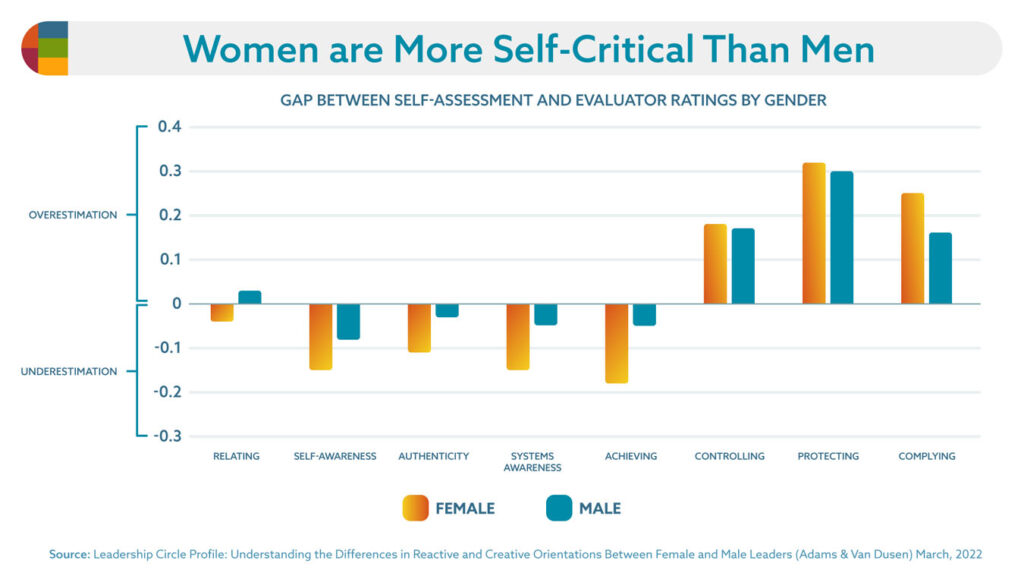
To lead effectively without the same cultural support as men, a woman must courageously value her unique gender-based strengths and emotional intelligence, transforming perceived weaknesses into high-impact leadership tools while surrounding herself with a support network that validates her authentic contributions.
Befriend Your Inner Critic
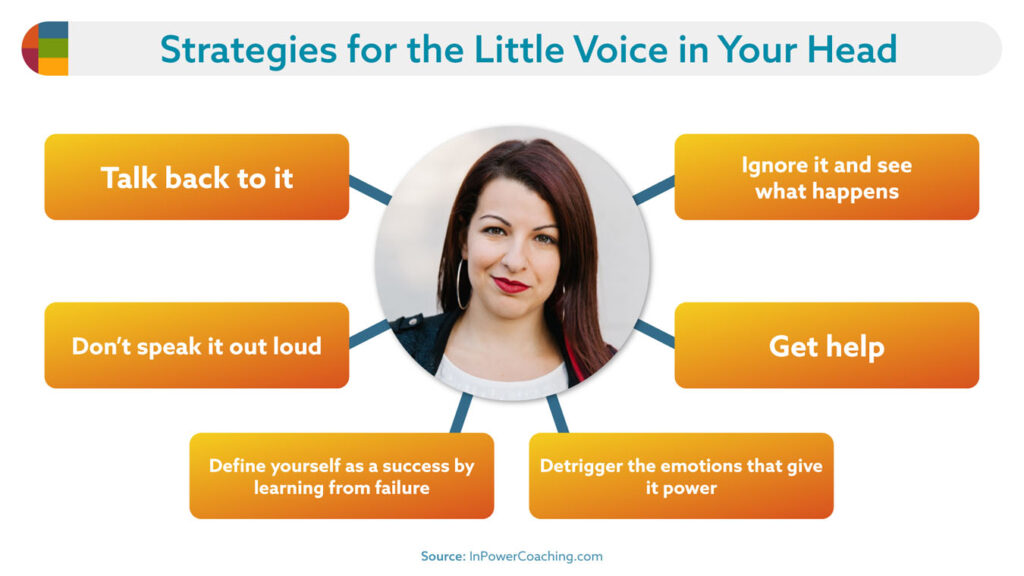
Even when women learn to internalize their value, they almost universally find that a “little voice of doubt in their head” has internalized the negative voices about themselves (or women in general), which they’ve heard over time.
👉👉👉 Download the full PDFwith graphics, over 100 links to research, and resources 👈👈👈
The little voice acts like an inner critic (often a product of psychological gaslighting), channeling unconscious negative biases, encouraging her to interpret events in ways that accentuate potential negative outcomes and threats. It “reminds” her that playing small, eschewing visibility, and accepting inequity can protect her from confrontation, conflict, and the possibility of being shamed, hurt, or fired.
Become a Master of Intention
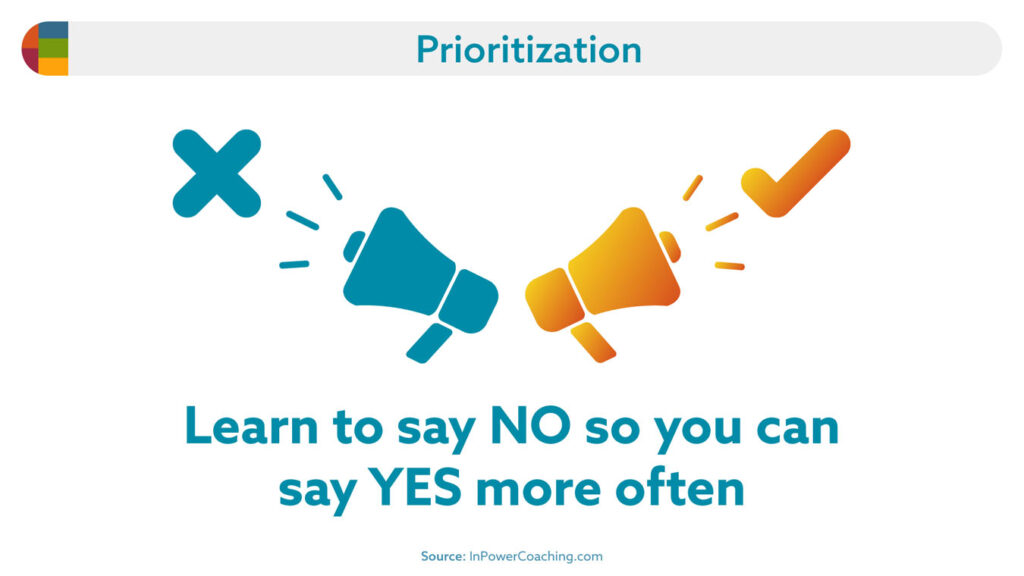
To navigate systemic biases and the pressure to work “twice as hard,” aspiring female leaders must shift from reactive overwork to a practice of ruthless prioritization rooted in a clear, proactive vision of success. By mastering the ability to set firm boundaries and say “no” to low-impact tasks, women can protect their limited time and energy for the strategic intentions that actually drive their leadership goals and prevent burnout.
Become a Master Communicator
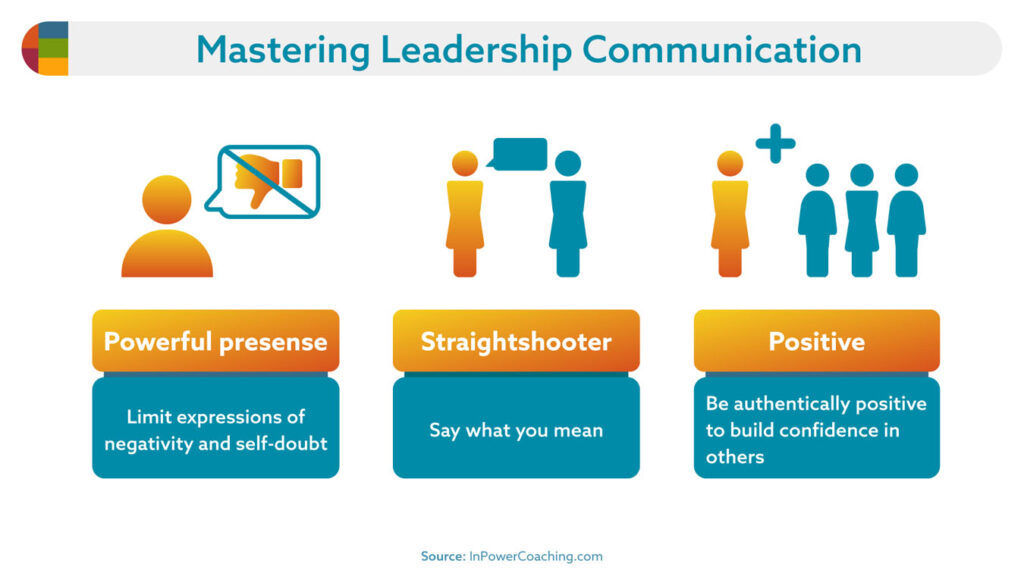
To communicate effectively, women must eliminate self-deprecating “pre-apologies” and powerless language that unconsciously signal a lack of confidence to others. While replacing these protective habits with the “silence trick” may feel vulnerable, it allows a leader to stand firmly behind her ideas and ensures her contributions aren’t dismissed before they are even heard.
👉👉👉 Download the full PDFwith graphics, over 100 links to research, and resources 👈👈👈
By silencing the internal chatter of doubt and learning to take others at face value, women can engage in more powerful, direct dialogues that are essential for championing their vision and asserting their influence.
Become a Master Risk Taker
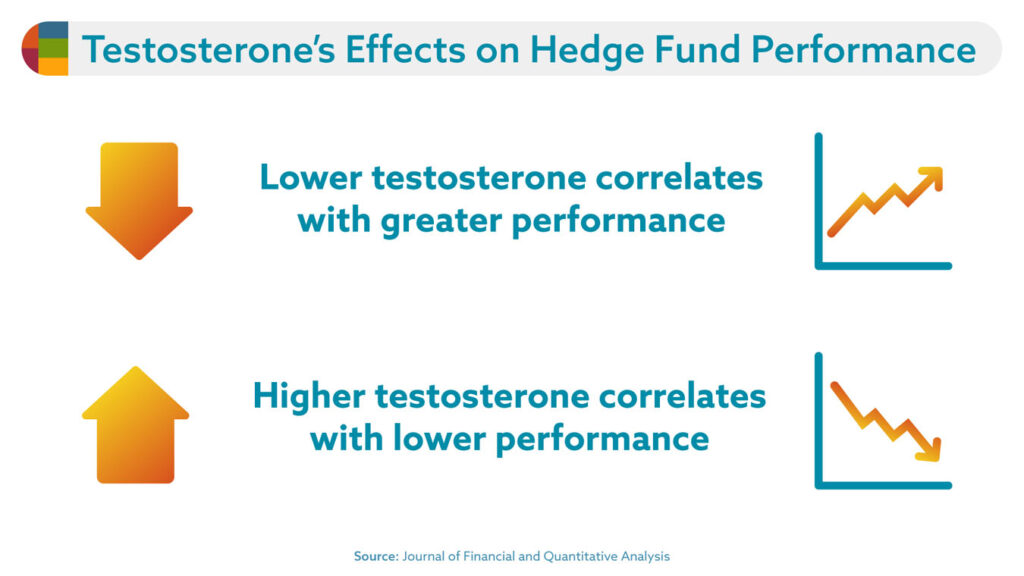
While research shows women are actually highly effective “considered risk-takers” who prioritize research over impulsivity, they must intentionally balance this caution with visible, audacious risks to counter the unfounded stereotype that they are risk-averse and to prove they possess the “boldness” traditionally rewarded in executive leadership.
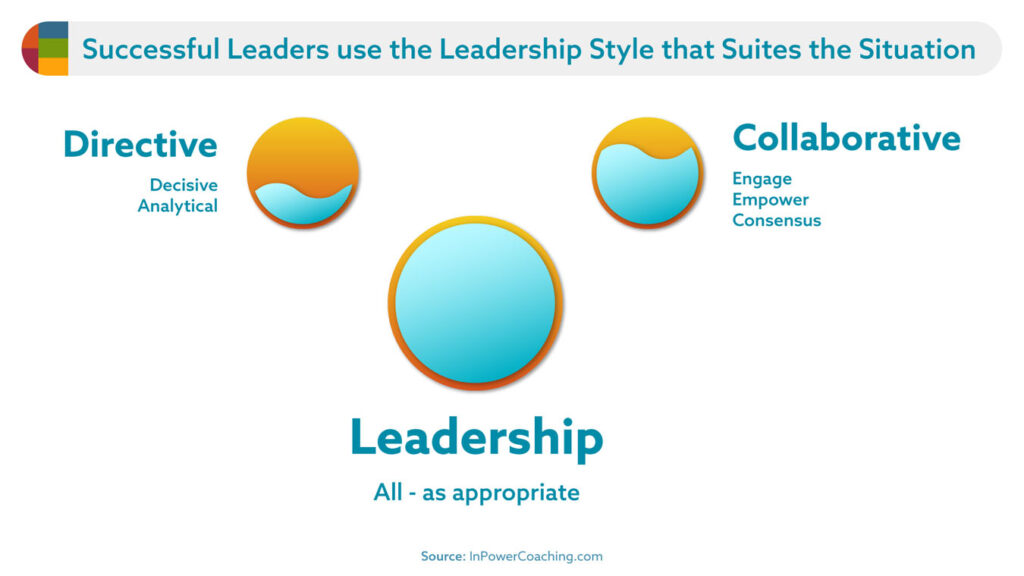
Become a Master of Situationally Appropriate Leadership
True leadership excellence requires moving beyond a singular “leadership style” to master a versatile spectrum of both masculine and feminine responses, a strategic adaptability that allows women to navigate unique situational demands and often leads to greater professional rewards than their male peers.
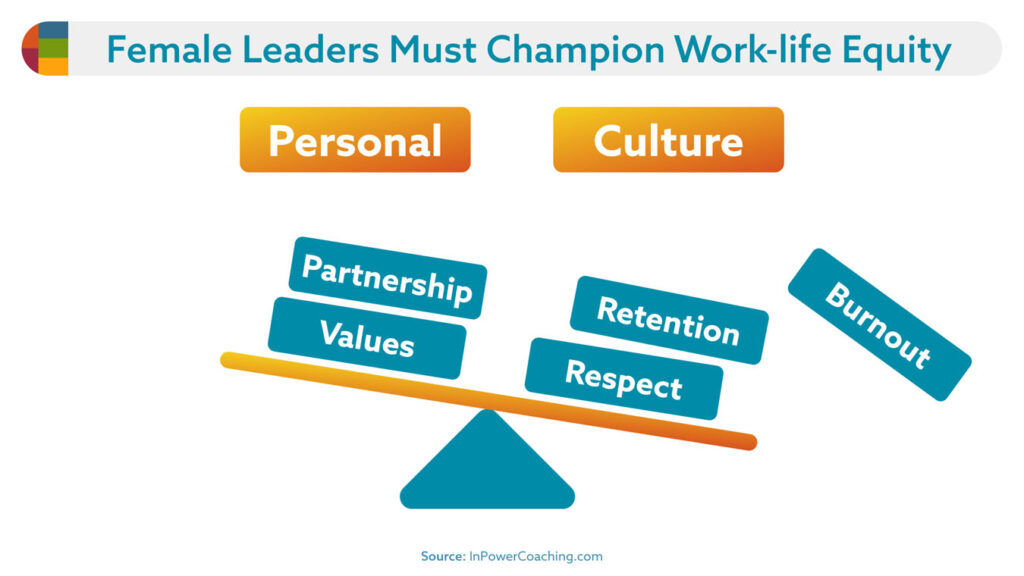
Strive for Work-Life Equity instead of Work-Life Balance
To reach the executive ranks, women must shift from the impossible pursuit of “balance” to the strategic negotiation of “equity,” ensuring they have the domestic support and personal boundaries necessary to handle the high-stakes crises that define senior leadership.
👉👉👉 Download the full PDFwith graphics, over 100 links to research, and resources 👈👈👈
As they gain power, female leaders are uniquely positioned to dismantle toxic workaholic cultures by championing organizational policies that destigmatize caregiving for all genders and measure success by impact rather than time spent in an office chair.
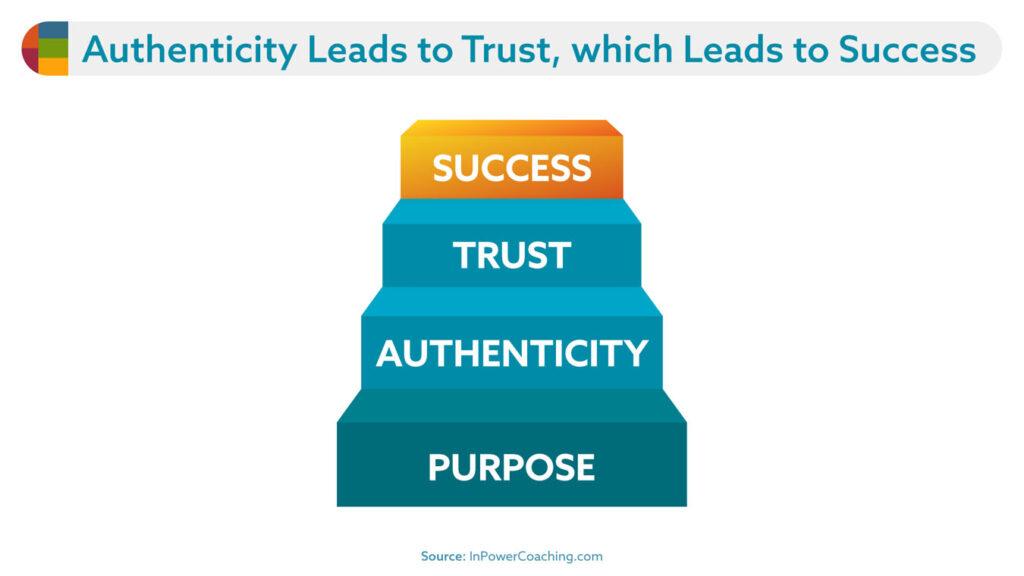
How to Craft an Authentic Executive Presence and Personal Brand
Be Who You Are and Why
To secure the highest executive posts, a woman must transcend the exhaustion of inauthenticity by rooting her leadership in a clear sense of purpose, using her unique strengths to inspire confidence amid uncertainty and proving that her authentic self is a reliable engine for high-stakes business results.
Take on Conflict, Competition and Negotiation
To reach senior leadership, women must reframe conflict and competition as mission-critical business skills, mastering a “win-win” negotiation style that leverages their natural relational strengths to turn either-or combat into both-and solutions.

Make Friends with the Imposter Syndrome
Imposter syndrome often peaks just as women approach high-level leadership roles, triggered by a lack of traditional mentorship and a heightened fear that their success is a “fake” that will be exposed under increased visibility. T
👉👉👉 Download the full PDFwith graphics, over 100 links to research, and resources 👈👈👈
o overcome this, women must reframe the Imposter as a signal of growth and use proactive strategies—like leaning into fear and setting specific stretch goals—to build the resilience needed to lead confidently through uncertainty.
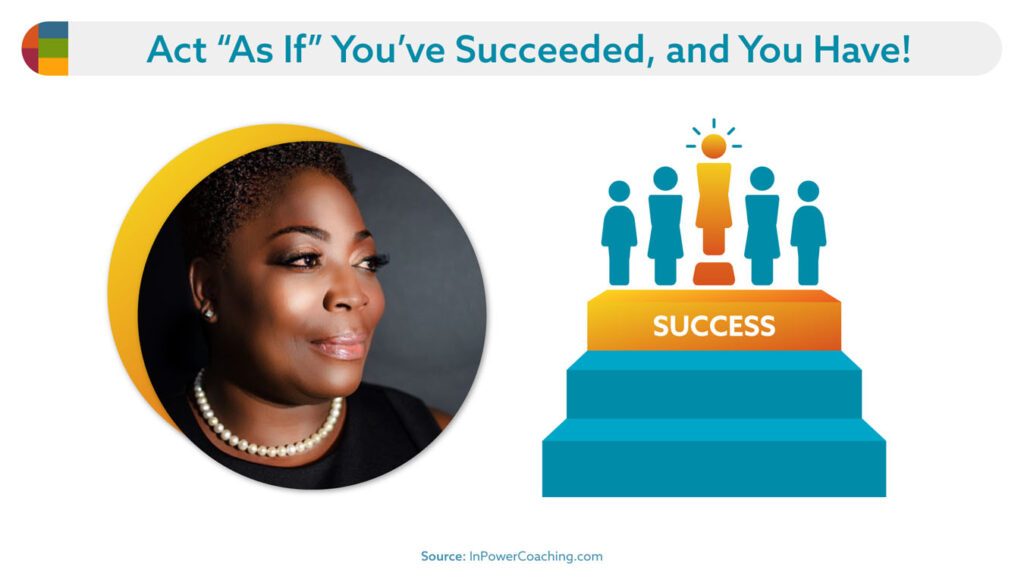
Take Credit and Ask for What You Want
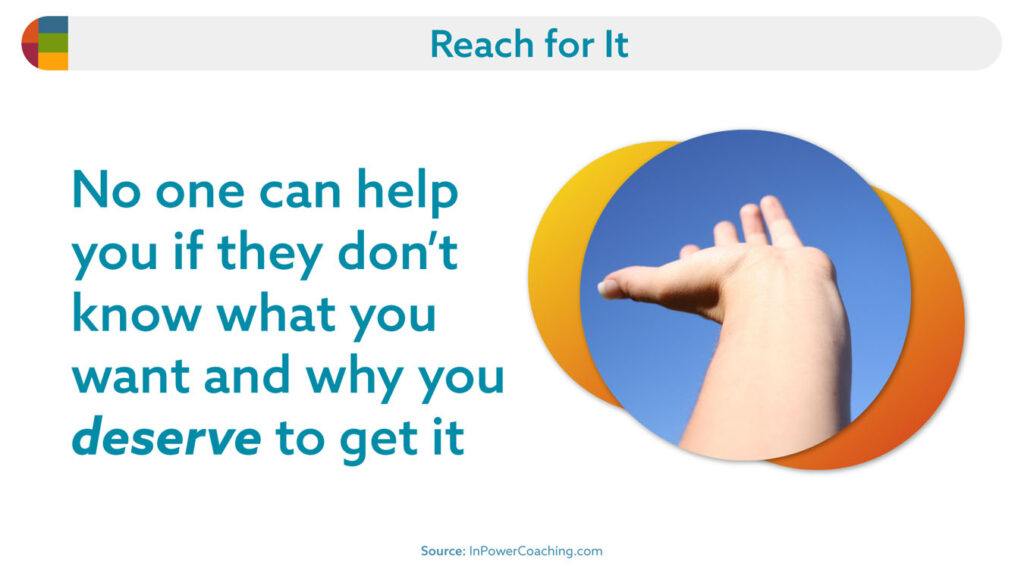
To reach the highest levels of leadership, women must abandon the “Cinderella myth” that hard work alone will be discovered and instead actively self-advocate, ensuring their accomplishments and career goals are visible to the sponsors and mentors who make key promotion decisions
Influence by Speaking So They Listen
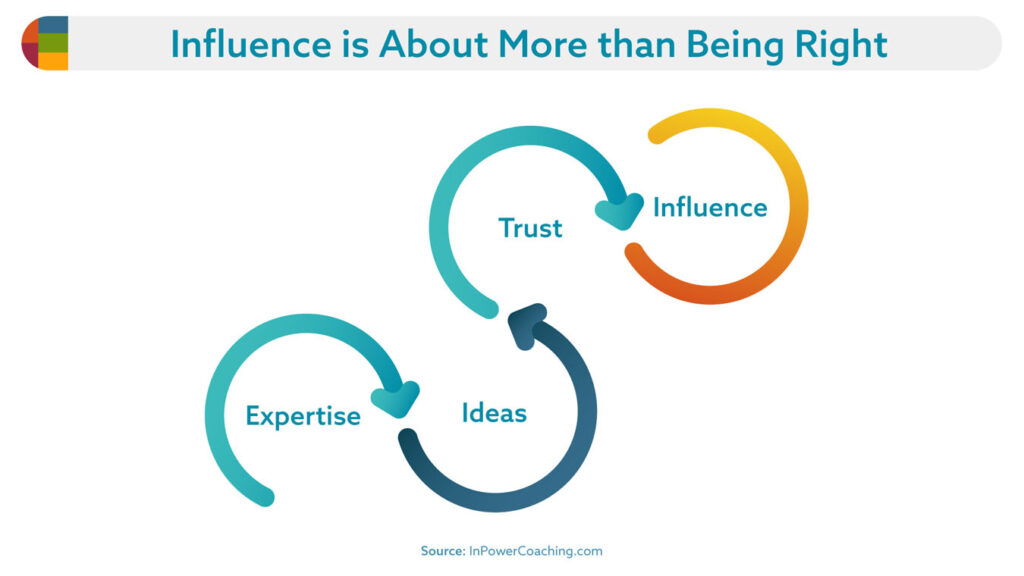
Mastering influence is less about possessing exhaustive expertise and more about the emotional intelligence to build trust and leverage motivations; therefore, women must overcome the urge to wait for “perfect information” and instead proactively use their voice to build a personal brand of credibility and strategic presence.
Network Authentically and Strategically
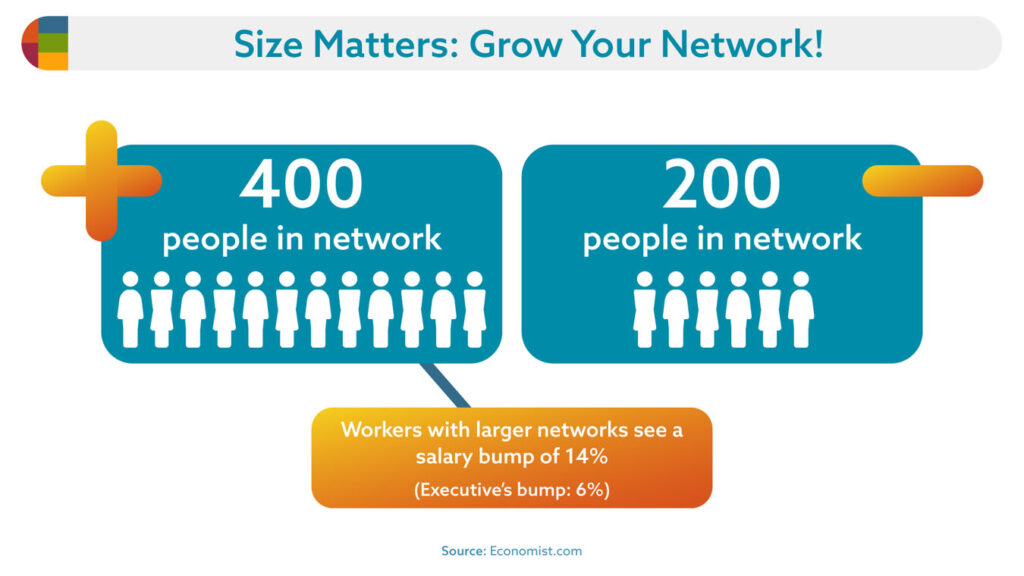
To maximize career opportunities, women must cultivate both a vast network of “weak ties” for broad visibility and a small, deep circle of female peers for navigating cultural challenges.
👉👉👉 Download the full PDFwith graphics, over 100 links to research, and resources 👈👈👈
Success requires shifting from comfortable, private relationships to a proactive strategy of building high-level alliances and engaging with a wide range of contacts who can advocate for their professional goals.
Know Your Next Big Thing
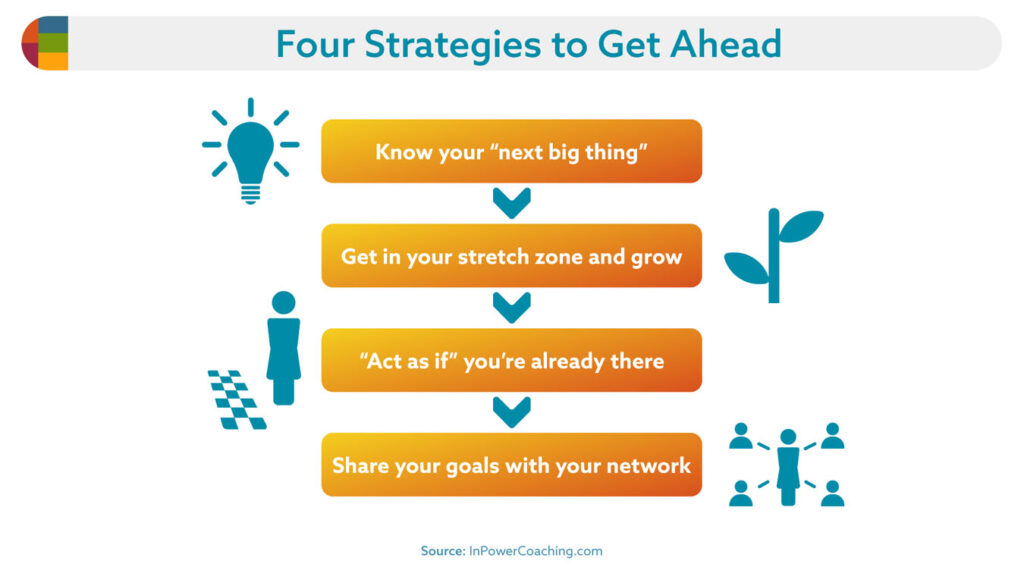
Achieving the next level of leadership requires a crystal-clear vision of success that enables women to prioritize strategic skills, project executive presence, and intentionally activate their networks to open doors aligned with their highest potential.
Ready to step up?
Resources and Tools for Women in Leadership
The work of earning her way into higher levels of leadership is a personal journey every woman takes, and our InPower mission is to support her every step of the way. The resources below provide a wide range of strategies to help women leaders at every level grow into their most authentic, feminine leader.
Self-Reflection
The following programs are designed to help you turn inward to tap your most authentic personal strengths:
- Emotional Detriggering – 1 week to greater emotional balance
- InPower Toolkit – 4 key tools (including detriggering) to help you tap your personal power
Career Planning & Career Development
The following programs will help you decide on your “next big thing,” prepare for a successful job search, and get the job you want at the salary you deserve:
- Career Planning Bundle – Tools to help you decide your next big thing
- Mentoring Women Bundle – Tools, topics, and templates for mentors and their female protégés
Leadership Development
The following programs will help you become a more effective leader, regardless of whether you manage a team or not:
- Personal Mastery – Core InPower tools for managing stress, developing your personal brand through your work, and communicating effectively
- Total Leadership Library – Complete package of leadership tools, including personal mastery tools, change leadership and executive leadership skills
Personal Brand & Executive Coaching for Women
Your challenges are as unique as you are. Go straight to the source with highly personalized executive coaching with Dana Theus:
- Free Resources for Women in Leadership – articles, videos, research, and more are available at InPowerCoaching.com/women.
- Executive Coaching for women – Dana will work with you on a regular basis (or as-needed) to identify the fastest, most effective, and lasting changes you can make to achieve your goals.
- Executive Women’s Mastermind Programs – Join Dana and other women leaders in a powerful monthly discussion and community of women dedicating themselves to making a difference with their careers.
Key Takeaways From This Article:
Scan these highlights from our Women’s Leadership Guide, designed to help women turn the tables on cultural bias, systemic discrimination, and internal scripts that keep them out of leadership positions.
- Bridge the “Broken Rung” and Transcend the “Glass Ceiling” with P&L Experience: Learn why “soft” functional roles like HR and Marketing often stall executive progress and how pivoting toward “hard” disciplines like Finance and Operations provides the essential trajectory for the C-suite.
- Master the “Treetops and Weeds” Mindset: Discover the specific psychological shift required to move from a detail-oriented “hard worker” to a strategic executive who can pivot seamlessly between tactical problem-solving and high-level visionary thinking.
- Lean Into Your Authentic Strengths: Explore the research-backed “Feminine Leadership Advantage” and learn how to stop emulating male styles in favor of relational and systems-thinking competencies that statistically lead to higher leadership effectiveness.
- Shift from Work-Life Balance to Work-Life Equity: Move beyond the “Cinderella Myth” of silent hard work and discover how to negotiate for the domestic and professional equity needed to handle high-stakes “five-alarm” business crises.
- Flip the Script on Risk and Conflict: Reframe “office politics” and “audacious risk” from intimidating hurdles into mission-critical tools, using “both/and” negotiation tactics to turn potential confrontations into strategic wins.
About the Author
Dana Theus helps women in leadership assignments activate their highest potential, heal disempowerment, and shape their most authentic feminine leadership style. Explore Dana’s full bio and read all client quotes.
👉👉👉 Download the full PDFwith graphics, over 100 links to research, and resources 👈👈👈