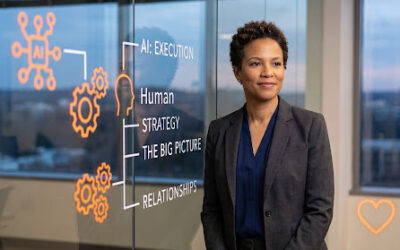
My feeds are full of some version of the question, “What will humans do when AI does all our thinking for us?” Considering the perspectives I hear in this debate, I think the answer is that humans will learn to develop and rely on their intuition much more than we do today. So we should reframe the debate less as “AI vs. human” and more around “AI vs. human intuition.”
Key Takeaways
- As AI absorbs the quantitative and algorithmic decisions, the human edge shifts to vision, goals, ethics, and values: becoming the stewards of meaning.
- Intuition is more than a hunch. It’s pattern recognition across emotional, sensory, social, and spiritual signals machines can’t read, and it’s a skill leaders can build.
- Most business cultures reward machine-supported strengths like efficiency and output. Leaders who can also name what’s worth doing, and why, will shape the future instead of ceding such vision to the machines.
- Quantitatively strong people aren’t losing their value, but everyone, including them, will need to grow human-interface skills to lead well alongside AI.
Photo by Markus Winkler
AI vs. humans: research and intention
If you’ve been paying attention, you know the pundits believe that the productivity model of the future is a combination of human and AI strengths. As more and more people find ways to use AI today (even if just as an enhanced Google search), we’re seeing that it is easy for AI to slip into human processes as a newly efficient tool. The harder question comes when AI agents become the decision-makers (circa…2027?). When that happens, humans may still make the big calls, but many of the choices we make today will be delegated to AI.
So which decisions should stay with humans? The research seems fairly definitive: let AI handle the quantitative and algorithmic work, while humans own the decisions about vision, goals, ethics, and values. In tests of various decision-making combinations, this dual model outperformed both AI-only and human-expert-only decision-making.
Humans focusing on vision, goals, ethics, and values is an interesting way to think about our new place in the world. On the surface, it appears to mean that we get to stay in charge, setting targets and managing boundaries. But it goes deeper than that: the role of humanity going forward is to become the stewards of meaning.
Meaning looks like answers to questions like these:
- What world do we want to live in?
- What and who matters, and how do we demonstrate that?
- What friction belongs in the system?
- What outcomes are worth the investment?
And to understand meaning, we have to learn to cultivate, trust, and use our intuition as a tool and skill set.
AI vs. Human Intuition: What is human intuition anyway?
Intuition is a pretty fuzzy concept for a lot of us. It is variously thought of as either completely separate from reality (e.g., psychic abilities) or merely a function of human pattern recognition based on deep, accumulated experience. While I’m not willing to completely dismiss the metaphysical, I am 100% sure about the pattern recognition, but probably not the way most people talk about it.
The patterns that humans intuitively recognize are not merely mental or analytical, and this is where we get stuck in the AI vs. human debate. Computers are purely analytical in the patterns they can recognize, but humans perceive other kinds of patterns as well: emotional, sensory/physical, cultural/social, interpersonal, and spiritual.
We find meaning in things that can’t be quantified. We care deeply about why a thing happens, or doesn’t. We GROW and CHANGE. We set qualitative goals, designed to achieve more than measurable outcomes. And most importantly, we find joy and purpose in the process.
I would argue that this isn’t just the way we keep up with and complement machines in the future; this is the point of living. And if we don’t start owning the point of living, we will abdicate it, and the world we build will optimize for what machines care about: efficiency and output at the expense of meaning and joy.
What does intuition in the future of leadership look like?
The problem is that until 2026, our business cultures have become incentivized to optimize for machines’ strengths. Our economies succeed when productivity is highest and measurable output comes at the lowest calculable cost. We don’t have value models that weigh quality and meaning for their own sake. If we don’t figure out how to economically value meaning, we’ll default to what the machines value instead of what we humans value.
Who might save us?
The leaders. The leaders who decide what we’re trying to achieve and why. The leaders who decide why we run our organizations the way we do. The leaders who inspire humans to show up and work with the machines to create value of any kind.
What can we do to develop and craft our intuition alongside AI?
Show me the incentive, and I’ll show you the outcome.” ~ Charlie Munger
Many leaders may look at the list above and feel a bit uncomfortable. Most leaders today are incentivized to answer easier questions, the kind that SMART goals conjure up, but when AI-powered machines can do the “left-brain” thinking better than we can, human leaders will have to spend all their effort honing their “right-brain” thinking and feeling skills to answer meaning-based questions. To some extent, this is what leaders have always done, and should be focused on. To a larger extent, we have to acknowledge that many of us go too often to the more measurable goals that are easy to declare victory over. So let’s challenge ourselves in the future to lean into the harder work of leadership that leverages our intuition more fully.
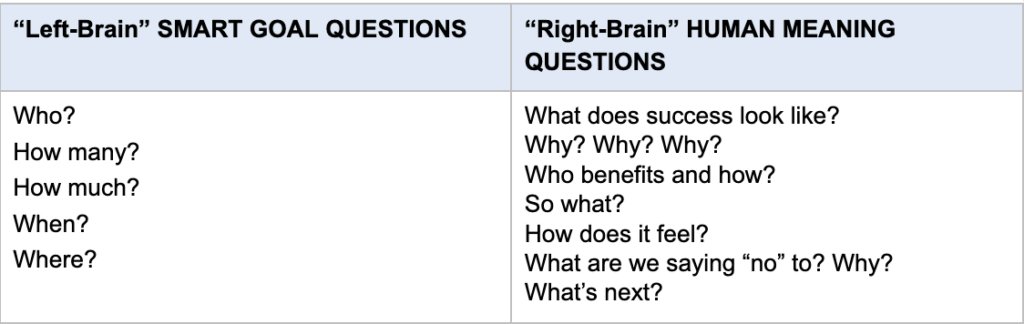
The measure-based questions and answers will soon be usurped by AI, but the meaning-based list will have to come from us. This should be easy. We’re literally built for it. Humans are meaning-making machines.
The human body is gifted with “feelings” that give us data a computer can’t detect or compile. That is the gift of our embodied experience: to integrate experience and rank it by what matters most—to others and to ourselves—drawing on empathy without being fully reliant on it. I’m not just talking about emotions (e.g., happy, sad, angry): I’m talking about subtler things like confusion, discomfort, disillusion, alignment, fulfillment, and satisfaction. Feelings tell us other things, too, including how much human energy (i.e., mental, physical, emotional, spiritual, relational, social, cultural) the system consumes and for what purpose.
In modern leadership parlance, this is called “emotional intelligence,” but the embodied experience of human intuition goes beyond that. It goes to the heart of what I think lies in humanity: a half-conscious awareness that can be brought into full consciousness to provide much more important, meaning-based information than computers can generate. This understanding, combined with AI-generated information, insight, and intelligence, gives leaders the power to create change and value unheard of in human history.
What does a leader need to do to become this powerful?
- Bring your own half-consciousness feelings about meaning into consciousness.
- Gather data in non-measurable form, and learn to combine it with AI-generated information to produce wisdom.
- Refuse to outsource your creativity and thinking to AI.
- Establish a vision for what matters and why it’s worth the investment.
- Steward co-created intentions to direct human and computer energy toward those outcomes.
- Set boundaries and manage resources using both qualitative and quantitative information.
This is nothing new. This has been the essential job of leadership for eons. We’ve just allowed ourselves to be distracted by the heroic feats of effort and calculation that humans can also perform.
One word of warning: human intuition is highly susceptible to cognitive biases, including confirmation bias, recency bias, gender bias, and many others. Intuition is much more than bias, but it does include built-in biases that streamline our thinking. The trick is to be self-aware enough to know we have biases and learn to unearth, review, and change them when they prove too limiting. AI is both a perpetuator and a challenger of our biases, so again, we find a natural partner in AI to help us find our blind spots and challenge each other to higher levels of thinking.
What should quantitatively strong humans do?
While our traditional business systems have, until this point, showered praise on people with quantitative skills for playing chess with computers, coding complex systems, and analyzing large volumes of data, these same people have, for the most part, not been incentivized to develop their empathic and human-interface skills. Unfortunately, too often this has bred toxicity and narcissism, and tolerated bullies at the top. In addition, there are people at all levels, on the neurodiverse spectrum, who struggle to mask a human-interface skill gap and yet still succeed on the strength of their quantitative minds. All of these people are becoming disproportionately vulnerable as AI competes for their jobs.
We still need them. We need quantitatively strong people to talk to AI on a technical level. We need them to keep AI honest. And they need to step up and develop as much human-interface skill as they can, to be good interlocutors between the human and automated worlds. They are not losing their value, but they will be challenged to shift and grow along with the rest of us.
Everything will change
While it may go without saying that accelerated change is the new normal, I believe AI is also giving us the tools to navigate it. To do so, we must all become masters of personal and organizational change. We must become excellent at letting go of the past and intuiting our way into the future. That’s how we build a world where the debate isn’t “AI vs. Human Intuition” but “AI and Human Intuition.”