
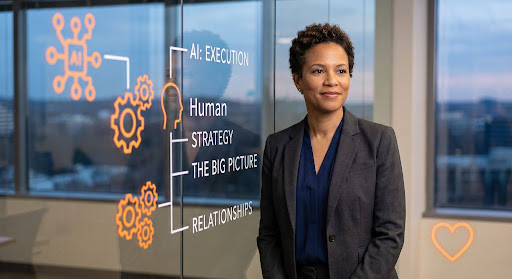
A question many of my clients are exploring in real time is, “What’s the difference between leadership and management?” The leader vs. manager debate goes back way before my time, but with the advent of AI it’s taking on new twists. Traditionally, the simplest way to think about this distinction has been that:
- managers do, and leaders think
- managers focus on the tactical and leaders focus on the strategic
- managers get the work done, and leaders decide what work needs to get done
- managers transact, and leaders transform.
And while these differences between leadership and management are still largely true in absolute terms, the answer is changing for the human beings who embody these roles.
In short, AI is taking over much of the work managers do: “getting things done.” The good news is that this will give managers more time to be strategic, and leaders will have more strategic allies in management. The bad news is that managers who are not prepared to lead will struggle, and lazy leaders who’ve grown used to performing like souped-up managers, i.e., managing at scale, will be called out more often, and their failures will be quickly apparent.
As the boundary between what human leaders and managers do begins to collapse, both leaders and managers need to update their career planning trajectory, leaning less on how things get done and more on what gets done and why.
The good news: lazy leaders can’t hide, and good leaders will have room to lead
I don’t know a single good leader who wants more busy work. I know plenty of so-so leaders who like to use micromanagement and “too much to do” as an excuse for:
- not focusing on the outcome of their work
- ignoring strategies that optimize their opportunity
- failing to prioritize work for themselves and their team, which keeps everyone in firefighting mode
- failing to empower and develop their team members
- focusing on the win in front of them instead of the win-wins all around them
I call this lazy leadership. Many leaders who fall into this trap aren’t even good managers because they don’t manage themselves, their team, or their resources very well. One study earlier this year discovered that across 10,000 executives in 25 countries, there was zero overlap between the competencies leaders displayed (e.g., presenting, competing) and those their followers actually want (e.g., effective communication, integrity and decision-making. They’re more likely to be obsessed with appearance and activity instead of team accomplishment. In the months and years ahead, lazy leaders will let themselves be overwhelmed by suboptimal AI output. For a time, they may appear successful, until the lack of results shows their efforts accomplished little more than AI slop at scale.
When routine activities that currently consume so much attention become more successfully automated, managers and leaders will have less to do. That is, unless they step up to the functions of true leadership, stewardship, and strategy:
- focusing on developing the what and why of both strategic and tactical goals
- actively managing priorities towards high-value outcomes
- empowering humans and AI agents appropriately and ethically
- developing humans to take the greatest advantage of their human talents and intuition
- navigating tricky human interactions and relationships to get decisions made and resources allocated
The best leaders and managers will thrive in this environment, partnering with team members, stakeholders, and AI to create value more quickly and accomplish more earlier in their careers. They’ll be able to bring ideas to fruition faster and keep up with the pace of change upon us.
The bad news: the “missing rungs” of human development, and immediate exposure to the consequences of bad strategy
Of course, climbing the ladder to become a good leader has traditionally resulted from learning to be a good manager earlier in your career. As more work is automated, managers have fewer opportunities to learn the intricacies of how things get done. It’s hard to lead and evolve something you don’t understand. This will make it harder for managers and new leaders to learn the nuances of their business at a level that gives them the instincts to truly lead it. We’re already seeing the beginning of this in the software engineering field, where the disappearance of entry-level coding jobs makes it very hard for junior developers to learn what good code looks like, which is a key skill they need to evaluate AI output and manage the AI agents.
Leaders will find themselves having to step in and more proactively develop, mentor, and coach rising leaders. They’ll have to become experts at empowering them, including letting them make non-fatal mistakes they can learn from. This will take leaders’ time and attention, even as the stakes get higher.
When AI lets us move so fast, humans will have to learn when and how to proactively slow down processes to validate strategy, ensure ethics, and give people the opportunity to learn. With the compressed output time AI offers, the results of poor strategy will become obvious much faster, and the damage may be done before many people realize it. Leaders will find themselves constantly challenged to evaluate success and pivot easily, quickly, and fluidly. Leaders will increasingly weigh the risks of speed against the benefits of prudence.
A case in point: too-fast execution
Here is a scenario only slightly adapted from the real world. Imagine a senior marketing leader giving instructions to their team to produce a new booth for the annual conference that “highlights the newest product.” A traditional approach to this project would include months of iterative design, development, approvals, and vendor contracting, during which the senior leader would have many opportunities to guide mid-level managers toward a refined understanding of what they originally meant by “highlighting” as the process ground on.
In an era not so far away (where the design bids and contracting could be largely delegated to AI agents managed by mid-level leaders with relatively few product launches under their belts), the process could take weeks instead of months. In this scenario, a lack of specificity in the original requirement could be incredibly expensive and embarrassing. In the New World, a poorly defined objective results in immediate delivery of AI slop of the highest order.
Leaders run these risks today, of course. The best leaders are very clear about how the new booth design would be evaluated as a success, and empower their teams to deliver it. They use accountability and iteration to build sound judgment into team members and processes. However, when the process runs longer and less efficiently, many lazier leaders can still achieve success.
The margin for error that iterative processes once granted is about to shrink dramatically. Looking backward from a more AI-automated future, where we used automation to lean into more intentional leadership, we’ll realize that inefficiency was operating as a safety net for weak leadership.
What to do about it: career planning and a focus on 4 strategic skills for the AI-era leader
Leadership has traditionally meant the ability to motivate, inspire, and point the way for team members mired in the doing. At the same time, especially in recent years, “the doing” has become so complicated that it’s eaten much of a leader’s time and energy (and all of a manager’s). This pressure to succumb to overwhelm will continue, but the most successful leaders will become expert at strategizing around it.
From here on, the best leaders will return to the core promises of leadership and ascend not because they’ve mastered the how of things getting done, but because they understand the dynamics of the how. They will also have a good strategic understanding of the environment, make the best judgment calls in responding, and lead others in a way that leverages the power of both human and technical capabilities.
It’s no longer enough just to produce good results; you need to prove that you can derive those good results through strategic acumen. This means you need to find career opportunities that let you develop these skills.
If you’re planning a career as a leader in a world where managers are more strategic, and business moves more quickly, here are four skills to lean into.
Understand the big picture
The biggest career-planning shift in this new world for both leaders and managers will be their ability to open doors to greater authority by demonstrating that they can produce results aligned with the strategy, not just by producing results alone.
Getting out of the weeds of the day-to-day work is really hard, even when it’s your full-time job, as it is for senior leaders. Managers in particular need to spend a lot of time in the weeds. More than ever, escalating a career into higher levels of leadership will require allocating more energy to understanding elements of the strategic environment that appear tangential to the necessary weed-whacking. Beyond just reading the company strategy to align their team’s goals, managers and leaders have to be able to explain the strategy in ways that put the weed-whacking in context. They’ll need to push back diplomatically and challenge priorities passed down to them, demonstrating their understanding of the strategic context and learning more about the why to better steward resources.
Occasionally, when you’re so plugged into the strategy that you can push back effectively, you’ll be able to contribute greater insight from the front lines so more senior leaders gain an appreciation of what it takes to bring the strategy to life. When this happens, you’ll gain the kind of attention that can open doors to more leadership opportunities.
A key tool for linking big-picture imperatives with tactical weed-whacking is the OKR (Objectives and Key Results) goal-setting and management system, which is used to align organizations and leaders. OKRs strip away low-priority distractions, define what success looks like at key milestones, and coordinate efforts toward outcomes that genuinely move the needle. They are a deceptively simple concept but challenging to implement because they require strategic discipline and constant effort to stay in alignment. With some relief from weed-whacking, both leaders and managers should have greater capacity for making the most out of goal-setting systems like OKRs.
Learn to prompt the humans, not just the machines
It’s ironic that one of the laments of the modern workforce is the extent to which our managers and leaders micromanage people, telling them how to do their jobs instead of giving them empowering clarity on the what and why of the work and leaving workers largely free to determine how the work gets done. The micromanagement tendency is no doubt a leftover of both apprentice and industrial workplace models. Yet AI is training us from the moment we begin using it to empower it with detailed prompts that focus on the conditions for success, leading us to trust it in the execution, which can be more efficient than a human approach. Good AI prompts describe the final state, as well as context and why the work matters.
Humans need this too! We’re learning the value of incredibly clear communication through technology prompts. With a little luck, the rapid turnaround of results AI can produce may teach managers and leaders alike to communicate more clearly with people, too. But humans need more than clarity when it comes to leadership.
Humans need empowerment.
Empowerment is an art, not a science. Empowerment begins with clarity of meaning: an aligned understanding of what success looks like, how the outcome will be evaluated, and why it matters. Empowerment also requires the limited transfer of authority and clear guardrails on how that authority can be used so that it is not abused. Finally, empowerment requires accountability and leader support for ensuring those who are empowered have everything they need to be successful.
Empowering human prompts are different from machine prompts in an important way. For humans to be empowered, we need meaning, personally and more broadly, and focusing on meaning opens up all kinds of benefits. Meaning-making can bring people together in collaboration to improve the what and the why before machine prompts help execute it quickly. Meaning can motivate people to overcome obstacles that might stymie the machine. Understanding the meaning and larger context can also guide humans into ethical pauses that the machines will never take on their own.
Treat managers like teachers instead of students
As Parker J. Palmer put it, “We teach what we most need to learn.” To steward your managers more quickly into strategic thinking, help them see the strategic implications of their work. Expose them to the intricacies of the strategy and hold them accountable for expanding on it to achieve it. Challenge them to critique AI-generated scenarios, use human creativity to think of scenarios the AI can’t imagine, expand the algorithm’s assumptions, and “fail” through low-cost scenarios that lead to better systems.
This expands the empowerment concept and helps them own the results of their AI-powered work. By granting managers limited authority to teach human staff and AI systems ways of achieving strategic goals, leaders can meet their responsibility of developing both humans and AI-backed systems while expanding the capability of both.
Home in on relationships and results
A more disciplined focus on results and outcomes will be critical in an age when AI can overwhelm us with “output,” much of which looks more valuable than it actually is. AI is becoming increasingly skilled at producing stuff. Some of it is valuable; some of it simply appears valuable and turns out to be either error-prone or simply not very insightful when you dig into it. Humans will be the ones to discern the value in both AI- and human-produced output. They will do this based less on how meaningful it appears, and more on how meaningful it actually is in both strategic and human contexts, such as stakeholder relationship development.
Knowing when an outcome moves you closer to success and when it sucks up resources for little gain will be the critical role of humans in leadership and management going forward
AI will always outpace humans in speed and sheer processing volume, but we still live in a human economy. Humans have personal agendas; they make decisions on qualitative grounds rather than strictly quantitative ones. They make choices that do not always appear rational, but which can move mountains and stymie armies. Humans—including our foibles and quirks—will determine our success, and humans thrive on relationships. While AI can help us think of human factors we haven’t thought of, it can’t navigate human systems and human motivations as skillfully as flesh-and-blood people. Never outsource communication with your employees, customers, or stakeholders to a machine. Find your authentic way to navigate organizational politics, interpersonal relations, and stakeholder management.
Find your authentic style for being human. Excel at it.
What the leader vs. manager shifts mean for your career plan
The distinction between leading and managing has never really been about titles. It’s always spoken to where your value originates. For a long time, most of the value of both leaders and managers has lived in knowing how things got done. That is exactly what’s being automated by AI-driven systems. In the future, both leaders and managers will have to generate their value in a more strategic context.
So the career planning question isn’t whether you’re a leader or a manager. It’s how much of your value is still tied to how the work gets done, and how deliberately you can move it toward the what and the why. Make the strategic shift in your career plan to:
- audit where your reputation currently comes from
- notice which parts of it an agent could plausibly do in the next 2 yearsan agent could plausibly do in the next two years
- start building the parts it can’t
Focus on honing your skills and judgment about which outcomes matter, stewarding people who need room to make non-fatal mistakes, and building the relationships that get decisions made and resources allocated.
Regardless of your age today, before your career is over, managing at scale won’t be much of a career. Leading at scale will be.
Pick one outcome you own this quarter. Get specific about how you’d know it succeeded. Then hand off the how — to a person, to an agent, or to a person with agents — and spend what you get back on the humans.
Leader vs. manager in the AI era: FAQ
What is the difference between a leader and a manager?
The traditional answer: managers do, and leaders think; managers focus on the tactical and leaders on the strategic; managers get the work done, and leaders decide what work needs doing; managers transact, and leaders transform. In the abstract, these dichotomies still hold. What’s changing in the age of AI is that a shrinking share of the doing belongs to humans, which collapses the practical distance between the two roles. In the future, both leaders and managers will do more of what we call “leading” today.
How is AI changing the difference between leadership and management?
AI is absorbing much of the execution work that used to define management. Managers get more room to be strategic, and leaders gain strategic allies where they once had order-takers. The catch is that leaders who have been managing at scale rather than genuinely leading lose the cover that this busywork provided. As AI becomes capable of implementing bad strategy at scale, the stakes are becoming higher for leaders and managers, both.
What is lazy leadership?
Lazy leadership substitutes activity for accomplishment: micromanaging, firefighting, and using “too much to do” as a reason not to prioritize, empower, or develop anyone. have always hidden lazy leadership by eating up energy in the doing of things. As routine work automates with greater use of AI, there’s less of it to hide behind.
Will AI replace managers?
AI is more likely to replace parts of the manager’s job than the manager themselves. The greater risk in implementing AI to replace management layers in an organization will be in taking out critical rungs in the ladder to leadership: when entry-level execution disappears, so does the activity that used to teach people how a business actually works. Software engineering is already showing this: fewer junior coding jobs mean fewer developers learning what good code looks like, and the judgment they need to evaluate AI output. Leaders will have to build that learning deliberately in their junior management staff, rather than assume the job provides it.
What should leaders understand about leadership in the AI era?
Leaders must become expert at understanding the big picture — business strategy and context — and use that understanding to prioritize work for both human and technical resources. Leaders must use strategic clarity, accountability, and limited grants of authority to empower humans and systems to both achieve results and develop greater capacity and skill. Finally, leaders must steward human relationships and manage ethics because the economy will forever be accountable to human definitions of success.
What skills do leaders need in the AI era?
To lead effectively when AI replaces many functions currently performed by humans, leaders must: understand the big picture to lead strategically, prompt the humans (instead of just the machines) with empowering leadership styles, treat managers as teachers instead of students, and hone in on managing relationships and producing meaningful results.
How should I update my career plan for AI-era leadership?
Move the center of your value proposition from how things get done to what gets done and why. Audit where your reputation comes from today, identify the parts an agent could take over, and invest in what remains: judgment about which outcomes matter, the development of people, and the relationships that get decisions made and resources allocated.
What is the biggest risk of AI-accelerated execution?
Speed exposes weak strategy and ethical imprudence. When a vague instruction took months to become a deliverable, there were many chances to correct it along the way. When it takes weeks, a poorly defined objective turns into expensive, embarrassing output much faster and with greater potential for ethical compromise. The solution is both to create greater specificity at the front end about what success looks like and to take measured steps to manage the process — even at the risk of slowing it at times — to keep costly risks from propagating out of control.