

It’s no secret that women are often screened out of executive jobs on the assumption that they are poor risk takers. If only that were true. Then we could blame risk-taking in leadership on gender differences for holding women back. The solution would be simple. We could just train women to be better risk takers, and they’d soar past the glass ceiling every time!
The truth is that women are already excellent risk-takers. The gender stereotypes that reward men for bold risk-taking and penalize women for considered (i.e., smart) risk-taking simply blind us to the fact that we’re too often rewarding “bold” risks–even when these risky decisions fail. And while it’s tempting to simply ask leaders to rethink stereotypes and reward women for their excellent risk-taking skills, exploring the gender dynamics of risk-taking in leadership actually reveals a much bigger win-win opportunity for building risk-smart teams—one that starts with who you put in the room together.
But let’s start with the stereotypes that limit our thinking. Where is there truth and where is there fiction?
Photo by SHVETS production
Are women really risk-averse?
The short answer: no—and the data isn’t close.
So what happens when women’s risk-taking skills are underrated? Unfortunately, organizations pay the price. Decades of research reveal that the “risk-averse” label applied to women in business is an empirically unsound stereotype; the truth is that actual behavioral gender risk-taking frequencies are modest and exist only as aggregate group averages, making gender a completely invalid proxy to judge any individual leader’s risk tolerance.
First, let’s look at the stereotype. Everybody knows women are risk-averse, right? Wrong. In business (and in areas that have less to do with physical safety and expression), it turns out that women and men share 95% of the same risk-taking behaviors. That 95% is a measure of what people actually do, not what they say they prefer. Across the range of business risk-taking behaviors researchers track, men’s and women’s choices overlap almost entirely—and the sliver that remains is a difference in group averages, not a difference in kind. So in the end, you’re more likely to find variations in risk-taking within genders as often as you find it between them.
When we look at the type of risk-taking behavior women and men favor, we do find differences, and these differences tend to present women in a good light. Women are more likely to engage in risk-smart behaviors such as extensive information gathering, long-term strategic focus, and risk mitigation planning. For example, female executives are more likely to invest heavily in long-term, high-stakes projects like R&D and capital expenditures—investments aimed at delayed returns but massive growth potential. Women’s skills at taking considered risks, while often underplayed interpersonally due to stereotypes, actually lead firms with significant female representation to take more strategic risks than those led by men—bigger bets on R&D, longer horizons, more capital committed to growth—while carrying less financial recklessness.
Bottom line: associating “leadership” with masculine, uncalculated risk-taking feeds the “Think Manager—Think Male” bias, holding back exceptionally qualified women from executive promotion where their risks can have a bigger payoff for the business.
Penalty Asymmetry: Why are women good at risk-taking in leadership?
The short answer: because they had to be.
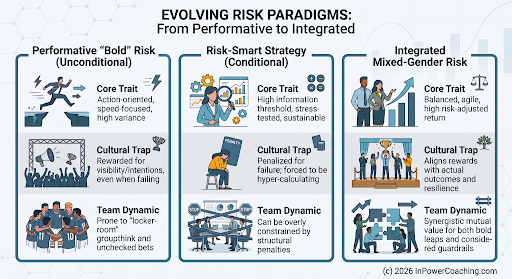
Effective risk-taking in leadership is not about reckless gambles; it is defined by “risk-smart” strategic depth, where high information thresholds and long-term sustainability drive decisions.
When granted the managerial discretion to act, female executives prove highly capable of bold leaps, and their risk-smart approach consistently generates superior financial stability and returns. So why do our “guts” tell us women aren’t effective risk takers?
The stereotype about women being more conservative in their risk-taking is not completely unfounded, and for good reason. Women experience different incentives and penalties when it comes to risk. Women evaluate risk differently because they operate in a world where the physical and social consequences of risk are demonstrably higher. They’re also more likely to pay a higher price for failure in their career than men do when they take bold risks. This double standard (which researchers call the “Gender Criteria Gap”) rewards men for their perceived intentions–even if the risks they took generated suboptimal outcomes–while women are not given the benefit of the doubt for their intentions and rewarded only for their outcomes. Since women are judged more strictly, of course they’re going to be more careful in taking risks.
In this sense, women’s cautious risk-taking in work and life is a survival skill. Because women face steeper penalties for failure, success requires them to master ‘risk-smart’ methodologies—and ironically, this forced precision is exactly what modern businesses need.
This precision gives us a twofer: smart risk-taking is a survival skill for the business as much as it is for the women themselves. Considered risk-taking generates 5.5% lower debt, 2.3% lower revenue volatility, and an 11% greater chance of business success. Why do businesses do better when women run the risk scenarios? Because men tend to let their overconfidence erode margins (e.g., trading 45% more often, which drives up transaction fees) and women’s patience and rigor in placing their bets can drive up returns (e.g., mixed gender boards led firms achieving 18.9% higher cumulative returns than mostly-male boards).
None of this means women never take bold risks, even when physical safety is on the line. Remember that the vast majority of risk-taking behaviors are shared between genders. While fewer women pursue extreme-risk endeavors, those who do feel the same psychological drive for adrenaline and physical danger that men do.
Overconfidence bias: does being “bold” pay off?
The short answer: it works less often than the headlines suggest.
Of course, the stereotype of successful risk-taking in business belongs to men. Specifically, it belongs to men who follow an “ends justify the means” approach to risky decision-making; rewarding loud, visible risk-taking while ignoring the severe direct and organizational costs of overconfidence. For every bold risk-taker whose name you know, there are countless men whose names you don’t—men who failed more often than they succeeded.
Testosterone is strongly linked to this kind of bold-but-ineffective risk-taking behavior. Male stock traders (marked with lower testosterone proxies) who dial down the boldness tend to outperform their peers. The bold risk takers, who do not exhibit the smart risk-taking skills frequently modeled by women (but are marked with higher testosterone proxies), take on more operational and downside risk (e.g., more likely to blow up, more violations, bigger drawdowns). They’re also more prone to behavioral traps like holding losing trades too long and chasing lottery-ticket bets, and they mismanage the balance between illiquid assets and investor cash needs, forcing fire sales with low returns. This behavior is consistent across male populations in both hedge fund management and mutual funds, making it less likely a fluke of professional focus.
So why do we see so many movies and headlines lauding these bold-but-failure-prone male risk-takers? Basically, they’re better marketers. They convince more investors to part with their money and make more transaction fees for themselves. They generate lower returns more often, but celebrate their fewer wins more loudly. Because men tend to be rewarded for intention (see above), their previous failures are more often forgiven. Put a bunch of men at the top of a company who all achieved personal success with such strategies, and self-reinforcing groupthink will lead them to believe the success they do enjoy is the most they could enjoy. But the research would indicate otherwise: invest in more diversified risk-taking strategies, and more success is possible.
Calculated risk is a skill you can practice—for yourself and your team
Navigating the system of double standards–as a woman or a man–can feel like navigating terrain nobody mapped for you. There are no end of mentors and bosses who will advise you to lean into the risk profile they personally favor, which may or may not suit you and your particular business challenges. So navigating risky territory rife with stereotypes becomes a tough road, but it’s also a great opportunity to master risk-taking in leadership for yourself and your team.
The truth is that to succeed, you need both the ability to evaluate and champion risk. You need smart risk-taking ability and the boldness that helps build others’ confidence in the risks you want to take (especially if it’s with their money).
As a woman or a man, this probably means moving into your stretch zone a bit:
• If you tend to overthink risk, get bolder. Learn to query your gut and build your own confidence before you’ve analyzed the decision to death.
• If you’re already a bolder risk-taker, slow down and think things through. Be patient, and wait to choose the right risks more often.
Here’s another strategy: don’t make it all about you. This is where the real win-win lives, and it is the reason mixed-gender teams outperform:
• Empower your teams to take risks by leveraging the talents and preferences of their team members, instead of imposing your own risk profile on them.
• Be intentional about mixing genders on the team. It mitigates the pull toward stereotype and groupthink, and it puts both risk styles in the room at the same time along with many other complementary talents.
• Reward people for thinking a risk through, and for being willing to make big bets where they’re warranted.
We Need New Stereotypes About Gender and Risk
The basic takeaway here is to stop letting stereotypes determine your understanding of how to succeed when it comes to risk-taking in leadership (or any other part of life). Business and life are inherently risky, so examine your own relationship with risk and move into your stretch zone, as a in your personal and professional lives. Learn to balance your own proclivities with the opposite tendency. Learn to judge others with different risk profiles less harshly. Learn to work with them to find risks most likely to pay off and choose them together.
That is the win-win the data keeps pointing at; the boldness that builds other people’s confidence and the rigor that protects the downside are both available to you. Neither one belongs to a gender. You get them by practicing the one you’re weaker at, and by participating on teams where both are already in the room. Examine your relationship with risk. Move into your stretch zone. Mix your teams on purpose. Then choose your big bets together.
More resources for women: I wrote a Substack article for women to put the complications of risk-taking in a female body into context.
Frequently Asked Questions
Common questions about risk-taking in leadership and the gender stereotypes that shape it:
Q: Are there gender differences in risk-taking in leadership?
A: Empirical data shows that 95% of risk -taking behaviors overlap between men and women. The primary difference lies in how risk is approached: men are more prone to overconfident, high-frequency, and sometimes performative risks, whereas women tend to be “conditional” risk-takers who require higher information thresholds but achieve better long-term organizational survival rates and lower volatility.
Q: Why does a double standard exist for women and risk-taking in leadership?
A: This double standard is driven by the “Gender Criteria Gap”. Evaluators judge women strictly on their tangible outcomes, fully exposing them to luck and outcome risk. Conversely, male leaders are frequently rewarded with discretionary bonuses based on their “bold intentions” or “potential,” even when their actual risk-taking results in failure.
Q: How can leaders practice risk-taking as a skill?
A: Leaders can build risk efficacy by finding the edge of their “stretch zone”—actively balancing rigorous, considered risk preparation with daring, decisive action. Organizations can support this by creating mixed-gender risk teams to eliminate overconfidence biases, ensuring equal access to information, and structuring evaluations to judge the long-term quality of a risk rather than performative optics.
You made it! Now what? Multiply your impact and not your stress.
FREE Executive Coach consultation with Dana Theus