Women have always been great leaders. We just don’t talk or hear about them.
Sometimes I’ll read articles about why women should be leaders, as if we need an argument upon argument to support women’s leadership. I have noticed that some of these articles focus on stereotypes – women’s personality traits, management styles, and differences. It’s almost as if male leaders and traits are portrayed as “bad” and female leaders are “good.” That’s troubling.
Stereotypes, although positive, are still stereotypes. Leaders should be evaluated as individuals.
Rather than prove why women make great leaders, I’d rather show how women have always been successful leaders by looking at their track records in three areas:
History
Motherhood
Women business leaders
History
Men and women were considered equals in early Egyptian dynasties as well as Japan, China, India, Africa, and the Americas. In some cultures, laws (religious and secular) controlled women’s behaviors, mainly for inheritance and lineage.
If women were able to own land and trade like men, there may have been more women leaders than we know. Some may have been written out of history.
Here are a few we remember:
Hatshepsut – her tomb was discovered recently, her body hidden from its original location. She was a woman pharaoh erased from history. It is not clear why and it is unfair to assume it was simply because she was a woman; there is no proof. We do know that, “she reigned peaceably, building temples and monuments, resulting in the flourish of Egypt.” She is considered to be one the most successful pharaohs.
Artemisia I of Caria – In addition to being a queen of Carians (Turkey), Artemisia fought as an ally of Xerxes I, King of Persia, against the free Greek city states during the second Persian invasion of Greece (yes, she was the warrior leader in the the movie 300: Rise of an Empire). There are mixed reviews of her accomplishments:
Herodotus praised her decisiveness and intelligence and emphasized her influence on Xerxes
The Trung Sisters of Vietnam are celebrated by the Vietnamese for their attempts to halt Chinese domination in Vietnam. They were the daughters of a general, trained in the martial arts. They led a number of campaigns to remove the Han Chinese from Nanyue, and managed to resist additional attacks for 3 years. They were eventually defeated.
These are a handful of women leaders that we can find in history and we don’t always learn about in school. How many other women leaders are missing?
Motherhood
“The mother is a school; if she is well reared, you are sure to build a nation.”
Mothers are leaders. Many women and mothers don’t realize the power and influence they have (neither does society); mothers could influence and change the minds of a generation.
I think we have a tendency to discount motherhood. In our society today we are focused on achievements that are earned and you don’t necessarily earn a child. Being a mother is a biological result, but being a good mother is work.
Mothers at home are, by definition, unproductive, even though by educating and socializing their children, they contribute to the human capital that is critical to economic growth. And because their work isn’t quantified, they disappear from pictures of the economy that are drawn with the data.
–Paul Starr, Women’s Work, New York Time Review of Books
We sometimes dismiss what mothers will do for their children as to-do list activities, rather than see a woman’s larger strategy for leading and teaching. There is a LinkedIn piece by Jas Singh, How Mothers Make Great Leaders. He identifies 4 leadership traits he believes mothers exhibit – being giving, handling pressure, efficiency, and empathy.
There is an additional trait to add – the ability to create opportunities for others to shine and realize their potential.
My mother helped me with homework, taught me ethics and values, was a Girl Scout troop leader, drove me to lessons and appointments. That may sound like a long to-do list, but her motivation was to make sure I had as many opportunities as possible available to realize my potential. She didn’t want me to ignore my dreams and goals, thinking that they weren’t possible. She believed anything was possible.
That’s something great leaders do.
Women business leaders
Profits reflect great leadership. How leaders encourage their organization to earn revenue can vary (watch proof from Jim Tamm’s TED talk about cultivating collaboration, which men and women nurture). Rather than discussing leadership stereotypes or styles, let’s just focus on bottom line results:
“All the cash in the last two quarters is coming from companies run by women…I don’t have a single company run by a man right now that’s outperformed the ones run by women.”
Quantopian, a Boston-based trading platform based on crowdsourced algorithms, pitted the performance of Fortune 1000 companies that had women CEOs between 2002 and 2014 against the S&P 500’s performance during that same period. The comparison showed that the 80 women CEOs during those 12 years produced equity returns 226% better than the S&P 500.
With results like these, how can there be a debate about a woman’s ability to lead businesses? Why don’t we hear about these types of results more often? How someone achieves results is different than knowing what has been achieved. And women are achieving.
Women Have Always Been Great Leaders. Why Do We Need to Prove It? – Click To Tweet
Great leaders come from driven individuals – men and women. Rather than comparing the two and proving that women can be great leaders because of their traits or differences, why don’t we look at what women have achieved – historically, as mothers, and in business.
Ever found yourself wondering about the effectiveness of your goals and how they align with your overarching life ambitions? ‘Intentions vs goals’ is not a competition. Both are important to your overall success, but most of us pay way too much attention to goals and not enough to intentions. Both have distinct roles in shaping our path to personal success. Intentions embody our inherent values and guide our actions, while goals are the specific targets we set to measure progress. Intentions galvanize our intuition and goals focus our minds on what we want to achieve. We need both to manage the overwhelm and noise of modern life.
Key Takeaways
Intentions offer a limitless vision and emotional compass, informing our instincts, guiding our actions and infusing motivation, while goals provide specific, tangible targets to achieve and feel successful in the present moment.
Excessive focus on goals can lead to diminished motivation post-achievement and create blindspots to important aspects of success that don’t fit neatly into checkboxes.
Integrating intentions and goals fosters balance and overall well-being.
Daily reflection and mindfulness in introducing and adhering to intentions, combined with setting measurable goals, can create an impactful, aligned approach towards authentic personal and business success.
Understanding Intentions and Goals: The Key Differences
At first glance, intentions and goals might seem like two sides of the same coin, but they serve different purposes in our journey toward success. Intentions are broad visions of success and embody our determination and emotional connection to act in alignment with our values and vision without necessarily requiring a detailed plan or concrete outcome. They are limitless and touch various aspects of our lives, providing a powerful source of motivation and accountability from within.
On the other hand, set goals are specific, future-oriented milestones that keep us focused on achievement. They are often influenced by external factors such as responsibility and common sense. While goals give us clear targets to aim for, intentions provide the emotional and moral compass that guides us through the process, helping us set priorities for how we spend our time and energy along the way. Together, they form a dynamic duo that keeps us both focused and inspired.
The Role of Emotional Energy in Intentions and Goals
Emotional energy plays a pivotal role in setting intentions. It aligns our actions with our broader life purpose and priorities, creating a positive impact on our overall well-being. When we set intentions, we shift our focus from merely achieving outcomes to enjoying the journey and setting our priorities to help manage and preserve the energy we need to show up as our best selves. This mindset shift can significantly enhance our sense of fulfillment and happiness.
Moreover, voicing our intentions allows us to:
Concentrate on desired feelings and outcomes
Empower ourselves to take control of our emotional state
Increase our physical energy, making it easier to carry out daily actions that align with our values and goals
Focus on our inner desires which we control more often (intrinsic motivation) rather than external achievements (extrinsic motivation)
Pave the way for personal growth and a more meaningful life
The Importance of Being Fully Present
Being fully present in the moment is crucial for both setting intentions and achieving goals. Regularly setting intentions and being mindful in each moment leads to a more mindful way of living, aligning our decisions and actions with our desired path.
This deeper engagement in daily interactions encourages mindfulness and helps us stay focused on what truly matters, ultimately enhancing our personal success and our connection to the physical one.
The Downside of Goal Setting: Why It’s Not Enough
While goal setting is essential for achieving specific milestones, an overemphasis on goals can have its downsides. One major drawback is the potential for a decrease in motivation and happiness after achieving a goal, often due to a drop in dopamine levels. This can lead to a reduced sense of fulfillment, leaving us feeling empty despite our accomplishments. It’s important to consider the possible outcome of this scenario when focusing on goal setting.
Moreover, focusing solely on big goals can strip away the emotional links between our sense of worth and our specific achievement. This narrow focus can result in inattentional blindness, causing us to neglect other important areas of life that are not directly tied to our goals.
Additionally, goals often become competitive, putting more emphasis on ensuring we win while others lose. A culture centered on competitive goal setting can undermine collective effort and empathy, harming both individual well-being and organizational harmony.
Overcoming the Limitations of Goal Setting
To overcome the limitations of goal setting, it’s essential to reframe failure as a stepping stone to learning and personal growth toward a motivational and meaningful intention. This mindset shift can help us view setbacks as opportunities rather than obstacles. Building a support network of friends, family, mentors, or peers is also crucial, as they provide encouragement and accountability, helping us stay on track with our goals.
Another effective strategy is to focus on personal growth and progress rather than solely on external achievements. By celebrating small wins and acknowledging our efforts, we can maintain motivation and continue striving towards our goals without feeling overwhelmed by the finish line. This balanced approach ensures that we remain dedicated to our personal goals while also enjoying the journey.
Combining Intentions and Goals for Personal Success
Combining intentions and goals can lead to a more holistic approach to personal and business success. By aligning our intentions with measurable goals, we create a guiding philosophy that keeps us focused and grounded. As we manage our time, energy, and priorities towards specific goals, intentions help us make hard decisions about how to use our limited resources. Intentions act as our North Star, helping us see when the pursuit of our short-term goals is taking us off track of our longer-term success path. For instance, a one-word intention that keeps us continually focused on our ultimate goal can inspire decision-making and keep our actions aligned with our values and desired achievements.
Writing down our intentions makes them more tangible and reinforces our commitment. Techniques such as using a vision board and visualization during meditation can serve as daily visual inspiration and increase our emotional connection to the goals that align more strongly with that longer term vision of success. This integrated approach helps prioritize what truly matters and aligns our daily activities with our personal values.
Practical Steps to Integrate Intentions and Goals
Integrating intentions and goals into our daily lives requires reflection and mindfulness.
Start by reflecting on your personal values and writing down specific intention that excites you and bring your energy up when you imagine them coming true. Find a way to anchor this intention in a word, phrase, image, sound, movement or anything that embodies the good feeling you get when you imagine having achieved this intention. Practice using this anchor to bring you back to that good feeling several times every day, just for the fun of feeling so good, and reminding you where you’re going. This is like glancing up at the North Star when you’re traveling tricky territory trying to get north. When you do this regularly, you’ll find yourself feeling successful much more often, regardless of what you’re actually doing and which goals you’ve actually met!
Revise your goals list to align them more directly with your intentions.
Attach new actions to existing habits that align you more with your intentions.
Use journaling to understand how your intentions guide and influence your daily decisions, priorities, accomplishments, and goals.
Revisit, reflect and adjust both your goals and intentions on a regular basis, ideally weekly, monthly, quarterly and annually.
Employing mindfulness techniques can reduce distractions and keep you focused on your intentions throughout the day. Take walks or engage in physical activities as moments of reflection on your goals, and celebrate small wins to maintain motivation and progress towards your goals. This balanced approach ensures that you remain dedicated to your personal goals while also enjoying the journey.
Examples of Personal and Group Intentions
Personal and group intentions provide flexibility and alignment in achieving success. For example, you might have a goal to leave the office every day by 6 pm to spend time with your family. However, if business intervenes, this goal can lead to guilt and frustration. Instead, having the intention to spend as much quality time with your family as possible gives you the flexibility to handle work problems in different ways, on different days, leaving work at different times to balance your work and family goals. When you let the intentions guide you, spending more quality time with your family, you can leave the office early one day and late the next without guilt, allowing you to achieve success on your own terms.
Group intentions work similarly in aligning organizational dynamics. A goal to get customer feedback can be achieved, but it might not provide actionable insights. A broader intention to build good relationships with customers to maximize retention helps you act on feedback immediately and see more opportunities for improvement. This shift in focus from mere data collection to relationship-building fosters a more holistic approach to success.
Intention Phrases: A Powerful Tool for Alignment and Growth
Intention phrases act as a personal motto, providing focus and direction over time. They serve as a compass or North Star, guiding decisions and offering support during challenging times. By defining your intention phrase, you create a mentally and emotionally meaningful point of reference that helps you stay aligned with your values and goals.
These phrases can be particularly powerful in moments of doubt or difficulty. When faced with challenges, an intention phrase can bring you back to that embodied alignment of your core beliefs and aspirations, helping you navigate through tough times with resilience and clarity. In turn, raises your ability to overcome obstacles and stay focused on your goals.
How to Choose Your Intention Phrase
Choosing an intention phrase involves an intuitive and thoughtful process of reflection and brainstorming. Start by reflecting on your personal values and aspirations to identify words that resonate with you. Brainstorm a list of potential words, striving for simplicity and clarity.
Start by trusting your instincts to choose a word that deeply aligns with your personal values and goals. Words like:
‘growth’
‘joy’
‘balance’
‘courage’
‘mindfulness’
can serve as powerful guides for personal development and happiness in the year ahead. Your chosen word may be enough to act as a source of inspiration throughout the year.
Next, imagine yourself living in complete alignment with this value, having achieved the most meaningful success you can imagine. Notice what you’re doing, thinking, and believing when this is true. Write that down and develop a short phrase, image, or other mnemonic that brings you back to this amazing feeling state.
Now you’ve got your intention! Write it down, draw it or otherwise capture it for future reference.
The Science of Intentions and Goals
Scientific research supports the effectiveness of combining intentions and goals. Studies by Peter M. Gollwitzer show that strong goals can lead to significant changes in behavior, especially when supported by intentions. Intentions positively impact individual well-being, partly due to their influence on our inner state and emotional state.
Intentions make you work out of both sides of your brain. – Click To Tweet
Research by Elliot and McGregor highlights the benefits of different types of goals, such as mastery-approach and performance-approach, in various contexts. Locke and Latham’s theory of goal-directed action emphasizes the importance of self-generation, value-significance, and goal-causation in achieving success. These insights underscore the importance of a balanced approach that integrates both intentions and goals.
Tips for Setting Effective Intentions and Goals
Setting effective intentions and goals involves regular practice, reflection, and specificity. Practice your daily intentions regularly to integrate them into your life and make them automatic over time. Set intentions in the morning to ground your day, or connect them with established habits for better adherence.
Break tasks into smaller, manageable steps to avoid procrastination and stay on track with your goals. Writing down your intentions and keeping them visible can constantly remind you of your commitments. Also, checking off steps towards your goals gives you an ongoing sense of success. Completing tasks becomes easier when you share your intentions with trusted friends and make it visible in your environment, deepening your engagement with it and showing others how they can support you in achieving them.
Focus on your breath, which helps to center your mind and set intentions more effectively
Connect deeply with your intentions and remain grounded
Mindfulness practices like meditation play a vital role in connecting deeply with your intentions and remaining grounded. Mindfulness helps you train your brain to focus on what is in front of you without draining your energy into worry about things outside your control, especially those in the past or the future.
Setting intentions right after meditation when your mind is clear can strengthen your commitment and enhance present-moment awareness. Post-meditation journaling about your experiences and emerging insights can deepen your understanding and commitment to your intentions. This practice aligns your daily actions with your personal values and purpose, making it an integral part of your routine.
Summary
Understanding the difference between intentions and goals and learning how to effectively combine them can transform your approach to personal and business success. Intentions provide the emotional and moral compass that guides us, while goals give us clear targets to aim for. Together, they create a balanced approach that keeps us focused and inspired.
By integrating intentions and goals into your daily life, you can achieve a fulfilling and successful year ahead. Remember, the journey is just as important as the destination. Set your intentions, align them with your goals, and enjoy the process of becoming the best version of yourself.
Frequently Asked Questions
What is the main difference between intentions and goals?
The main difference between intentions and goals is that intentions are broad visions aligned with personal values and purpose, while goals are specific, future-oriented milestones. You need both short-term focused goals and long-term focused intentions to navigate your way to success.
How can emotional energy impact goal setting?
Emotions are a major source of personal energy, which strongly affect our sense of success. Emotionally meaningful intentions positively impact goal setting by aligning actions with our broader life purpose, providing motivation and underpinning overall well-being.
Why is being fully present important in achieving goals?
Being fully present is important in achieving goals because it encourages mindfulness, helping you stay focused on your priorities and aligning your actions with your desired path on a moment-by-moment basis. This will lead to better decision-making and increased productivity.
What are some practical steps to integrate intentions and goals?
By reflecting on your values, setting specific intentions, attaching new actions to existing habits, and using daily mindfulness techniques, you can integrate your intentions and goals effectively. These practical steps will help align your goal-focused actions with your intention-focused aspirations.
How can intention phrases help in personal growth?
Intention phrases can serve as a personal motto, offering focus and direction, and aiding decision-making in difficult situations. Embracing them will aid in personal growth. Reflecting on them and revising them will help you move to ever-more-meaningful versions of your best self.
FREE EBOOK
Coaching Tips: How to Avoid the Most Common Career Mistakes
As a technology and marketing professional, an executive coach and a human recovering from trauma, I have studied change ever since I can remember. In fact, change and transformation have become my personal way of life and nothing gives me more pleasure than helping others learn to walk this path without the shock and confusion that usually accompanies significant transitions in our lives and work. As I’ve begun systematizing processes to help individuals, teams and cultures master the process of change, I’ve come to a major realization: modern change management theory is based on a model of destruction, whereas the change management theory that I have found actually works for individuals and organizations is based on a model of creation.
It’s a well-documented fact that we fail at organizational change far more often than we succeed. This is too bad since change spews at us from the future faster every year. Our habit of change failure has been the norm for decades, and the most common culprit of change failure is attributed to “resistance to change,” which most leaders assume is both inevitable and undesirable.
Change Management Theory 1: Resistance Warps an Otherwise Simple Process
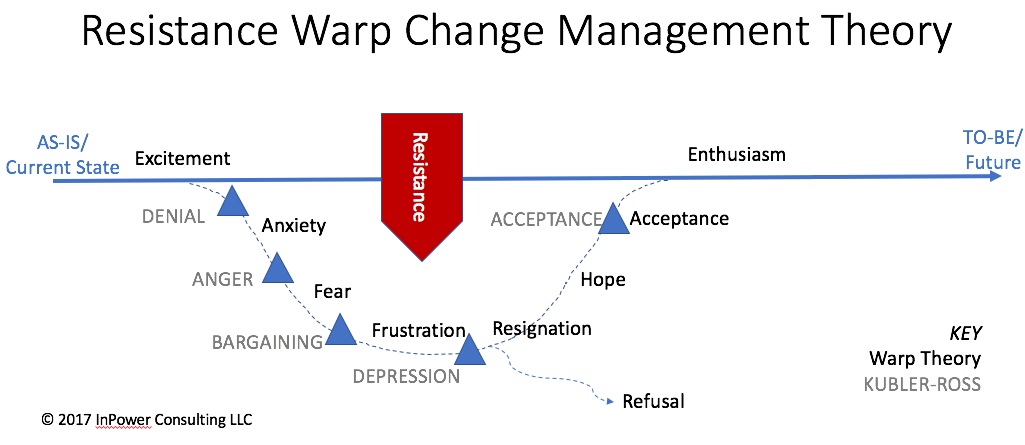
Resistance has been vilified as the enemy of change ever since change management theorists sought to explain its ability to throw a curve into the theoretically linear process of change. The most popular way resistance is theorized to affect the change process comes from an adaptation of Dr. Elizabeth Kubler-Ross’s theory of grief, published in her 1969 book On Death and Dying. Dr. Kubler-Ross’ big idea was that grief at facing loss (i.e., the As-Is/current state of things) was a natural human process following predictable stages: Denial, Anger, Bargaining, Depression and, ultimately, Acceptance. The “stages of grief” model of change has since been popularized in models like the one below, wherein resistance warps the linear process of change, if it doesn’t completely run it off its rails.
When humans express discomfort and resistance, this popular theory holds that they reach a turning point when they reach bottom, and a high point when they accept the inevitable and finally get with the program. Once they’re on the bandwagon, the ditch in the road has been successfully traversed, then the linear process of change may proceed efficiently and uninterrupted. If the change doesn’t stick, this theory posits that people never really accepted the inevitable and refused to participate.
Reframing Change Management Theory as an Act of Creation – Click To Tweet
This warp theory of change reflects a simplistic view of people and resistance. All resistance is not generated by grieving something that will soon be lost. Many people welcome change which brings with it relief from problems and frustrations they experience in the current state. Even where people do grieve a loss of something they appreciate, that loss may be accepted only to be replaced by resistance generated by other emotions and responses as complex as confusion, resentment, or knowledge and perspectives that diverge from the leaders’.
This simplistic, warped approach emphasizes the process of loss and acceptance by focusing on the fact that the As-Is will be destroyed. It posits change as initiated by those above and “done to people” at the bottom. It is a model based on loss created to spur empathy in change leaders at the top, by encouraging them to see followers at the bottom as helpless casualties. It generates negative energy and passive participants.
Change Management Theory 2: Change as an Act of Creation for Everyone
Focusing on the ways resistance drives an otherwise simple process off track is like looking at a seed bursting into a flower and grieving the loss of what has become a lifeless husk. Yes, change requires that old things be discarded, and maybe even grieved, but the new creation is much more interesting. Why don’t more people naturally focus on the act of creation when change is afoot in an organization?
I think the answer to this question is that the creative process of change is too often reserved for a few people, usually at the top of an organization, to engage in privately. These people get to explore the future proactively, influence it in the choices they make about how it will come about and adapt themselves to the new way of things gradually. When they spring the change on everyone else, they forget that they know more about, and have adjusted more to, the new things than anyone else has had the chance to. When everyone else experiences surprise and resistance, they are shoved aside as fuddy-duddies who don’t like change and are succumbing to the “not invented here” syndromes.
This is not only unfair to the people labelled as resistors, who feel that change is being “done to them,” but potentially lethal to the budding change project. Many of the people offering resistance have important insights to offer and are critical to bring on board for the change to “stick” in the end. So when resistance is viewed as a contribution to the process, the importance of which can only be understood by exploring it more, inviting those who may resist into the process early on in order tounderstand their resistance builds integrity into the project from the outset. More importantly it allows more people to engage in the creative acts of change, giving them the opportunity to contribute (if not control) and adapt to the future before it arrives.
Many who like to create change shame others for succumbing to resistance because it “wasn’t their idea,” but those same people don’t like it when change is “done to” them any more than the people they are happy to label. It’s human nature to resist change when we’re not part of the process, and while not everyone involved will embrace it just because they play a role in creating change, the chances go way up.
Creating Change Intentionally
The truth is that involving people in creating change is challenging so it seems easier to create it in a small group and then “do it to” everyone else. The problem is that this is a recipe for failure.
So what if you like this reframing of change as creative and participatory? If you want to get started preparing yourself to be a creator of change, no matter where in the organization you sit, you can start by investing in your own emotional intelligence skills.
Learn to detrigger your emotions and thoughts so you can engage in constructive resistance conversations without dragging your own baggage and getting stressed the process. There’s more to it than that, but becoming a student of detriggering is the essential first step in reduced-trauma change.
Learn to become intentional about everything, starting with your daily schedule. One of the keys to successful, creation-based change is focus and intentions are an easy way to focus yourself so you can help others focus as well.
Let me know what you think about this new, and I hope refreshing, approach to change.
Words are powerful communicators of attitudes that can build people up or tear them down. As a leader, your words carry more weight than you realize, and you need to be careful you’re not parroting things that are driving people to leave. Employee turnover is expensive in more ways than one, so when it comes to your language, just don’t go there. Christy does a great job of culling out some of the most egregious violations of this simple concept. Leaders (and would-be leaders), take heed. – InPower Editors
We are all guilty of saying things we regret when we are frustrated, mad or worried but as leaders, it’s imperative to remember your employees are always watching and taking the lead from your words and actions. That random phrase you uttered at the end of the meeting could have left a lasting effect on your team and depending on what was said that impression may not be as positive as you’d like. Part of your job as a leader is to encourage excellent performance and minimize employee turnover. But are there certain phrases or attitudes that a great leader should never say or demonstrate in order to achieve these goals? Here are five red flag phrases that can (or should) cause your employees to worry and possibly leave them dusting off their resume to head to more positive waters.
“That’s not my job”
This phrase is listed first for a reason, it’s one of the biggest problems. Accountability and responsibility are essential traits of any successful employee. Dedication to a job well done, empowerment and initiative are critical to any successful leader. Anyone who ignores needed work because it is not part of their core responsibilities is not a true team player and ultimately not focused on meeting the needs of the organization.
I was once involved in interviewing a new Facilities Manager for a growing organization. During a tour of the building one candidate noticed a piece of trash on the floor, she quietly picked it up and threw it away in the next trash can she saw. She never discussed it, never drew attention to it, she just did it. As a Facilities Manager she would supervise the cleaning staff but it would not be part of her primary responsibilities. As a candidate it definitely wasn’t needed or expected but that one action told us that she was more concerned about getting a job done than about whose job it was. We hired her and she has since been promoted numerous times and now runs the department.
“Do what I say, not what I do”
This one didn’t work on us as kids and definitely doesn’t work on us as adults. Phrases like, actions speak louder than words and leading by example clearly demonstrate why this philosophy doesn’t work but when it comes from the head of your organization it is twice as bad. A leader has to set the tone and culture of an organization. If they arrive at 10 am, leave at 2 pm and take a 2 hour lunch break in between but expect their employees to put in 12 hour days it won’t take long for employees to start doing the same or even worse, losing respect for them as the leader of the organization. Effective leaders make sure they not only talk the talk, but walk the walk. They go one step beyond what they expect others to do so their actions inspire just as much if not more than their words.
“That will never work”
Individuals want to know that their ideas are appreciated, valued and desired. Organizations love to grow their business by capitalizing on “the next big thing”. Combine those two things and you realize that innovative and creative employees lead to successful organizations full of satisfied employees. Individuals will only share their ideas if they believe they will be well received. Brainstorming works best when it’s a safe place to throw out ideas without judgment. If a boss immediately says no to every new concept they will miss out on the one or two that could have revolutionized the business.
“It’s not my fault”
Effective leaders understand that the best way to teach responsibility is to demonstrate it. When problems occur they don’t spend time pointing fingers, they spend time searching for solutions. They also understand that “the buck stops here”. If they hired the team, trained the team, and gave the team their assignments then they are involved in the successes and failures of the team. That doesn’t mean that employees shouldn’t be held accountable and that under-performers should be allowed to continue to underperform but the first order of business is to fix the problem and the next is to work to ensure that same problem doesn’t occur again. Effective leaders focus on the solutions instead of denying any involvement in creating the issue and take just as much responsibility for misses as they have pride in the hits.
“Failure is not an option”
No one likes to fail. No one revels in the idea of messing up but out of failures come lessons that sometimes can’t be learned any other way. In business, we strive to minimize the negative effects of mistakes but we understand that mistakes will happen. Employees who are too afraid to make a decision because of fear of failing can end up not making timely decisions and getting stuck in “analysis paralysis”. Leaders who manage by fear are typically viewed as dictators as opposed to true leaders.
The post-it-note came from a failed attempt at making glue. Michael Jordan failed to make his middle school basketball team. Failure isn’t ideal, but it’s reality and bosses who take that option away miss out on the wonderful innovations, lessons and resilience that failing creates.
It doesn’t matter if you actually say these things or just hold those attitudes (your people can tell!), either way they work against the goals of the organization and risk the possible loss of your company’s most important resource, its human capital. The result? Employee turnover, low moral and unhappiness walking down the halls. How can you eliminate those phrases from your vocabulary and what effects have you seen those phrases cause? Share your stories and thoughts below and let’s learn from each other.
A stereotypical leader is not always “kind,” yet kindness can be one of the most important leadership qualities when it comes to building employee loyalty and motivation. Being kind also doesn’t mean bing a sap. Know the difference to be a great leader. – InPower Editors
Strong leadership and kindness are not mutually exclusive. In fact, they fit together effectively. The most successful leaders treat their team members with kindness. They realize that kindness is motivating.
“Unexpected kindness is the most powerful, least costly, and most underrated agent of human change. – Bob Kerrey ” – Click to Tweet
Motivated team members lead to a winning organizational culture, which leads to people having pride in their work, their team and their company, which leads to outstanding results and superior client service.
In several recent conversations about kindness, people pointed out that what we say and do must be genuine. Yes, definitely. When I say kindness, I do not simply mean making platitudes.
Kindness includes being positive and encouraging. It also includes helping people feel good about themselves. This is a great description of leadership: how we help make someone feel, how we inspire a can do attitude, how we help others gain confidence.
In my work with business leaders, with 360 leadership assessments and developing winning organizational cultures and teamwork, I regularly hear that people want their managers to be honest and make the time to help them learn and succeed. They realize this often means being forthright and leveling with them about areas of professional development. Yet, managers are often too busy to realize their responsibility to give constructive feedback to help their people learn and grow.
It is important to realize that giving constructive feedback, mentoring and coaching our team members and others are also acts of kindness. Everyone wants to do well and be successful. Their learning, growth and success is our responsibility as leaders just as much as it is our team members’ own responsibility.
We can give constructive feedback in a kind manner, letting our people know we genuinely care about them.
Ideally we have these conversations in person, and if we cannot be with them, we pick up the phone and call them.
I recently had a conversation with Emily Clark, a regional marketing manager at Billy Casper Golf. She is a strong natural leader who is all about the team. Emily made an important point: It is important for us as leaders to take the time to reach out to our people when good things happen, not just when something goes wrong.
“We rise by lifting others. – Robert Ingersoll” – Click to Tweet
My invitation this week is to think “kindness” in our work and interactions and to notice the difference we make.
Take charge of your career development to get the job that supports your work and your life. Check out the tools and resources in the InPower Coaching Career Center.
FREE PDF Guide to Women in Leadership
Executive Coach Dana Theus shares her tried and true strategies to help women excel in higher levels of leadership and achieve their executive potential.
For women in leadership perspective is everything. Even though sometimes reading the day’s headlines or encountering the accidental sexist at the water-cooler can make you feel like women aren’t getting ahead in leadership, this little retrospective may give you hope that things for women in leadership are moving in the right direction. Check out our in depth Women in Leadership Guide – InPower Editors
To put help gender balance in perspective, we’ve put together an overview of key moments throughout history that have signaled significant firsts for women in leadership. It also shows what some women achieved over 80 years ago. There’s no good reason why this can’t happen again.
Academics:
Data in the last twenty years shows the general trend of girls outperforming boys in academic achievement in terms of class grades across all subjects and college graduation rates, but boys scoring higher on standardized tests and being better represented in the higher-paying and more prestigious STEM fields (science, technology, engineering, and math).
(Source: Kafir, Krista (April 2007). “Taking the Boy Crisis in Education Seriously: How School Choice can Boost Achievement Among Boys and Girls.” Independent Women’s Forum.)
In 2005/2006, women earned 62% of Associate’s degrees, 58% of Bachelor’s degrees, 60.0% of Master’s degrees, and 48.9% of Doctorates.
(Source: Nces.ed.gov. Retrieved April 24, 2012.)
In 2016/2017, women are projected to earn 64.2% of Associate’s degrees, 59.9% of Bachelor’s degrees, 62.9% of Master’s degrees, and 55.5% of Doctorates.
(Source: Degrees conferred by degree-granting institutions, by level of degree and sex of student: Selected years, 1869-70 through 2016-17)
In 2007, Harvard University named Drew Gilpin Faust its first woman president in the school’s 371-year history.
Some 38% of women ages 25-32 now hold bachelor’s degrees, compared with 31% of young men. As a result, 49% of employed workers with at least a bachelor’s degree last year were women, up from 36% in 1980. That means more women in higher-skilled, higher-paying positions.
The current ratio of hourly earnings for young women to young men, now at 93%, is up from 67% in 1980 and is the highest in government records dating back to at least 1979. Across all age groups, the median hourly wage for women last year was 84% as much as men – $14.90 vs. $17.79, up from 64% in 1980.
At the same time, the Pew study indicates that a woman’s job advancement often will hit a ceiling, due in part to competing demands of work and family. Women remain twice as likely as men to work part-time and are more likely to take significant time off from employment during their lives to care for children or other family members.
Among young women, 59% say that being a working parent makes it harder to advance in a job or career, compared with just 19% of young men. Across all age groups, 22% of women and 9% of men report having quit jobs for family reasons at some point during their working lives.
Source: The Pew study was based on interviews with 2,002 adults by cellphone or landline from Oct. 7-27. The Pew poll has a margin of error of plus or minus 2.7 percentage points.
Government:
Frances Perkins becomes the first female member of a Presidential cabinet in 1933. Perkins, a sociologist and Progressive reformer in New York, served as Franklin D. Roosevelt’s Secretary of Labor. She kept her job until 1945. In 2014, three women in leadership positions serve on the President’s Cabinet:
Department of the Interior Secretary Sally Jewell
Department of Health and Human Services Secretary Kathleen Sebelius
Department of Commerce Secretary Penny Pritzker
President Ronald Reagan nominates Sandra Day O’Connor to be the first woman on the Supreme Court, 1981. On August 7, 2010, Justice Elena Kagan became the 112th justice to serve on the Court. In all, four women have served on the Supreme Court.
In 1997, Madeleine K. Albright was sworn in as the United States’ 64th Secretary of State. She was the first woman to hold that job, which made her the highest-ranking woman in the federal government’s history. In 2004, Condoleezza Rice became the second woman–and first African-American woman to hold the job. Five years later, in January 2009, the former Senator (and First Lady) Hillary Rodham Clinton became the third female Secretary of State. There have been a total of sixty-eight Secretaries of State.
In 1916, Jeannette Rankin, of Montana, is the first woman to be elected to the U.S. House of Representatives.
In 1922, he first woman to serve in the U.S. Senate was Rebecca Latimer Felton of Georgia. Sworn in on November 21, 1922, the 87-year-old’s term in office lasted only one day. The wife of former U.S. Representative William Henry Felton, she had a background in politics and civic affairs.
In 1933, Hattie Wyatt Caraway, of Arkansas, becomes the first woman elected to the U.S. Senate.
In 1925, Nellie Tayloe Ross becomes the first woman to serve as governor of a state, in Wyoming. In the fall of 1924 she was elected to succeed her deceased husband, William Bradford Ross. (Miriam Amanda “Ma” Ferguson is inaugurated governor of Texas days later.)
In 1984, Geraldine Ferraro is the first woman to run for vice-president on a major party ticket.
2007: Nancy Pelosi (D-Calif.) becomes the first woman Speaker of the House of Representatives.
Currently there are ninety women in Congress. Seventy-three are serving in the House of Representatives and seventeen are in the Senate. Out of all the women that have ever been elected to Congress, 32.5 percent, or approximately one-third, are in office today.
2008: Hillary Clinton wins the New Hampshire Democratic presidential primary, becoming the first woman in U.S. history to win a presidential primary contest.
2008: Sarah Palin, governor of Alaska, becomes the first woman to run for vice president on the Republican ticket.
2005: Angela Merkel, Chancellor, Germany. The world’s most powerful woman is the backbone of the 27-member European Union and carries the fate of the euro on her shoulders. Fresh off a commanding reelection in September 2013, she has served as Chancellor of Germany since 2005; the first woman in the position. (Source: Forbes Magazine)
Business/Executive/Finance:
In 1934, Lettie Pate Whitehead becomes the first American woman to serve as a director of a major corporation, The Coca-Cola Company.
In 1967, Muriel “Mickey” Siebert becomes the first woman to own a seat on the New York Stock Exchange and the first woman to head one of its member firms.
In 1972, Juanita Kreps becomes the first woman director of the New York Stock Exchange. In 1977 she became the first woman appointed Secretary of Commerce.
In January 2014, the Senate confirms Janet Yellen as the chairwoman of the Federal Reserve Board. She is the first woman to hold the position.
Christine Lagarde, IMF chief: The first woman to run the 188-country financial organization has spent much of her first two years on the job battling the debt crisis in Europe and calling for ailing global economies to accelerate steps for stable growth. Her push for debt-sharing between EU nations and an increase in rescue funds has faced resistance from Angela Merkel, chancellor of Germany. French-born Lagarde was a labor and antitrust attorney in the U.S. before a six-year stint as French finance minister; rumor has it she may make a run for the French presidency. Most recently, Lagarde issued a stark warning to the U.S., urging it to raise its congressionally-mandated debt ceiling. (Source: Forbes Magazine)
Cultural:
In 2010, Kathryn Bigelow becomes the first woman ever to win an Academy Award as best director. She claimed the Oscar for her 2009 Iraq War movie The Hurt Locker.
NASA:
Jerrie Cobb is the first woman in the U.S. to undergo astronaut testing. NASA, however, cancels the women’s program in 1963. It is not until 1983 that an American woman gets sent into space.
In 1983, Dr. Sally K. Ride becomes the first American woman to be sent into space.
2007: Dr. Peggy Whitson, an American astronaut, becomes the first woman to command the International Space Station.
NGOs:
Melinda Gates: The Gates Foundation gave away $3.4 billion last year, the vast majority to global health programs, and has made more than $26 billion in grant commitments since the Foundation’s 2000 founding.
Judith Rodin: At the helm of the 100-year-old Rockefeller Foundation for the past 8 years, Judith Rodin oversees leadership programs that tackle a menu of the most pressing global issues, from climate change and health to high-impact micro-investing. The first female president of the philanthropic organization (and first female president of an Ivy League), Rodin is responsible for $171 million in charitable contributions last year.
Margaret Chan, Director-General of World Health Organization: Now in her second term as leader of the World Health Organization, Chan is the most powerful person in global public health and the only person with the authority to call a worldwide pandemic. Her advice on drugs and treatments direct countries battling major diseases and viruses like malaria and HIV/AIDS
Ertharin Cousin, World Food Programme Executive Director: Cousin fed over 97 million people this year. In April 2012 she landed as executive director of the world’s largest humanitarian organization with $3.92 billion in contributions. In her first year on the job Cousin and her staff of 13,000 focused on fighting hunger brought on by drought in West Africa and civil war in Syria. Her agenda for the rest for the year is to transition from food aid to food assistance in an attempt to shift from handouts to self-sustenance. 2013 SPOTLIGHT: Pointed to climate change as a “game changer” that “increases the vulnerability of the hungry poor.”
(Source: Forbes List of 100 Most Powerful Women)
Religion:
Ellen Johnson Sirleaf, Leymah Gbowee, and Takawel Karman, joint recipients of the 2011 Nobel Peace Prize. Each of the Nobel Peace Prize winners this year demonstrated a tireless commitment to peace inspired by their faith. In addition to this joint accolade, each woman is accomplished in her own right.
Ellen Johnson Sirleaf, a committed Methodist, is the president of Liberia and the first female head of state on the African continent.
Leymah Gbowee, a practicing Lutheran, helped lead peaceful protests during Liberia’s second Civil War and has been an important player in the post-war reconciliation process.
Takawei Karman, a Muslim journalist from Yemen, helped organize the 2011 Yemeni uprising, which became part of the larger movement for peace and democracy, dubbed the “Arab Spring.” Coming from countries where religion has historically been used as a tool of persecution and suppression, these women used it as a catalyst for change.
There are a LOT of books out there on women in professional settings. I don’t read them all, or recommend many, though all of them are worth exploring for new ideas and insights. I am recommending that women and men both read The Power Code: More Joy. Less Ego. Maximum Impact for Women (and Everyone).
Here’s why you should read The Power Code
Authors Katty Kay and Claire Shipman have written other good books about confidence, which are worth reading, but in The Power Code they do an excellent job of painting a broad picture of the challenges women have in the workplace while also offering actionable advice. They take a perspective on women and power that is realistic–eyes wide open–and hopeful. They talk to real women who struggle and still find ways to wield power with joy and impact.
And this is the real takeaway of their book, when women see power as an opportunity to bring joy to their own lives and change to the world, they can often be more successful than they ever thought possible.
But Kay and Shipman don’t shy away from the reasons too many women don’t believe they can find joy in power–hard work, pressure on family, too little time to yourself. And they show why many women decide those are worthy prices to pay–satisfaction, pride, a sense of fulfillment in making a difference. They point out that the process of achieving power is harder than of actually having it. And, side comment from me, is that any different for men? I don’t think so.
It’s worth reading about these women who’ve attained power to see what joy looks like for them, and the difference they can make in the world because of it. My personal favorite was the story of Christine Lagarde, currently President of the European Central Bank, who made years of mothering count as relevant management work experience when hiring new employees.
Women, think about this: wielding power in pursuit of your purpose brings you joy. #ThePowerCode #workingwomen #career <=Click to Tweet
The book also weaves a compelling story for how a driving purpose can motivate women to attain and use power to achieve needed change in the world. In short, it makes the case for how wielding power in pursuit of your purpose brings you joy. I wish more women thought this was possible and found ways to achieve it.
Key Concept: The Power To
I highlight the point about joy and purpose above because I don’t think we talk about that enough, but related to this is the idea that power is often misunderstood as domination, or “power over” others.
Many women don’t like to play the power game because they (usually correctly) assume that it’s rigged against them. In a zero sum game where there is only one winner, the one who dominates the other, women are more likely to lose than the men they play with. This is true for several reasons, including the fact that men are more likely to want to win, and women are penalized for wanting to win, the “power over” game. Who wants to play a game you’re destined to lose?
Kay and Shipman point out, and tell stories of, women who explore an alternative model to the “power over” game, which women are more motivated to win and tend to be very good at, which is the “power to” game. Whereas “power over” implies domination and control, “power to” implies empowerment and impact. Women are more likely to seek power to create positive change in the world and while many men are also, our cultural stories about male dominated power and leadership are rife with the opposite, including unhealthy ego and the effort to disadvantage others.
For women who are pursuing, or considering pursuing, power in their lives it’s worth thinking about this concept.
If you want power, why?
What change do you want to create in the world and how can getting to know it intimately ‘power’ you through the challenges it will take to achieve it?
What stories do you tell yourself about how ‘power over’ is the only kind of power that matters, and what becomes possible if you focus your lens on seeking the ‘power to’ make important changes?
What’s Working and What’s Not
The Power Code is also a good overview of many of the dynamics we cover in our own work on Women in Leadership including:
How women and men are both struggling in the current work culture and how “women’s issues” need to be redefined as “people issues”
Biases we have to live with and grow beyond
How “worklife balance” is being replaced by a search for “worklife blend”
The dynamics of home life, and male partners, and how this affects women’s ability to succeed in the office
The reality many men face trying to help women achieve more, and the empathy we need to have for them in this effort
What companies can and should do to effect change
Your Power Code
One of the most powerful aspects of the book is the way each chapter identifies a handful of personal action items we, in our day-to-day lives, can take to turn these dynamics around for ourselves and our families. Here are just a few I personally like, but it’s worth buying the book to review them all. Many are things I teach in coaching and I know they work!
Flip the narrative and get in touch with what changes you would make if you could achieve power, and let that motivate you to go get it
Stamp out fear and lead by example
Find joy in the power you have
Prime yourself for future power by remembering and reflecting on times when you had, and enjoyed, power in the past
Understand all the value you contribute, including emotional labor, and help others value it
Be empathetic with men and help them adjust to women’s power
Show up
Find ways to engage in radical authenticity
As you can see there is a lot of wisdom, data and experience to explore in The Power Code. It’s a good resource for a book club or discussion with family and friends. You’ll find many opportunities to challenge your own thinking when you read it, and to challenge others.
InPower Women’s Mastermind
We don’t Mastermind your business. We Mastermind YOU!
Psychological safety fuels team intelligence: When team members feel safe to share without fear of judgment, everyone contributes, boosting the team’s overall problem-solving and innovation capabilities.
Creating safety is an active leadership role: Leaders can foster psychological safety by practicing non-judgmental listening, engaging in individual conversations, and ensuring clarity around the team’s purpose.
Simple actions yield significant impact: By focusing on how individuals feel within the team dynamic and ensuring everyone understands the shared goals, leaders can cultivate a more productive and psychologically safe environment.
You gotta love Google. Who else would conduct a data study on human soft skills dynamics to teach us what we already know? Ok, maybe we don’t already “know” that psychological safety produces more successful teams, but we each individually know:
we’re more comfortable adding our two cents on the teams where we don’t fear being shamed for offering up our ideas (i.e., psychological safety).
And thus the key finding beneath Google’s research that teams that enforced norms that made people feel psychologically safe:
When teams invite everyone on the team to contribute, team intelligence goes up. – Click To Tweet
Teams aren’t smart because smart people are on them; teams are smart because everyone—no matter how small—contributes and feels comfortable doing so.
Key Criteria for Team Performance
So if you’re working to build a corporate culture where psychological safety runs rampant through team norms and culture, what do you do?
What Google did was inform people and teach managers about how teams operate and gave team managers a tool to poll team members on the five dimensions that make team productivity go up:
Psychological Safety
Dependability
Structure and Clarity
Meaning
Impact
Learning To Create A Safe Team Space
But what if you don’t work at Google? What if you’re on your own for making your team psychologically safe and more productive? Here are several things you can do yourself to make your team more effective, and it will grow you as a leader at the same time.
Listen without judgment
We all judge things; it’s how the human brain is designed. But when people feel judged—particularly by a leader—they tend to shut down and hold their ideas inside. So practice reserving judgement until you’re in private. You don’t have to withhold judgement completely, just withhold it while people are talking and don’t allow others to pile it on. Practice separating the time for listening from the time for judging by some “consideration time” to help you truly open your mind to hearing what people say. When you get good at it you’ll be surprised how much your immediate judgment screened out information that made it hard for you to truly hear what people were saying before. You’ll pick up information and ideas this way and your team will feel more psychologically safe.
Spend time with people one-on-one
It’s easy to look at team-time as time-saving time so you don’t have to deal with all these pesky individuals, but when you take the time to talk to people outside the team context, you can learn what is really bothering them, and why they may not feel safe in the team dynamic. You learn more about what they think and how to “read them” so you can invite them into the team discussion in the right way at the right time. The team dynamic is unique, but understanding how people individually interact with it makes you a better team leader.
Be very clear about team purpose
People don’t now how to offer their best if they don’t understand the group’s purpose. And people forget. You think because you explained it three months ago everyone else remembers as clearly as you do what you’ve come together to do. Don’t assume. Reiterate and—importantly—invite everyone to frequently put the team purpose into their own words (this is when it becomes more real to them.) Having a shared purpose can be magical in the way it naturally brings people together. Got a tough team-member who’s not bought into the purpose? Spend some one-on-one time with them to find out what they have at stake when the group is successful. That will help them align to the group goal in a personally meaningful way.
Break Free from Emotional Triggers
Free eCourse
When you’re emotionally triggered, your reactions to stressful situations (and people) feel out of control. All the stress reduction in the world can’t help you if your emotional triggers are in charge. These 3 lessons will get you back in the driver’s seat.
Can an exercise in “expressive writing” reduce your stress, improve your mood and help you get ahead in your career? The answer is yes.
Before I started coaching, I took a wandering, self-improvement journey. I quickly discovered that I had a secret “inner coach” living in my head who had amazing powers to help me sidestep challenges I thought I’d never overcome. Over time I’ve evolved techniques to tap this vast inner resource to help clients in my coaching practice, in both one-on-one and group formats. The most powerful techniques involve self-administered, worksheet and journal based writing exercises to help people detrigger their emotions, focus on daily productivity, determine how to achieve their career goals and more. What I’ve come to realize is that I couldn’t help people as effectively as I do without helping them tap their own inner coaching instincts through pen-and-paper tools.
While I knew this approach worked, I never fully understood the psychology behind these inner coaching strategies until I happened upon a NY Times article on “expressive writing” that put the pieces together for me and I want to lay it out here, for readers and clients, to try to demystify this particular process of tapping your personal powers more deeply. Once you understand the power of personal writing to unlock your inner self-help guidance, which lives in you 24/7, you have the most important tool you need for success.
What is Expressive Writing?
When I first discovered what the research calls “expressive writing” it was called journaling. I still call it journaling because that makes sense to many people, but not to everyone. Some people think of journaling (or writing a diary) as writing for potential publication, but that’s rarely a good idea if what you’re looking for is personal insight. While a few talented people can publish their diaries to critical acclaim, many more don’t (and thank goodness, in my case!)
The power of personal expressive writing to heal, or journaling to figure stuff out for yourself, is completely different than writing to give other people an experience you want them to have. The latter is creative writing and the former is expressive writing. Creative writing is a show you put on for an external audience. Expressive writing is a 100% internal process, a dialog with yourself. The purpose and power of expressive writing is to make sense of things—for an audience of you–in narrative form, to weave together the story your life. It’s a way of putting yourself and your life in a context that creates coherence between you and your world–inside your head and heart.
What Does Expressive Writing Do For You?
When you’re engaged in expressive writing, you’re reflecting on your memory of events and feelings. You’re giving yourself the opportunity to see things you hadn’t seen clearly in the moment, to connect dots you thought at the time were unrelated, to edit and reorganize your experiences so they are more helpful and healthful to you and your sense of evolving identity.
While it’s tempting to write this off as “making stuff up,” or “fooling yourself,” the truth is that our brains do this anyway. They filter and select information for us constantly so that our reality and identity is always a filter on “what really happened.” This is one reason why reasonable people can perceive the same fact or experience very differently; we apply different filters and make sense of what gets through them in personally unique ways. Using expressive writing to shape your personal reality is simply the process of becoming conscious about which filters you want to apply, choosing the ones that serve you and putting the facts, memories and feelings of your life into a coherent narrative that supports your goals and sense of self.
The Benefits of Expressive Writing
The benefits seem to be widespread. As the NYTimes article states:
“The scientific research on the benefits of so-called expressive writing is surprisingly vast. Studies have shown that writing about oneself and personal experiences can improve mood disorders, help reduce symptoms among cancer patients, improve a person’s health after a heart attack, reduce doctor visits and even boost memory.”
Check out this comprehensive and fascinating podcast on the science and psychology of journaling (August 2026)
The Narrative Benefits of Expressive Writing
Expressive writing is also key to success, because the way it reframes your reality helps you build your identity around your successes instead of the noise (including failures) of everyday life. Again, from the NYTimes:
“In another study, Stanford researchers focused on African-American studentswho were struggling to adjust to college. Some of the students were asked to create an essay or video talking about college life to be seen by future students. The study found that the students who took part in the writing or video received better grades in the ensuing months than those in a control group.”
While this latter example is more of a creative writing exercise, it demonstrates the power of expression to rewrite the narrative in your head from one of struggle to one of success.
There is also power in the act of physically writing, as opposed to typing on a keyboard. Using a pen and paper leverages different cognitive processes than typing. Both have their place, but handwriting and drawing seem to tap into a more creative and integrated physical experience that is useful in the expressive part of expressive writing.
What IS an Inner Coach, And How Can I Get One?
When I come across clients who struggle with the idea of using expressive writing to tap the power of their inner voice more reliably, it can be either the writing or the expressing part they have trouble connecting with.
Challenges With Writing
If the challenge is simply a discomfort with the physical act of writing, then one-on-one dialog with a coach or therapist, talking to oneself on a recording or even group discussions can take the place of writing. Writing imposes a structure that many of these other formats can lack, but the basic dynamic of establishing an inner dialog can-paradoxically-be achieved in any communication format, as long as it gets the ideas out of the echo chamber in your head.
More than the writing, the expressing part holds power because it gives your inner self a true voice. If the voice in your head stays in your head, its voice is diminished. If it gets into the world in any form, it’s power is enhanced. That voice becomes more real to you, and you give it more weight. By expressing it, the voice gains credibility and it’s harder for you to ignore, which is usually a good thing.
Challenges with Expressing
If my client can handle the writing but struggles with the expressing part, that is something else entirely. It’s more normal than you think to not really know what you’re feeling, much less how to express it. Getting to the point where you can reliably identify and know what you think or feel is a process unto itself, and it’s a key to improving your emotional intelligence, which helps you manage yourself and get along with others. This reliable self-awareness requires that you give yourself permission to feel what you feel and know what you know. Writing it out sometimes helps this process too, even if you trash or burn the very paper you wrote on.
If you struggle expressing yourself because you’re not sure what you’re feeling or thinking, the best thing to do is keep trying to express yourself. In the process of trying to find the words, you’ll get closer to the reality. Over time you will figure it out, I promise. This process is messy, but it’s also why doing it by yourself, using the paper in front of you as your “sounding board” is a good idea. If you get it wrong, you haven’t given anyone else the wrong impression, you’ve just shown yourself that you’re still figuring out how you feel, which is the whole point.
Let it Go
Expressive writing may produce something dear to you that you want to keep forever, and it may be the vehicle for things inside you that you want to get rid of. Whether you keep the paper or destroy it doesn’t matter; when you internalize the habit of expressive writing, you will do both as appropriate.
And this is the key to finding your inner coach. When your inner self gains its voice and the dialog with your outer voice becomes smooth and fluid, you will know what is important and what isn’t. You’ll come to understand what you need to act on, and what’s better left alone. Coaches, therapists and good friends can help you fine-tune your perspective and tweak up your filters, but the core process will be yours. And this is as it should be, because in genuine, powerful dialog with yourself you can become whoever you want to be.
I would love to guide you into a true, deep and powerful dialog with yourself for career and leadership success. Learn more about my coaching services and reach out if you believe I can help you!
Break Free from Emotional Triggers
Free eCourse
When you’re emotionally triggered, your reactions to stressful situations (and people) feel out of control. All the stress reduction in the world can’t help you if your emotional triggers are in charge. These 3 lessons will get you back in the driver’s seat.
Leaders are often told to be “humble,” but this can actually work against women who are trying to get into leadership. Why? Not because humility isn’t a virtue, but because some women use it to mask a lack of confidence and virtually disappear as a result. Think of this kind of self-effacement as self-erasement. Don’t do that! – InPower Editors
One of the qualities we admire in leaders is humility…the ability to influence others without bravado or self-involvement. This is a compelling facet of the ‘grace’ side of leadership, because it fosters connection, loyalty and trust.
But humility has a less noble and effective relative – self-effacement. Unlike a humble leader, who conveys a quiet self-respect, the self-effacing leader scoots out from under her own value. She’s the one that negates a compliment by pointing out a shortcoming. She minimizes her accomplishments. She shies away from credit.
I don’t see self-effacement as a skillful stance for women in the workplace. It may be comfortable (for us and for others), but it doesn’t garner respect. It doesn’t influence. It diminishes us and, by extension, the people we lead. When we are self-effacing, we are self-erasing; we become active participants in the process of being overlooked.
But the minute we see the limitations of self-effacement, we’re eye-to-eye with a difficult challenge. How do we stand for ourselves effectively, avoiding being seen in the extremes of ‘doormat’ (too much grace) or ‘bitch’ (too much grit)?
Here are a couple of dos and don’ts that I’ve gleaned from women leaders who have managed to find that sweet spot: communicating self-respect in commanding and connecting way.
When someone compliments your work
Do look him/her in the eye and say ‘thank you.’ Don’t smile coyly, look down, tilt your head or say, “It was nothing.” Don’t tell the person all the things you also did wrong.
Do acknowledge others’ contributions if appropriate. Don’t negate your own contribution. Avoid the instinct to say, “It was all my team.”
When someone indicates that you’re being considered for promotion or plumb assignment
Do consider saying something like, “What an exciting opportunity. Let’s explore it.” Don’t say, “REALLY? You think so?” Try to avoid at all costs the whole Sally Field “You really like me!” thing.
When disagreeing
Do hold the person with whom you disagree with respect. It’s very difficult to influence someone if they know you hold them in disdain. Don’t make nice. As MSNBC news anchor Melissa Harris-Perry once said, “Don’t smile and nod unless you are happy and agree.”
When asking a question
Do raise it by saying “I have a question” or “I’d like to raise an additional perspective.” Don’t start with “I’m sorry” or “I have a stupid question.”
When negotiating salary
Do your homework! Get data. Know what the company or industry pays (men) for your skills and experience. Don’t equate salary numbers with your value as a person. The less personally you can take a negotiation, the more power you’ll have in it.
When managing your career
Research shows that men tend to interview frequently for other jobs – even when they’re satisfied with their present position. Women tend not to interview until they’re miserable.
Do interview for a new job every year or so – both to keep your interview skills sharp and to stay in touch with your current value in the marketplace. Don’t wait to job-hunt until you can’t stand your current job. It puts you in the vulnerable position of needing to jump fast and not knowing know your worth.
Watch your interactions at work over the next couple of weeks. See if you can catch yourself in self-effacing acts. Each time you notice it, jot down what you did (or didn’t do) that was self-effacing.
Later in the day, you can go back and reflect on these moments in more detail.
What internal or external forces caused you to draw upon the strategy of self-effacement? Was it merely habit, or was something else going on?
How did that self-effacing move feel to you? (Comfortable/uncomfortable?)
What effect did that move seem to have on others and on your standing as a full participant in the conversation?
To what degree do you feel that it was self-erasing, i.e. that it sent message that you were somehow of less value than the others?
What’s the cost of that to you? What might the cost be of other people for whose interests you need to advocate?
If you could go back and do that interaction again, what would do differently?
What would it require from you to do it differently?
I’d love to hear about the results of your experiments with self-effacement, self-erasement and anything else that comes up for you reading this!