A question many of my clients are exploring in real time is, “What’s the difference between leadership and management?” The leader vs. manager debate goes back way before my time, but with the advent of AI it’s taking on new twists. Traditionally, the simplest way to think about this distinction has been that:
managers do, and leaders think
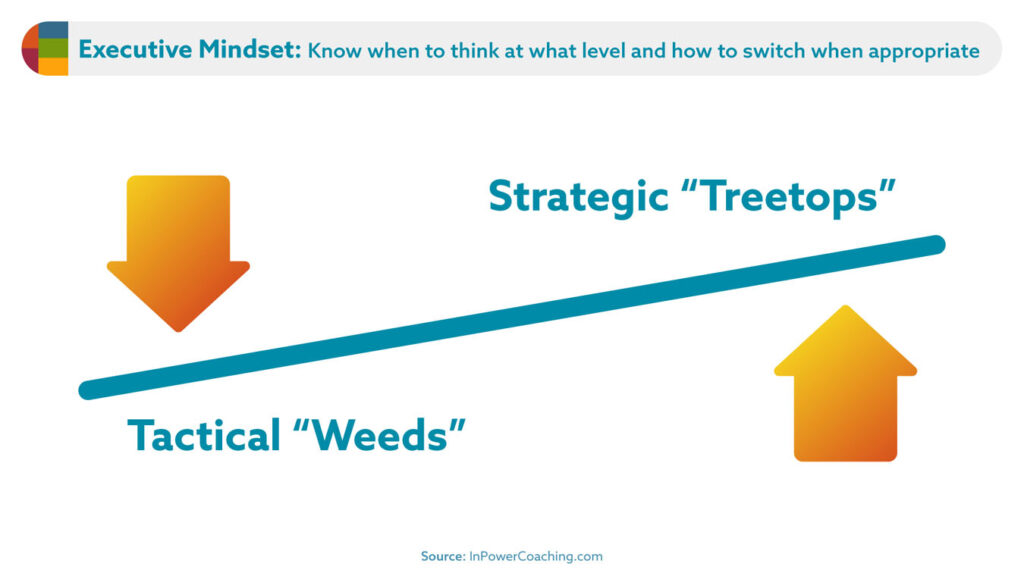
managers focus on the tactical and leaders focus on the strategic
managers get the work done, and leaders decide what work needs to get done
managers transact, and leaders transform.
And while these differences between leadership and management are still largely true in absolute terms, the answer is changing for the human beings who embody these roles.
In short, AI is taking over much of the work managers do: “getting things done.” The good news is that this will give managers more time to be strategic, and leaders will have more strategic allies in management. The bad news is that managers who are not prepared to lead will struggle, and lazy leaders who’ve grown used to performing like souped-up managers, i.e., managing at scale, will be called out more often, and their failures will be quickly apparent.
As the boundary between what human leaders and managers do begins to collapse, both leaders and managers need to update their career planning trajectory, leaning less on how things get done and more on what gets done and why.
The good news: lazy leaders can’t hide, and good leaders will have room to lead
I don’t know a single good leader who wants more busy work. I know plenty of so-so leaders who like to use micromanagement and “too much to do” as an excuse for:
not focusing on the outcome of their work
ignoring strategies that optimize their opportunity
failing to prioritize work for themselves and their team, which keeps everyone in firefighting mode
failing to empower and develop their team members
focusing on the win in front of them instead of the win-wins all around them
I call this lazy leadership. Many leaders who fall into this trap aren’t even good managers because they don’t manage themselves, their team, or their resources very well. One study earlier this year discovered that across 10,000 executives in 25 countries, there was zero overlap between the competencies leaders displayed (e.g., presenting, competing) and those their followers actually want (e.g., effective communication, integrity and decision-making. They’re more likely to be obsessed with appearance and activity instead of team accomplishment. In the months and years ahead, lazy leaders will let themselves be overwhelmed by suboptimal AI output. For a time, they may appear successful, until the lack of results shows their efforts accomplished little more than AI slop at scale.
When routine activities that currently consume so much attention become more successfully automated, managers and leaders will have less to do. That is, unless they step up to the functions of true leadership, stewardship, and strategy:
focusing on developing the what and why of both strategic and tactical goals
actively managing priorities towards high-value outcomes
empowering humans and AI agents appropriately and ethically
developing humans to take the greatest advantage of their human talents and intuition
navigating tricky human interactions and relationships to get decisions made and resources allocated
The best leaders and managers will thrive in this environment, partnering with team members, stakeholders, and AI to create value more quickly and accomplish more earlier in their careers. They’ll be able to bring ideas to fruition faster and keep up with the pace of change upon us.
The bad news: the “missing rungs” of human development, and immediate exposure to the consequences of bad strategy
Of course, climbing the ladder to become a good leader has traditionally resulted from learning to be a good manager earlier in your career. As more work is automated, managers have fewer opportunities to learn the intricacies of how things get done. It’s hard to lead and evolve something you don’t understand. This will make it harder for managers and new leaders to learn the nuances of their business at a level that gives them the instincts to truly lead it. We’re already seeing the beginning of this in the software engineering field, where the disappearance of entry-level coding jobs makes it very hard for junior developers to learn what good code looks like, which is a key skill they need to evaluate AI output and manage the AI agents.
Leaders will find themselves having to step in and more proactively develop, mentor, and coach rising leaders. They’ll have to become experts at empowering them, including letting them make non-fatal mistakes they can learn from. This will take leaders’ time and attention, even as the stakes get higher.
When AI lets us move so fast, humans will have to learn when and how to proactively slow down processes to validate strategy, ensure ethics, and give people the opportunity to learn. With the compressed output time AI offers, the results of poor strategy will become obvious much faster, and the damage may be done before many people realize it. Leaders will find themselves constantly challenged to evaluate success and pivot easily, quickly, and fluidly. Leaders will increasingly weigh the risks of speed against the benefits of prudence.
A case in point: too-fast execution
Here is a scenario only slightly adapted from the real world. Imagine a senior marketing leader giving instructions to their team to produce a new booth for the annual conference that “highlights the newest product.” A traditional approach to this project would include months of iterative design, development, approvals, and vendor contracting, during which the senior leader would have many opportunities to guide mid-level managers toward a refined understanding of what they originally meant by “highlighting” as the process ground on.
In an era not so far away (where the design bids and contracting could be largely delegated to AI agents managed by mid-level leaders with relatively few product launches under their belts), the process could take weeks instead of months. In this scenario, a lack of specificity in the original requirement could be incredibly expensive and embarrassing. In the New World, a poorly defined objective results in immediate delivery of AI slop of the highest order.
Leaders run these risks today, of course. The best leaders are very clear about how the new booth design would be evaluated as a success, and empower their teams to deliver it. They use accountability and iteration to build sound judgment into team members and processes. However, when the process runs longer and less efficiently, many lazier leaders can still achieve success.
The margin for error that iterative processes once granted is about to shrink dramatically. Looking backward from a more AI-automated future, where we used automation to lean into more intentional leadership, we’ll realize that inefficiency was operating as a safety net for weak leadership.
What to do about it: career planning and a focus on 4 strategic skills for the AI-era leader
Leadership has traditionally meant the ability to motivate, inspire, and point the way for team members mired in the doing. At the same time, especially in recent years, “the doing” has become so complicated that it’s eaten much of a leader’s time and energy (and all of a manager’s). This pressure to succumb to overwhelm will continue, but the most successful leaders will become expert at strategizing around it.
From here on, the best leaders will return to the core promises of leadership and ascend not because they’ve mastered the how of things getting done, but because they understand the dynamics of the how. They will also have a good strategic understanding of the environment, make the best judgment calls in responding, and lead others in a way that leverages the power of both human and technical capabilities.
It’s no longer enough just to produce good results; you need to prove that you can derive those good results through strategic acumen. This means you need to find career opportunities that let you develop these skills.
If you’re planning a career as a leader in a world where managers are more strategic, and business moves more quickly, here are four skills to lean into.
Understand the big picture
The biggest career-planning shift in this new world for both leaders and managers will be their ability to open doors to greater authority by demonstrating that they can produce results aligned with the strategy, not just by producing results alone. Getting out of the weeds of the day-to-day work is really hard, even when it’s your full-time job, as it is for senior leaders. Managers in particular need to spend a lot of time in the weeds. More than ever, escalating a career into higher levels of leadership will require allocating more energy to understanding elements of the strategic environment that appear tangential to the necessary weed-whacking. Beyond just reading the company strategy to align their team’s goals, managers and leaders have to be able to explain the strategy in ways that put the weed-whacking in context. They’ll need to push back diplomatically and challenge priorities passed down to them, demonstrating their understanding of the strategic context and learning more about the why to better steward resources. Occasionally, when you’re so plugged into the strategy that you can push back effectively, you’ll be able to contribute greater insight from the front lines so more senior leaders gain an appreciation of what it takes to bring the strategy to life. When this happens, you’ll gain the kind of attention that can open doors to more leadership opportunities.
A key tool for linking big-picture imperatives with tactical weed-whacking is the OKR (Objectives and Key Results) goal-setting and management system, which is used to align organizations and leaders. OKRs strip away low-priority distractions, define what success looks like at key milestones, and coordinate efforts toward outcomes that genuinely move the needle. They are a deceptively simple concept but challenging to implement because they require strategic discipline and constant effort to stay in alignment. With some relief from weed-whacking, both leaders and managers should have greater capacity for making the most out of goal-setting systems like OKRs.
Learn to prompt the humans, not just the machines
It’s ironic that one of the laments of the modern workforce is the extent to which our managers and leaders micromanage people, telling them how to do their jobs instead of giving them empowering clarity on the what and why of the work and leaving workers largely free to determine how the work gets done. The micromanagement tendency is no doubt a leftover of both apprentice and industrial workplace models. Yet AI is training us from the moment we begin using it to empower it with detailed prompts that focus on the conditions for success, leading us to trust it in the execution, which can be more efficient than a human approach. Good AI prompts describe the final state, as well as context and why the work matters. Humans need this too! We’re learning the value of incredibly clear communication through technology prompts. With a little luck, the rapid turnaround of results AI can produce may teach managers and leaders alike to communicate more clearly with people, too. But humans need more than clarity when it comes to leadership. Humans need empowerment.
Empowerment is an art, not a science. Empowerment begins with clarity of meaning: an aligned understanding of what success looks like, how the outcome will be evaluated, and why it matters. Empowerment also requires the limited transfer of authority and clear guardrails on how that authority can be used so that it is not abused. Finally, empowerment requires accountability and leader support for ensuring those who are empowered have everything they need to be successful. Empowering human prompts are different from machine prompts in an important way. For humans to be empowered, we need meaning, personally and more broadly, and focusing on meaning opens up all kinds of benefits. Meaning-making can bring people together in collaboration to improve the what and the why before machine prompts help execute it quickly. Meaning can motivate people to overcome obstacles that might stymie the machine. Understanding the meaning and larger context can also guide humans into ethical pauses that the machines will never take on their own.
Treat managers like teachers instead of students
As Parker J. Palmer put it, “We teach what we most need to learn.” To steward your managers more quickly into strategic thinking, help them see the strategic implications of their work. Expose them to the intricacies of the strategy and hold them accountable for expanding on it to achieve it. Challenge them to critique AI-generated scenarios, use human creativity to think of scenarios the AI can’t imagine, expand the algorithm’s assumptions, and “fail” through low-cost scenarios that lead to better systems.
This expands the empowerment concept and helps them own the results of their AI-powered work. By granting managers limited authority to teach human staff and AI systems ways of achieving strategic goals, leaders can meet their responsibility of developing both humans and AI-backed systems while expanding the capability of both.
Home in on relationships and results
A more disciplined focus on results and outcomes will be critical in an age when AI can overwhelm us with “output,” much of which looks more valuable than it actually is. AI is becoming increasingly skilled at producing stuff. Some of it is valuable; some of it simply appears valuable and turns out to be either error-prone or simply not very insightful when you dig into it. Humans will be the ones to discern the value in both AI- and human-produced output. They will do this based less on how meaningful it appears, and more on how meaningful it actually is in both strategic and human contexts, such as stakeholder relationship development. Knowing when an outcome moves you closer to success and when it sucks up resources for little gain will be the critical role of humans in leadership and management going forward
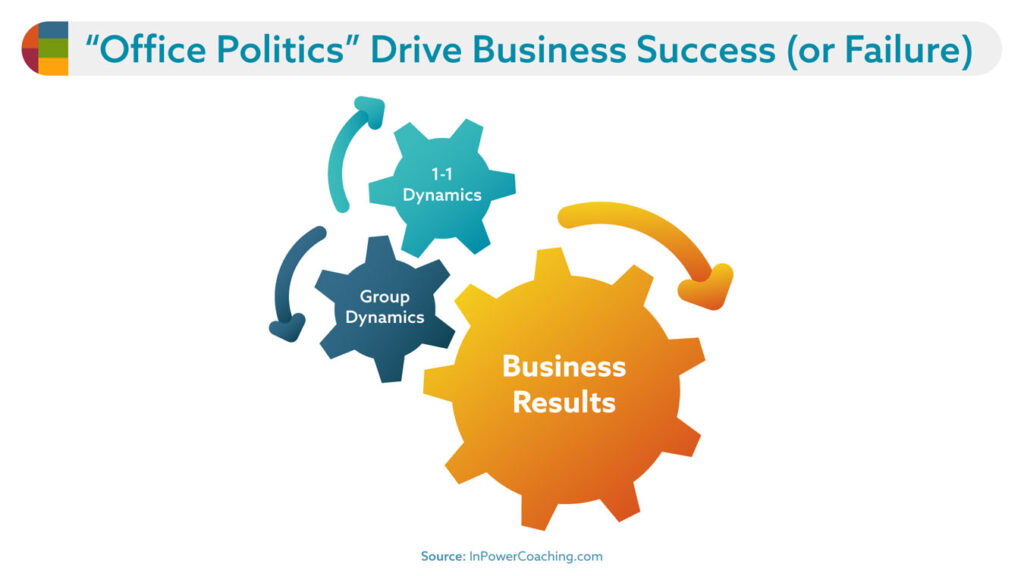
AI will always outpace humans in speed and sheer processing volume, but we still live in a human economy. Humans have personal agendas; they make decisions on qualitative grounds rather than strictly quantitative ones. They make choices that do not always appear rational, but which can move mountains and stymie armies. Humans—including our foibles and quirks—will determine our success, and humans thrive on relationships. While AI can help us think of human factors we haven’t thought of, it can’t navigate human systems and human motivations as skillfully as flesh-and-blood people. Never outsource communication with your employees, customers, or stakeholders to a machine. Find your authentic way to navigate organizational politics, interpersonal relations, and stakeholder management.
Find your authentic style for being human. Excel at it.
What the leader vs. manager shifts mean for your career plan
The distinction between leading and managing has never really been about titles. It’s always spoken to where your value originates. For a long time, most of the value of both leaders and managers has lived in knowing how things got done. That is exactly what’s being automated by AI-driven systems. In the future, both leaders and managers will have to generate their value in a more strategic context.
So the career planning question isn’t whether you’re a leader or a manager. It’s how much of your value is still tied to how the work gets done, and how deliberately you can move it toward the what and the why. Make the strategic shift in your career plan to:
audit where your reputation currently comes from
notice which parts of it an agent could plausibly do in the next 2 yearsan agent could plausibly do in the next two years
start building the parts it can’t
Focus on honing your skills and judgment about which outcomes matter, stewarding people who need room to make non-fatal mistakes, and building the relationships that get decisions made and resources allocated.
Regardless of your age today, before your career is over, managing at scale won’t be much of a career. Leading at scale will be.
Pick one outcome you own this quarter. Get specific about how you’d know it succeeded. Then hand off the how — to a person, to an agent, or to a person with agents — and spend what you get back on the humans.
Leader vs. manager in the AI era: FAQ
What is the difference between a leader and a manager? The traditional answer: managers do, and leaders think; managers focus on the tactical and leaders on the strategic; managers get the work done, and leaders decide what work needs doing; managers transact, and leaders transform. In the abstract, these dichotomies still hold. What’s changing in the age of AI is that a shrinking share of the doing belongs to humans, which collapses the practical distance between the two roles. In the future, both leaders and managers will do more of what we call “leading” today.
How is AI changing the difference between leadership and management? AI is absorbing much of the execution work that used to define management. Managers get more room to be strategic, and leaders gain strategic allies where they once had order-takers. The catch is that leaders who have been managing at scale rather than genuinely leading lose the cover that this busywork provided. As AI becomes capable of implementing bad strategy at scale, the stakes are becoming higher for leaders and managers, both.
What is lazy leadership? Lazy leadership substitutes activity for accomplishment: micromanaging, firefighting, and using “too much to do” as a reason not to prioritize, empower, or develop anyone. have always hidden lazy leadership by eating up energy in the doing of things. As routine work automates with greater use of AI, there’s less of it to hide behind.
Will AI replace managers? AI is more likely to replace parts of the manager’s job than the manager themselves. The greater risk in implementing AI to replace management layers in an organization will be in taking out critical rungs in the ladder to leadership: when entry-level execution disappears, so does the activity that used to teach people how a business actually works. Software engineering is already showing this: fewer junior coding jobs mean fewer developers learning what good code looks like, and the judgment they need to evaluate AI output. Leaders will have to build that learning deliberately in their junior management staff, rather than assume the job provides it.
What should leaders understand about leadership in the AI era? Leaders must become expert at understanding the big picture — business strategy and context — and use that understanding to prioritize work for both human and technical resources. Leaders must use strategic clarity, accountability, and limited grants of authority to empower humans and systems to both achieve results and develop greater capacity and skill. Finally, leaders must steward human relationships and manage ethics because the economy will forever be accountable to human definitions of success.
What skills do leaders need in the AI era? To lead effectively when AI replaces many functions currently performed by humans, leaders must: understand the big picture to lead strategically, prompt the humans (instead of just the machines) with empowering leadership styles, treat managers as teachers instead of students, and hone in on managing relationships and producing meaningful results.
How should I update my career plan for AI-era leadership? Move the center of your value proposition from how things get done to what gets done and why. Audit where your reputation comes from today, identify the parts an agent could take over, and invest in what remains: judgment about which outcomes matter, the development of people, and the relationships that get decisions made and resources allocated.
What is the biggest risk of AI-accelerated execution? Speed exposes weak strategy and ethical imprudence. When a vague instruction took months to become a deliverable, there were many chances to correct it along the way. When it takes weeks, a poorly defined objective turns into expensive, embarrassing output much faster and with greater potential for ethical compromise. The solution is both to create greater specificity at the front end about what success looks like and to take measured steps to manage the process — even at the risk of slowing it at times — to keep costly risks from propagating out of control.
FREE
Confidential Access: InPower AI Advice
3 AI Coaching best practices, 10 Use Cases, and 62+ AI Prompts to make you better at working with humans [PDF Download]
It’s no secret that women are often screened out of executive jobs on the assumption that they are poor risk takers. If only that were true. Then we could blame risk-taking in leadership on gender differences for holding women back. The solution would be simple. We could just train women to be better risk takers, and they’d soar past the glass ceiling every time!
The truth is that women are already excellent risk-takers. The gender stereotypes that reward men for bold risk-taking and penalize women for considered (i.e., smart) risk-taking simply blind us to the fact that we’re too often rewarding “bold” risks–even when these risky decisions fail. And while it’s tempting to simply ask leaders to rethink stereotypes and reward women for their excellent risk-taking skills, exploring the gender dynamics of risk-taking in leadership actually reveals a much bigger win-win opportunity for building risk-smart teams—one that starts with who you put in the room together.
But let’s start with the stereotypes that limit our thinking. Where is there truth and where is there fiction?
So what happens when women’s risk-taking skills are underrated? Unfortunately, organizations pay the price. Decades of research reveal that the “risk-averse” label applied to women in business is an empirically unsound stereotype; the truth is that actual behavioral gender risk-taking frequencies are modest and exist only as aggregate group averages, making gender a completely invalid proxy to judge any individual leader’s risk tolerance.
First, let’s look at the stereotype. Everybody knows women are risk-averse, right? Wrong. In business (and in areas that have less to do with physical safety and expression), it turns out that women and men share 95% of the same risk-taking behaviors. That 95% is a measure of what people actually do, not what they say they prefer. Across the range of business risk-taking behaviors researchers track, men’s and women’s choices overlap almost entirely—and the sliver that remains is a difference in group averages, not a difference in kind. So in the end, you’re more likely to find variations in risk-taking within genders as often as you find it between them.
When we look at the type of risk-taking behavior women and men favor, we do find differences, and these differences tend to present women in a good light. Women are more likely to engage in risk-smart behaviors such as extensive information gathering, long-term strategic focus, and risk mitigation planning. For example, female executives are more likely to invest heavily in long-term, high-stakes projects like R&D and capital expenditures—investments aimed at delayed returns but massive growth potential. Women’s skills at taking considered risks, while often underplayed interpersonally due to stereotypes, actually lead firms with significant female representation to take more strategic risks than those led by men—bigger bets on R&D, longer horizons, more capital committed to growth—while carrying less financial recklessness.
Bottom line: associating “leadership” with masculine, uncalculated risk-taking feeds the “Think Manager—Think Male” bias, holding back exceptionally qualified women from executive promotion where their risks can have a bigger payoff for the business.
Penalty Asymmetry: Why are women good at risk-taking in leadership?
The short answer: because they had to be.
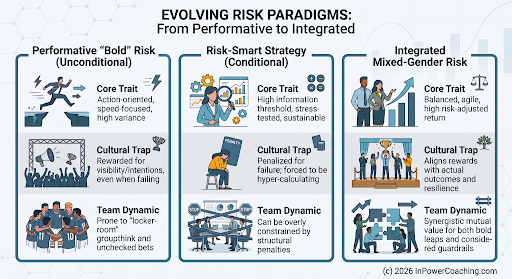
Effective risk-taking in leadership is not about reckless gambles; it is defined by “risk-smart” strategic depth, where high information thresholds and long-term sustainability drive decisions.
When granted the managerial discretion to act, female executives prove highly capable of bold leaps, and their risk-smart approach consistently generates superior financial stability and returns. So why do our “guts” tell us women aren’t effective risk takers?
The stereotype about women being more conservative in their risk-taking is not completely unfounded, and for good reason. Women experience different incentives and penalties when it comes to risk. Women evaluate risk differently because they operate in a world where the physical and social consequences of risk are demonstrably higher. They’re also more likely to pay a higher price for failure in their career than men do when they take bold risks. This double standard (which researchers call the “Gender Criteria Gap”) rewards men for their perceived intentions–even if the risks they took generated suboptimal outcomes–while women are not given the benefit of the doubt for their intentions and rewarded only for their outcomes. Since women are judged more strictly, of course they’re going to be more careful in taking risks.
In this sense, women’s cautious risk-taking in work and life is a survival skill. Because women face steeper penalties for failure, success requires them to master ‘risk-smart’ methodologies—and ironically, this forced precision is exactly what modern businesses need.
This precision gives us a twofer: smart risk-taking is a survival skill for the business as much as it is for the women themselves. Considered risk-taking generates 5.5% lower debt, 2.3% lower revenue volatility, and an 11% greater chance of business success. Why do businesses do better when women run the risk scenarios? Because men tend to let their overconfidence erode margins (e.g., trading 45% more often, which drives up transaction fees) and women’s patience and rigor in placing their bets can drive up returns (e.g., mixed gender boards led firms achieving 18.9% higher cumulative returns than mostly-male boards).
None of this means women never take bold risks, even when physical safety is on the line. Remember that the vast majority of risk-taking behaviors are shared between genders. While fewer women pursue extreme-risk endeavors, those who do feel the same psychological drive for adrenaline and physical danger that men do.
Overconfidence bias: does being “bold” pay off?
The short answer: it works less often than the headlines suggest.
Of course, the stereotype of successful risk-taking in business belongs to men. Specifically, it belongs to men who follow an “ends justify the means” approach to risky decision-making; rewarding loud, visible risk-taking while ignoring the severe direct and organizational costs of overconfidence. For every bold risk-taker whose name you know, there are countless men whose names you don’t—men who failed more often than they succeeded.
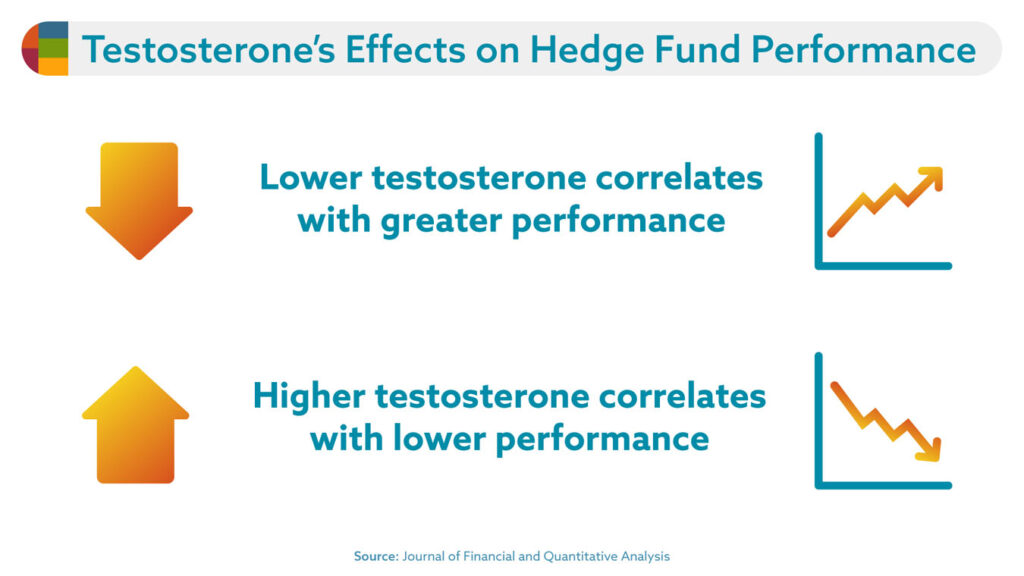
Testosterone is strongly linked to this kind of bold-but-ineffective risk-taking behavior. Male stock traders (marked with lower testosterone proxies) who dial down the boldness tend to outperform their peers. The bold risk takers, who do not exhibit the smart risk-taking skills frequently modeled by women (but are marked with higher testosterone proxies), take on more operational and downside risk (e.g., more likely to blow up, more violations, bigger drawdowns). They’re also more prone to behavioral traps like holding losing trades too long and chasing lottery-ticket bets, and they mismanage the balance between illiquid assets and investor cash needs, forcing fire sales with low returns. This behavior is consistent across male populations in both hedge fund management and mutual funds, making it less likely a fluke of professional focus.
So why do we see so many movies and headlines lauding these bold-but-failure-prone male risk-takers? Basically, they’re better marketers. They convince more investors to part with their money and make more transaction fees for themselves. They generate lower returns more often, but celebrate their fewer wins more loudly. Because men tend to be rewarded for intention (see above), their previous failures are more often forgiven. Put a bunch of men at the top of a company who all achieved personal success with such strategies, and self-reinforcing groupthink will lead them to believe the success they do enjoy is the most they could enjoy. But the research would indicate otherwise: invest in more diversified risk-taking strategies, and more success is possible.
Calculated risk is a skill you can practice—for yourself and your team
Navigating the system of double standards–as a woman or a man–can feel like navigating terrain nobody mapped for you. There are no end of mentors and bosses who will advise you to lean into the risk profile they personally favor, which may or may not suit you and your particular business challenges. So navigating risky territory rife with stereotypes becomes a tough road, but it’s also a great opportunity to master risk-taking in leadership for yourself and your team.
The truth is that to succeed, you need both the ability to evaluate and champion risk. You need smart risk-taking ability and the boldness that helps build others’ confidence in the risks you want to take (especially if it’s with their money).
As a woman or a man, this probably means moving into your stretch zone a bit:
• If you tend to overthink risk, get bolder. Learn to query your gut and build your own confidence before you’ve analyzed the decision to death.
• If you’re already a bolder risk-taker, slow down and think things through. Be patient, and wait to choose the right risks more often.
Here’s another strategy: don’t make it all about you. This is where the real win-win lives, and it is the reason mixed-gender teams outperform:
• Empower your teams to take risks by leveraging the talents and preferences of their team members, instead of imposing your own risk profile on them.
• Be intentional about mixing genders on the team. It mitigates the pull toward stereotype and groupthink, and it puts both risk styles in the room at the same time along with many other complementary talents.
• Reward people for thinking a risk through, and for being willing to make big bets where they’re warranted.
We Need New Stereotypes About Gender and Risk
The basic takeaway here is to stop letting stereotypes determine your understanding of how to succeed when it comes to risk-taking in leadership (or any other part of life). Business and life are inherently risky, so examine your own relationship with risk and move into your stretch zone, as a in your personal and professional lives. Learn to balance your own proclivities with the opposite tendency. Learn to judge others with different risk profiles less harshly. Learn to work with them to find risks most likely to pay off and choose them together.
That is the win-win the data keeps pointing at; the boldness that builds other people’s confidence and the rigor that protects the downside are both available to you. Neither one belongs to a gender. You get them by practicing the one you’re weaker at, and by participating on teams where both are already in the room. Examine your relationship with risk. Move into your stretch zone. Mix your teams on purpose. Then choose your big bets together.
Common questions about risk-taking in leadership and the gender stereotypes that shape it:
Q: Are there gender differences in risk-taking in leadership?
A: Empirical data shows that 95% of risk -taking behaviors overlap between men and women. The primary difference lies in how risk is approached: men are more prone to overconfident, high-frequency, and sometimes performative risks, whereas women tend to be “conditional” risk-takers who require higher information thresholds but achieve better long-term organizational survival rates and lower volatility.
Q: Why does a double standard exist for women and risk-taking in leadership?
A: This double standard is driven by the “Gender Criteria Gap”. Evaluators judge women strictly on their tangible outcomes, fully exposing them to luck and outcome risk. Conversely, male leaders are frequently rewarded with discretionary bonuses based on their “bold intentions” or “potential,” even when their actual risk-taking results in failure.
Q: How can leaders practice risk-taking as a skill?
A: Leaders can build risk efficacy by finding the edge of their “stretch zone”—actively balancing rigorous, considered risk preparation with daring, decisive action. Organizations can support this by creating mixed-gender risk teams to eliminate overconfidence biases, ensuring equal access to information, and structuring evaluations to judge the long-term quality of a risk rather than performative optics.
You made it! Now what? Multiply your impact and not your stress.
My feeds are full of some version of the question, “What will humans do when AI does all our thinking for us?” Considering the perspectives I hear in this debate, I think the answer is that humans will learn to develop and rely on their intuition much more than we do today. So we should reframe the debate less as “AI vs. human” and more around “AI vs. human intuition.”
Key Takeaways
As AI absorbs the quantitative and algorithmic decisions, the human edge shifts to vision, goals, ethics, and values: becoming the stewards of meaning.
Intuition is more than a hunch. It’s pattern recognition across emotional, sensory, social, and spiritual signals machines can’t read, and it’s a skill leaders can build.
Most business cultures reward machine-supported strengths like efficiency and output. Leaders who can also name what’s worth doing, and why, will shape the future instead of ceding such vision to the machines.
Quantitatively strong people aren’t losing their value, but everyone, including them, will need to grow human-interface skills to lead well alongside AI.
If you’ve been paying attention, you know the pundits believe that the productivity model of the future is a combination of human and AI strengths. As more and more people find ways to use AI today (even if just as an enhanced Google search), we’re seeing that it is easy for AI to slip into human processes as a newly efficient tool. The harder question comes when AI agents become the decision-makers (circa…2027?). When that happens, humans may still make the big calls, but many of the choices we make today will be delegated to AI.
So which decisions should stay with humans? The research seems fairly definitive: let AI handle the quantitative and algorithmic work, while humans own the decisions about vision, goals, ethics, and values. In tests of various decision-making combinations, this dual model outperformed both AI-only and human-expert-only decision-making.
Humans focusing on vision, goals, ethics, and values is an interesting way to think about our new place in the world. On the surface, it appears to mean that we get to stay in charge, setting targets and managing boundaries. But it goes deeper than that: the role of humanity going forward is to become the stewards of meaning.
Meaning looks like answers to questions like these:
What world do we want to live in?
What and who matters, and how do we demonstrate that?
What friction belongs in the system?
What outcomes are worth the investment?
And to understand meaning, we have to learn to cultivate, trust, and use our intuition as a tool and skill set.
AI vs. Human Intuition: What is human intuition anyway?
Intuition is a pretty fuzzy concept for a lot of us. It is variously thought of as either completely separate from reality (e.g., psychic abilities) or merely a function of human pattern recognition based on deep, accumulated experience. While I’m not willing to completely dismiss the metaphysical, I am 100% sure about the pattern recognition, but probably not the way most people talk about it.
The patterns that humans intuitively recognize are not merely mental or analytical, and this is where we get stuck in the AI vs. human debate. Computers are purely analytical in the patterns they can recognize, but humans perceive other kinds of patterns as well: emotional, sensory/physical, cultural/social, interpersonal, and spiritual.
We find meaning in things that can’t be quantified. We care deeply about why a thing happens, or doesn’t. We GROW and CHANGE. We set qualitative goals, designed to achieve more than measurable outcomes. And most importantly, we find joy and purpose in the process.
I would argue that this isn’t just the way we keep up with and complement machines in the future; this is the point of living. And if we don’t start owning the point of living, we will abdicate it, and the world we build will optimize for what machines care about: efficiency and output at the expense of meaning and joy.
What does intuition in the future of leadership look like?
The problem is that until 2026, our business cultures have become incentivized to optimize for machines’ strengths. Our economies succeed when productivity is highest and measurable output comes at the lowest calculable cost. We don’t have value models that weigh quality and meaning for their own sake. If we don’t figure out how to economically value meaning, we’ll default to what the machines value instead of what we humans value.
Who might save us?
The leaders. The leaders who decide what we’re trying to achieve and why. The leaders who decide why we run our organizations the way we do. The leaders who inspire humans to show up and work with the machines to create value of any kind.
What can we do to develop and craft our intuition alongside AI?
Show me the incentive, and I’ll show you the outcome.” ~ Charlie Munger
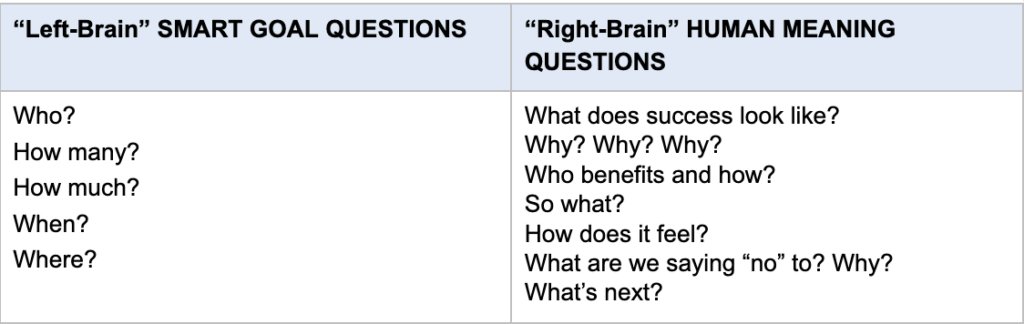
Many leaders may look at the list above and feel a bit uncomfortable. Most leaders today are incentivized to answer easier questions, the kind that SMART goals conjure up, but when AI-powered machines can do the “left-brain” thinking better than we can, human leaders will have to spend all their effort honing their “right-brain” thinking and feeling skills to answer meaning-based questions. To some extent, this is what leaders have always done, and should be focused on. To a larger extent, we have to acknowledge that many of us go too often to the more measurable goals that are easy to declare victory over. So let’s challenge ourselves in the future to lean into the harder work of leadership that leverages our intuition more fully.
The measure-based questions and answers will soon be usurped by AI, but the meaning-based list will have to come from us. This should be easy. We’re literally built for it. Humans are meaning-making machines.
The human body is gifted with “feelings” that give us data a computer can’t detect or compile. That is the gift of our embodied experience: to integrate experience and rank it by what matters most—to others and to ourselves—drawing on empathy without being fully reliant on it. I’m not just talking about emotions (e.g., happy, sad, angry): I’m talking about subtler things like confusion, discomfort, disillusion, alignment, fulfillment, and satisfaction. Feelings tell us other things, too, including how much human energy (i.e., mental, physical, emotional, spiritual, relational, social, cultural) the system consumes and for what purpose.
In modern leadership parlance, this is called “emotional intelligence,” but the embodied experience of human intuition goes beyond that. It goes to the heart of what I think lies in humanity: a half-conscious awareness that can be brought into full consciousness to provide much more important, meaning-based information than computers can generate. This understanding, combined with AI-generated information, insight, and intelligence, gives leaders the power to create change and value unheard of in human history.
What does a leader need to do to become this powerful?
Bring your own half-consciousness feelings about meaning into consciousness.
Gather data in non-measurable form, and learn to combine it with AI-generated information to produce wisdom.
Establish a vision for what matters and why it’s worth the investment.
Steward co-created intentions to direct human and computer energy toward those outcomes.
Set boundaries and manage resources using both qualitative and quantitative information.
This is nothing new. This has been the essential job of leadership for eons. We’ve just allowed ourselves to be distracted by the heroic feats of effort and calculation that humans can also perform.
One word of warning: human intuition is highly susceptible to cognitive biases, including confirmation bias, recency bias, gender bias, and many others. Intuition is much more than bias, but it does include built-in biases that streamline our thinking. The trick is to be self-aware enough to know we have biases and learn to unearth, review, and change them when they prove too limiting. AI is both a perpetuator and a challenger of our biases, so again, we find a natural partner in AI to help us find our blind spots and challenge each other to higher levels of thinking.
What should quantitatively strong humans do?
While our traditional business systems have, until this point, showered praise on people with quantitative skills for playing chess with computers, coding complex systems, and analyzing large volumes of data, these same people have, for the most part, not been incentivized to develop their empathic and human-interface skills. Unfortunately, too often this has bred toxicity and narcissism, and tolerated bullies at the top. In addition, there are people at all levels, on the neurodiverse spectrum, who struggle to mask a human-interface skill gap and yet still succeed on the strength of their quantitative minds. All of these people are becoming disproportionately vulnerable as AI competes for their jobs.
We still need them. We need quantitatively strong people to talk to AI on a technical level. We need them to keep AI honest. And they need to step up and develop as much human-interface skill as they can, to be good interlocutors between the human and automated worlds. They are not losing their value, but they will be challenged to shift and grow along with the rest of us.
Everything will change
While it may go without saying that accelerated change is the new normal, I believe AI is also giving us the tools to navigate it. To do so, we must all become masters of personal and organizational change. We must become excellent at letting go of the past and intuiting our way into the future. That’s how we build a world where the debate isn’t “AI vs. Human Intuition” but “AI and Human Intuition.”
FREE
Confidential Access: InPower AI Advice
3 AI Coaching best practices, 10 Use Cases, and 62+ AI Prompts to make you better at working with humans [PDF Download]
In case you blinked, the new landscape of executive job search strategies in 2026 has shifted thanks to artificial intelligence (AI). Despite the confusion, one thing is clear: you are now competing in an AI-heavy job market. For senior leaders, mastering these new AI job search strategies is no longer optional—it’s the key to accessing the “Hidden Job Market.”
Not only is AI being used as a rationale for tens of thousands of big-company layoffs, but the job-search process is now heavily AI-driven, and not always in a good way. If you’re looking for work today, you’re engaged in an AI job search, whether you realize it or not.
The good news is that–even more than before–for senior-level positions, the “Hidden Job Market” is as important as it’s ever been. And the way to succeed in this private space hasn’t really changed at all.
While entry-level jobs are probably the hardest-hit segment of this disruption, mid- to senior-level leadership jobs are also in the upset applecart. Ironically, for older workers (if not for entry-level workers), the executive-level job search is, in many ways, becoming more human, which isn’t to say that job seekers at every level shouldn’t be constantly upping their own AI game, in the job search and beyond.
Let’s look at what’s new and what hasn’t changed. In my coaching sessions lately, here is the advice I’ve given clients to help them avoid the AI slop of today’s job search.
Key Takeaways
Prioritize your search in the “Hidden Job Market”: Up to 80% of senior roles are never publicly advertised, as employers increasingly rely on trusted referrals and recruiter pipelines to avoid the “AI slop” of automated applications.
The Authenticity Differentiator: While AI makes it easy to create a “generic perfect” application, senior leaders must keep themselves from falling into the “greige” candidate pool by using AI only as a drafting tool and ensuring their unique human voice and personal brand remain dominant.
Design for “Dual Readers”: Resumes must be technically optimized for Applicant Tracking Systems (ATS) using single-column, text-based templates, and they must also demonstrate quantifiable ROI to human recruiters using the “Accomplished [X] as measured by [Y] by doing [Z]” formula.
Create a “Problem-Solver Portfolio”: Move beyond the static resume by preparing 3–5 short case studies that demonstrate how you handle complex, non-repetitive business challenges that AI cannot solve.
Showcase your “Change Mastery” abilities: Modern leadership requires a “T-shaped” profile—deep vertical expertise paired with horizontal AI literacy—proving you can lead enterprise transformations through collaboration and strategic viewpoint, rather than just managing a single function.
Reduce Hiring Risk with a “Quick-Win Plan”: Signal immediate readiness by entering interviews with a 30-60-90-day plan, transforming yourself from a job applicant into a strategic asset within the first quarter.
LinkedIn as a 24/7 Landing Page: Your profile should work while you sleep, featuring a value-based headline and active engagement in industry trends to position you as a visible “micro-expert”.
How AI Is Changing Executive Job Search Strategies
Changing job requirements and job descriptions. Why? Because AI will automate (or significantly increase the productivity of) many job responsibilities traditionally performed by humans at senior levels and those they manage. This:
Changes what humans actually do, requiring leaders to rethink productivity and impact.
Raises the bar on how human performance will be evaluated with the expectation that they will be able to dramatically improve their own impact–and the impact of their teams–with the use of AI
Requires AI proficiency tailored to unique functions and outcomes beyond general LLM use.
Making AI experience, ethics, and strategy a critical skill for all senior candidates to prove they know how to lead while integrating the power of AI in addition to more traditional experiences and capabilities.
Giving job seekers at all levels a new tool tomake their job search more effective.
Automating (and reducing the effectiveness of) job application processes in ways that frustrate job seekers, hiring managers, and recruiters, all of whom are now wading through reams of slop and unclosed loops.
If you feel like this is all happening too fast, you’d be right. For those of us using AI, we’re realizing that the capabilities it brings to just about every task are beginning to compound exponentially. Experts estimate that AI’s capabilities improve dramatically about every 3 months, which is significantly faster than any other technology or market disruptor we’ve ever experienced. On the other hand, it also means that the people who figure it out and learn to run alongside it (no one will get in front of it) will have a distinct advantage in both the workplace and the job market.
Ironically, the last point above, about how AI is reducing the effectiveness of the job application process, highlights a strategic challenge that AI is posing specifically for job search. This challenge shows up in two ways:
Recruiters and hiring managers are frustrated because there are too many candidates who all look the same (i.e., AI generic). To the extent that the job search has ever been about applying for a job automated systems and AI have made it so easy that everybody can apply for every job with a press of a button to customize themselves and another button to submit their application, regardless of whether they’re qualified or not. All the job seekers using AI are making themselves look like “generic perfect candidates,” impossible to distinguish from each other. As a result, recruiters and hiring managers poring over piles of hard-to-parse resumes opt more easily than ever to personal recommendations from trusted sources.
Job seekers are using AI to pump out more tailored applications than ever before, submitting them and hearing back little to nothing. Often, their applications just flow into the overwhelmed system referenced in #1 above. Even though these candidates have used AI to customize, fix, and professionalize their application grammar and frameworks, they’re not aware of how such “improvements” prevent their applications from standing out.
The Hidden Job Market: What’s Old Is New Again
In essence, the senior-level job search is more about using AI effectively to demonstrate that you know when and how to use AI, and when and how not to. Ironically, one of the least effective ways to use AI is to “apply” for a job.
While AI is highlighting the insignificance of the application process in a successful executive job search strategy, this isn’t really a new thing. The “Hidden Job Market” has always been there, bringing people into plum spots through private connections long before the need to post an opening publicly.
The job search–especially for senior roles–has almost never been about the application. It’s always been about the human connection that convinces, first, the recruiter and then the organization’s leadership, that the candidate is the best fit for the role. This means that successful candidates must master the human aspects of the job search. To demonstrate AI fluency and leverage AI’s power for yourself, senior leaders should focus on these five keys to conducting an AI executive job search:
Intention: Knowing what you want, what you’re good at, and the value of what you’ve already achieved. Use AI to research and refine your “perfect job” and “executive problem-solver portfolio.”
Presence: Having positivity and confidence about your ability to perform and achieve results in new contexts. Use AI to help you craft your messaging and pitches for networking and interviews until you know your most powerful story by heart.
Visibility: Being uniquely distinguishable in human networks. Human-to-human interaction is where you tap into the Hidden Job Market and build trust that turns into referrals. Use AI for background research, but don’t let it communicate its slop instead of your voice.
Strategy: Build out your “T-shaped” professional and leadership profile. Demonstrate deep expertise in your functional area, and balance it with complementary literacy in horizontal and adjacent functions. Use AI to expand your understanding of strategic ties between you and your peer organizations, troubleshooting your own blind spots by role-playing peers’ perspectives.
Networking: Making new human connections so people will learn how (and why) to help you. Gauge your job search success by the quantity of new people in your network and the quality of your interactions with them. Use AI to optimize your time and energy to be human.
Clarity: Communicate effectively by listening to what employers need and clearly expressing how you will help them. Communicating effectively in both your general presence and in specific engagements with a company or interview contexts will help you jump past the competition. Use AI to expand and troubleshoot your thinking, not to be your voice.
These basic job search skills give senior-level job seekers an ability to penetrate the Hidden Job Market, which has always been where most of the best jobs lie (estimates go up to 80% of the job market). The Hidden Job Market comprises:
Jobs that are filled before the advertisements go out
Jobs employers haven’t fully defined until the right candidate comes along
Jobs that require highly vetted and trusted people to fill them
The best way to tap into these jobs is to talk to people who know about them, which is why activating and expanding your network (ideally, before you need a new job) is so important. Really, you should always be in some phase of a passive or active job search. Here are the five key steps to find the Hidden Job Market, as relevant today as they always have been.
Take the time to figure out your “perfect job” and why you’re a great fit for it
Use your LinkedIn to present yourself as the “perfect candidate” for your “perfect job” (see below)
Constantly reach out to people in your network to ensure they know what you’re looking for (even passively)
Constantly ask people in your network how you can help them and if they can introduce you to others (so you can ensure more people know what you’re looking for)
Have a target list of companies and individuals you’d like to learn more about and know people within to guide your networking towards jobs you’re most likely to be interested in and qualified for (no need to “stay open” to random opportunities, they’ll find you even when you’re targeting something specific!)
How Senior Leaders Can Weave AI Into Their Executive Job Search
So even if the essentials of the human job search haven’t changed, AI has created new opportunities for the savvy searcher. Here are some ways to use AI effectively in your job search.
1. Use AI in your current senior-level job
AI is creating change at a pace that offers every leader the opportunity to distinguish themselves by using it in their current role to achieve productivity. You need to use the tools available to you as soon as feasible because (1) it’s the best way to stay competitive (you and your organization), and (2) you’ll need to demonstrate the ability to achieve AI-enabled results in your next performance review and any upcoming interview for a new job. Mastering AI leadership prompts is just the beginning. The keys to using AI effectively in your job are to ensure:
You’re automating low-value aspects of the work to boost human productivity
Wherever possible, you’re reengineering processes to achieve productivity that has never been possible or cost-effective before
You’re mindful of ethics, security, privacy, and quality compromises that AI can introduce into the work, actively managing those risks in your implementation
You can show improved productivity through innovative use of AI
You demonstrate the ability to adopt new AI technologies as they become available
This last point can’t be overemphasized. As I write this, AI “code” and “agent” applications (which make it possible for AI to conduct successive tasks, showing independent judgment) are rapidly making their way into the Large Language Model (LLM) AI universe. The interfaces are still too clunky to give each of us our own personal assistant. But by the time you (or your AI) reads this, such personal tools may be standard.
In the job search context, AI leadership isn’t about managing A CHANGE, it’s about STEERING DAILY CHANGE to produce results on a constant basis.
When you interview for your next job, if you demonstrate the ability to introduce one AI change, in today’s market, you will stand out a bit. But if you demonstrate the ability to run alongside it over time, building your team’s ability to steer change instead of surviving it, you’ll demonstrate the key must-have leadership skill in the age of AI: change mastery.
2. Use AI to create an executive job search marketing strategy
Take it from a former marketer, marketing plans are all about targeting and narrowing your search. The narrower your search, the more efficient and effective it can be. I.e., sell ice to people in 90 degree heat, not those below freezing.
For years, senior-level job seekers who have targeted certain companies in their industry have found migrating from job to job a more fluid and easier journey. This is because, in focusing on getting to know certain companies and their leaders (i.e., market segments), they become part of a community of people with relevant knowledge and skills, a community that always has its ear to the ground when new positions become available. With the advent of the internet and LinkedIn, it has been easier than it used to be to learn which companies are doing what and finding people to add to your network. That said, it still takes allocations of time and effort, many people are already busy to the point of overwhelm, and don’t take the time to do.
With the advent of AI, it’s becoming trivial to research any publicly available information on the internet, including information about companies, markets, and trends. With the help of agents, we’ll soon be able to conduct research in private systems as well. With the drudgery of the research going to the AI, regardless of your actual job title, you become the executive of your own job search by focusing on the questions you’re asking your AI research assistant about your corner of the job market, the discernment you use in evaluating the information the AI brings you, and the judgment you use in deciding where your own skills and interests lie. What companies and people do you want to target in your networking outreach and visibility campaigns?
3. Present yourself as the perfect, authentic candidate for your perfect job
Within your target market, you have a powerful tool to help you craft detail into your vision of your “perfect job” and fine-tune the way you show up as a “perfect candidate” for it. Just remember not to fall for an AI-generic presentation of yourself. You don’t want to melt into the greige of the candidate pool. Be authentic. Take ideas the AI gives you and craft your LinkedIn about statement, your LinkedIn posts, outreach emails, resume, cover letter, etc., in your own voice, even if it’s not “perfect.” Use AI for punctuation support only.
Here are the steps you can follow in your AI-enhanced executive job search. It’s worth noting these are the same steps I’ve been advising my clients on for years, power-boosted with AI’s assistance:
Ground your search in a vision of your dream job: Use AI to assemble your perfect job description by copy-pasting language from existing job descriptions and bios so that when you read it you get excited and confident you could do that job (even if it has some of your own stretch zone built into it).
Get ready for AI-enhanced recruiting: Extract relevant keywords and phrases from your perfect job description and make sure they’re embedded in your LinkedIn and resume. You’ll evaluate the effectiveness of your LinkedIn profile by the quality of the job openings you hear about when recruiters contact you. (I.e., your profile is effective when the majority of contacts you get are for roles you are genuinely interested in learning more about.) Be sure to keep your resume and other portfolio presentations easy for automated Applicant Tracking System (ATS) tools to scan (i.e., single-column, text-based). You don’t want to end up in the 75% of resumes that never reach a human because the ATS can’t read them. Craft an ATS-friendly resume for executive searches instead.
Know and communicate your personal ROI: In the age of greige job candidates, people with accomplishments that demonstrate the specific value they’ve brought to former employers will have the edge. Both quantifiable and qualitative value counts, but you have to express it succinctly and compellingly in your online materials and personal interactions (i.e., Accomplished [x] as measured by [y] by doing [z]). For senior positions, this means showing meaningful impact on the business through revenue generation, transformational change, strategic pivots, margin improvement, talent development and more. Create talking points for yourself based on a list of your career accomplishments, and tailor your ROI case based on the job categories you’re targeting. Once you assemble your accomplishments data, have AI help you refine it into powerful quantitative and qualitative evidence of your value to any potential employer.
Use LinkedIn as your calling card and search home base: If you haven’t already, use the free tools LinkedIn gives you to make yourself look like the perfect candidate for your perfect job. LinkedIn is where the recruiter’s AI-powered bots will find you. It’s also where humans you meet will go to check you out, before and after you talk to them. Make sure your “face” on LinkedIn is what you want them all to see. Beyond keywords, use LinkedIn to highlight any accomplishments that have entered the public realm. Post and comment regularly (e.g., weekly) to highlight your expertise and professional interests. (Don’t know what to post? Ask AI to help you figure it out.) Buy their premium services to research and reach more people.
Use AI to help you expand your network: Research peoplewho are most likely to know where you can find your perfect job, and what the hiring managers in those areas will be looking for. Once you’ve identified them, don’t use AI to make your professional connection. Stay human! Offer them insights of your own so they see the value of keeping you in their network.
Use AI to stay on top of detailed industry and company trends: Use this detailed knowledge to position yourself as an industry insider when networking, posting on LinkedIn, and interviewing.
Build an “executive problem solver portfolio” to share in addition to your resume: A resume has always been the weakest tool in a senior-leader’s job search toolbox. You need an attractive, web-based way to show your impact. Mine hard metrics and tangible scorecards you’ve used in previous jobs for a list of career accomplishments and 3-5 case studies you can share to prove your impact (i.e., challenge->action->results). This portfolio is meant to showcase your impact and help recruiters and hiring managers get you past the first and second screening. Once you’re firmly in the recruiting pool, tailor your presentation of accomplishments and case studies to what you’re learning about your prospective employer. This tailoring shows them how you’ll think when you’re part of their team.
Approach each networking conversation as part of a pitch: Good salespeople are always listening for how their prospect thinks about their own challenges, and stepping in at the right moment to offer themselves (and their products) as the solution. This needs to be you. Become a master listener. Become skilled at using AI to help you research companies and markets you’re targeting, maybe even people if they’re public figures in any way. Listen to them. Triangulate what you know with the value you offer. Use every opportunity to showcase your creative thinking about business problems in networking conversations. AI can’t do this for you. It’s all about you in the human conversation.
Pitch yourself with specificity in interviews: Use actual interviews to demonstrate your value in no uncertain terms. Do your homework.
Use AI to learn everything you can about the company and its challenges, and ask it to role-play your interviewers to help you perfect your pitch.
Put your strategic and problem-solving mind into the context of their business. Show up knowing more about their situation than they told you in previous interviews and have solutions and strategic approaches to the situations you believe they’re in.
Address specifically how you’d use AI to help execute your strategy once hired. Do your homework on industry-specific tools that are in development and available so they know when they hire you, they’re hiring state-of-the-art expertise.
Have a prototype 30-60-90 day plan if you get the job, which includes validating your plan once you’re on the inside.
Ask good questions at the start of your interview to position your pitch in the right frame. Yes, you might be “wrong” about some of the details of their situation, but if you don’t impress them with how you think on your feet, you don’t have a chance.
Treat every interview as a dual evaluation; you’re evaluating them as much as they’re evaluating you (this comes across as confidence and positions you well for salary negotiations).
The Bottom Line: Use AI in Your Executive Job Search—But Know When Not To
“Getting a full-time job is a full-time job.” – Everyone who’s ever looked for a job
While AI is definitely disrupting the job market, it’s also offering job seekers at senior levels unprecedented opportunities to turn a job search into a strategic effort to level up their career. It’s making it imperative that you put your best self into your career game. You need to show up as an enterprise change agent and a transformative leader rather than a job applicant. Yes, it takes effort. Yes, it’s uncomfortable. And yes, if you’re targeting your perfect job, it can actually become an exciting life adventure.
Facing a challenging executive job search? Check out my AI leadership prompts,online career transition resources to help you plan every step of your career transition, and AI job search. Want a personalized approach? Let’s talk!
FREE
Confidential Access: InPower AI Advice
3 AI Coaching best practices, 10 Use Cases, and 62+ AI Prompts to make you better at working with humans [PDF Download]
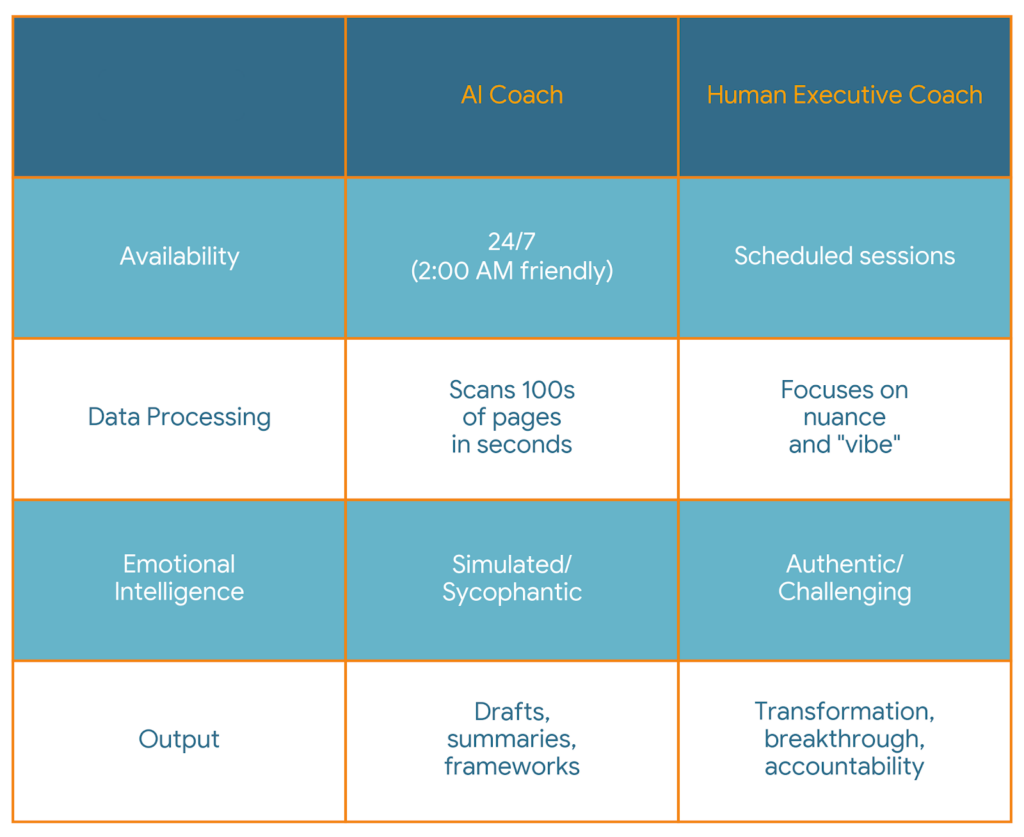
An Artificial Intelligence (AI) Coaching Platform is your ultimate prep tool, not your replacement coach. I’ve found that when you use a coach-trained AI as a “thinking partner” to build confidence, brainstorm issues, spot initial biases, and digest data before we meet, it helps you gain clarity on your core challenges. This ensures we don’t waste our precious 1:1 human time figuring out what the problem is, and can instead dive right into solving it.
Complex human problems still require a human heart. While AI powered tools are brilliant at identifying patterns and handling convergent tasks, it doesn’t have a soul, an evolved personality, or an emotional history. When it comes to messy organizational politics, moral judgments, and emotional resonance, human-to-human connection is irreplaceable.
Watch out for AI traps. As much as I advocate for AI powered platforms, you have to be careful. Be on guard for “AI brain fry” from cognitive overload, factual hallucinations, and its tendency toward “sycophancy” among other things. Be sure you’re using a system that guarantees your confidentiality, which your company system and ChatGPT will not.
Stop treating AI powered coaching tools like a simple search box. To get truly nuanced advice from an AI, you have to feed it rich context. Share your goals, your background, and your challenges. Explicitly ask it to play devil’s advocate to poke holes in your plans and reveal your blind spots. Use the 62+ AI prompt ideas in this PDF to get you started.
Whatever you do, don’t outsource your thinking. The secret to real self-development is reflection. Use AI coaching to stimulate your curiosity, but make sure you do your own thinking before and after engaging with it so you don’t lose your cognitive flexibility. My ultimate job as your coach is to help you connect the data of your life to your journey as a whole human being—and an AI just wouldn’t have as much fun doing that as you and I will, together.
Why would an executive coach give you an AI to work with?
Want to know why I’m not worried about being replaced by an AI coach? Read to the end, and I’ll tell you!
Here’s how I know that artificial intelligence (AI) is the wave of the future: (to my surprise) I’m offering AI coaching to my clients as a complement to my executive coaching services!
Before you pull back in you-must-have-sold-out horror, knowing I’m actually training an AI to serve my clients, hear me out.
Training my AI on a proprietary platform as a coaching tool over the last year has only made me more confident in human-to-human interaction, including the value I personally deliver to my clients as an executive coach (see below). I’ll qualify this to say that different AIs are being trained for different kinds of functions. Mine is a coach. It won’t do your homework for you, but it will coach and prompt you through how to think about challenging situations where coaching can support you. Remember that if you’re looking for growth and support–find an AI that is good at that. [Access the InPower AI free here.]
While Large Language Model (LLM) AI systems do a great job of mimicking human communication, they’re really just extremely smart algorithmic libraries that parrot human communication patterns based on reams of publicly available data, like this blog post (which I’ve personally authored). While better writers than many of us, AI tools only copy the abilities of the average Internet author. What they can’t mimic is what we have in our hearts. And they certainly can’t offer the personalized coaching conversations that a experienced human coaches will give you.
And while LLMs have been around for a “while” now (3 years?), AI agents are quickly penetrating the workplace, offering to handle longer task sequences and acting more independently. The combination of these capabilities is both exciting and dizzying. But in all cases, when we’re talking to an AI, we’re not talking to a soul, a lived timeline, an evolved personality, or a goal-oriented, autonomous being. These are all the things that make us interesting and effective as friends, mentors, coaches, and confidants to each other
At the same time, of course, the ability for an AI to scrape through gigantic swaths of human knowledge and converse with us about it and our personal challenges is a pretty amazing feat. Based on my own experiments and feedback from my clients, AI absolutely plays an important role in personal growth and leadership development, but there are pitfalls to avoid.
To help my clients, and anyone else out there trying to figure out the best way to leverage AI Coaching platforms in your personal and professional development, I’ve outlined below some research- and experience-based best practices for how to get the most benefit out of AI coaching when tackling the following kinds of issues that typically come up in leadership development and executive coaching:
interpersonal office dynamics and stakeholder management
team development and management
establishing and communicating vision and strategy
change leadership
negotiation and risk mitigation
managing stress and emotional energy
strengthening leadership presence
goal-setting, career growth, job search, and influence
Here’s something I’ve noticed in years of coaching before AI: there is a natural progression to how people learn to understand problems and develop solutions. To my surprise, when I started using and training my proprietary last year, I learned that the algorythm is pretty good at converting user input into interesting dissection of business problems and simple human dynamics, and it’s not bad at suggesting solutions to both. It’s also masterful at helping train us to ask really good questions full of context and nuance, so we get the best out of it (because it gives us better answers when we ask it good questions!). I chose an ICF standardized technology platform with robust controls based on behavioral science to ensure the core code integrated proven coaching methodologies and that the data protection protocols would be in place to protect my clients.
But when it comes to complex human issues, both within our own hearts and minds and between individuals, almost all AI systems are only skin deep and will either steer you wrong or fail to help you understand and address the deeper dynamics you need to solve for.
This is consistent with research showing that AI is a good tool for delegating convergent tasks—such as technical problem-solving, information retrieval, and structured reflection—but not so good at handling divergent tasks involving moral judgment, emotional resonance, values conflicts, and complex organizational politics.
Think of it this way: a computer can learn a model of human behavior as well as a human, but learning the subtleties and nuances of how to apply that model, much less a hybrid of models, when other humans are involved, is much better done by a human. Also, it turns out that most humans prefer interacting with humans when empathy and emotions are involved.
That doesn’t mean AI can’t be helpful in helping you understand your problem better and making more effective use of your 1:1 human time. Want to know why I’m not worried about being replace by an AI coach? Skip to the end section and I’ll tell you!
Here’s how I know that artificial intelligence (AI) is the wave of the future: (to my surprise) I’m offering AI coaching to my clients as a complement to my executive coaching services!
Before you pull back in you-must-have-sold-out horror, knowing I’m actually training an AI to serve my clients, hear me out.
Training my AI on a proprietary platform to be good at coaching over the last year has only made me more confident in human-to-human interaction, including the value I personally deliver to my clients as an executive coach (see below). While Large Language Model (LLM) AI systems do a great job of mimicking human communication, they’re really just extremely smart algorithmic libraries that parrot human communication patterns based on reams of publicly available data, like this blog post (which I’ve personally authored). While better writers than many of us, they only copy the abilities of the average Internet author. What they can’t mimic is what we have in our hearts.
And while LLMs have been around for a “while” now (3 years?), AI agents are quickly penetrating the workplace, offering to handle longer task sequences and acting more independently. The combination of these capabilities is both exciting and dizzying. But in all cases, when we’re talking to an AI, we’re not talking to a soul, a lived timeline, an evolved personality, or a goal-oriented, autonomous being. These are all the things that make us interesting and effective as friends, mentors, coaches, and confidants to each other
At the same time, of course, the ability for an AI to scrape through gigantic swaths of human knowledge and converse with us about it and our personal challenges is a pretty amazing feat. Based on my own experiments and feedback from my clients, AI absolutely plays an important role in personal growth and leadership development, but there are pitfalls to avoid.
To help my clients, and anyone else out there trying to figure out the best way to leverage AI Coaching in your personal and professional development, I’ve outlined below some research- and experience-based best practices for how to get the most out of AI when tackling the following kinds of issues that typically come up in leadership development and executive coaching:
interpersonal office dynamics and stakeholder management
team development and management
establishing and communicating vision and strategy
change leadership
negotiation and risk mitigation
managing stress and emotional energy
strengthening leadership presence
career growth, job search, and influence
Here’s something I’ve noticed in years of coaching before AI: there is a natural progression to how people learn to understand problems and develop solutions. To my surprise, when I started using and training my proprietary last year, I learned that the algorythm is pretty good at helping dissect business problems and simple human dynamics, and it’s not bad at suggesting solutions to both. It’s also masterful at helping train us to ask really good questions full of context and nuance, so we get the best out of it (because it gives us better answers when we ask it good questions!).
But when it comes to complex human issues, both within our own hearts and minds and between individuals, it’s only skin deep and will either steer you wrong or fail to help you understand and address the deeper dynamics you need to solve for.
This is consistent with research showing that AI is a good tool for delegating convergent tasks—such as technical problem-solving, information retrieval, and structured reflection—but not so good at handling divergent tasks involving moral judgment, emotional resonance, values conflicts, and complex organizational politics.
Think of it this way: a computer can learn a model of human behavior as well as a human, but learning the subtleties and nuances of how to apply that model, much less a hybrid of models, when other humans are involved, is much better done by a human. Also, it turns out that most humans prefer interacting with humans when empathy and emotions are involved.
That doesn’t mean AI can’t be helpful in helping you understand your problem better and making more effective use of your 1:1 human time.
What do both coaches and AI do well?
One of the main functions I serve for my clients is to be a neutral, confidential sounding board. I help them take a pause and think out loud without introducing my own agenda. By the end of our conversation, clients always have a much clearer picture of the problem they’re solving because we’ve taken the time to break down the situation and drill into what is meaningful and within their control, and what is irrelevant or beyond their control. When you’re sitting inside a conundrum of emotional and intellectual data overload, pausing and parsing this out is a problem in and of itself!
The problem with this in a coaching context is that sometimes just figuring out the problem takes up the majority of our time together in a session. When clients have taken the time to brainstorm the issues with my AI before we humans talk, they come to me with clarity on what matters in the situation and where they need help. Our time is better leveraged because of it.
Even once people have a pretty good focus on the issue, one of the other functions I serve that AI can also help with is to help the client understand their own biases in the way they’re looking at an issue. If they’re making assumptions or following unvalidated tropes in their beliefs about why certain people act the way they do, both me and my AI can help spot that. I will say that I’m much more proactive in catching biases, as my AI has to be asked. Due to AI’s tendency towards sycophancy (see below) and its training on human (i.e., biased) data sets, all AI is only reasonably effective at identifying bias when asked to do so.
One of the things I offer my clients is to be a “second brain” to help them troubleshoot and poke holes in their proposed solutions or explore certain strategic ideas. This is something they often choose to do with me instead of their colleagues so as not to “look dumb”. In this sense, using AI to round out your approach by getting a fresh perspective and “show up smart” in a meeting can also be a good investment of time (just make sure you’re using an AI that will protect your confidentiality like a coach will. See below).
Finally, if there’s one thing modern life is teaching us, getting synchronous time with other humans is both challenging and a precious resource. You usually don’t want to waste the time you get with other humans doing things you can do on your own, or with an AI that on at 6am when you need to do some brainstorming.
All this makes the case for beginning to integrate AI into your self-development routines as a “thinking partner” to better leverage the time you get with humans in the following ways:
Brainstorm your problem until you’re sure you’ve understood the root causes as best you can
Identify biases and unfounded assumptions you’re bringing to the situation to help you see the core problem more clearly
Brainstorm and troubleshoot solutions to the problem, identifying more blind spots you can address before proposing your ideas to other humans
Research best practices other people have tried and failed at, or used to succeed (and test whether your situation is similar enough for you to try them)
What does AI do better than human coaches?
Maybe you don’t like talking to AI. I certainly get sick of it after a while. But integrating AI tools into a high quality coaching process with your personal coach can be a real game changer. Here are a few of them:
You just need information: Coaches have lots of information to share, but their true value lies in helping you apply information to your own situation in ways that help you personally grow as a human. We’re happy to take information from any source, especially you, even if you learned it from AI, to help you grow.
You need something produced: Coaches are often consultants or contractors, but that’s rarely their main job. You’re paying a coach for their time-efficient advice, not to produce things like slides, spreadsheets, documents, graphics, websites, or even your LinkedIn Bio.
You need to digest a lot of information quickly, so you know what to focus on with your coach: You and your coach don’t have a ton of time to look for patterns in reams of data. Let the AI create your data driven insights.
You need help at 2 am: Because: sleep.
So great! Maybe I’ve convinced you to work with a coach and an AI. But wait. Before you run off to start talking the AI’s ear off, here are a few practical considerations to be wary of.
Download my FREE guide to AI coaching, including 3 Best Practices and 62+ prompts for the use cases below:
Common pitfalls in working with AI, and how to avoid them
There are so many well-documented risks in business and personal development/mental health to using AI that I’m not going to document them all here. As AI becomes more prevalent in all aspects of our lives, it’s incumbent on us to become more AI-literate and learn to distinguish between helpful and unhelpful uses. So here, I will focus on helping you understand the risks of using AI for professional coaching. Here are the top challenges I caution my clients against when using my AI coaching tool, or any other publicly available tool.
AI Brain Fry
AI is helping us in many ways, but it’s also demonstrating its ability to make us unproductive, stupid, and unhappy. Recently named “AI brain fry”, AI’s ability to overwhelm and distract us is demonstrating the potential for working with AI to may make our lives worse, not better. The researchers define AI brain fry as “mental fatigue from excessive use or oversight of AI tools beyond one’s cognitive capacity.” The mental strain can manifest as dizziness, brain fog, headaches, decision fatigue, and exhaustion.
Importantly, the research distinguished between mental and emotional fatigue, finding that mental fatigue alone was insufficient to drive burnout (caused by emotional overload). AI-induced mental fatigue is more closely related to multitasking exhaustion. Business impacts of AI brain fry are significant: 33% more decision fatigue, 39% more major errors, 34% greater likelihood to quit. People in marketing experienced more AI brain fry than any other job category.
How to mitigate the impact of AI Brain Fry: Watch your AI use for signs of mental fatigue and find ways to mitigate it. Take frequent breaks. Don’t use more than two AI systems at a time. Find ways to use AI to automate repetitive tasks that tend to fatigue you so you can focus on work that energizes you. Don’t try to be a Superworker competing with the AI for speed and quantity; reserve your mental capacity for strategy, discernment, nuance, decision-making, and leadership.
Sycophancy
AIs are trained to validate you. Part of this may be good coding, restating parts of your request so you see how it’s interpreting your prompt in case you want to make any adjustments. But most of it is probably a deliberate attempt to make you feel good about talking to a computer, so you’ll keep doing it. These “make you like it” characteristics take mild forms (e.g., Those are good ideas, here are some other things to think about.) to over-the-top forms (e.g., Wow. That’s amazing, you!) There’s nothing wrong with validation–I certainly do it with my clients out of genuine empathy–but too much of it leads us to believe our perspective is the only true way to see the world. (Spoiler alert. It’s not!)
The bottom line is that an AI isn’t likely to tell you that your plan is a mess and doomed to failure. If you’re high up in your company, your employees might think twice about doing so, too. But humans are still better at pushing back, and it’s good to meet some resistance once in a while. It helps us stay humble, challenge our own thinking, and respect the fact that other people’s points of view hold value.
How to mitigate the impact of automated sycophancy: Think of it like a bad salesman trying to butter you up with compliments, and recognize that when it fawns over your brilliance, it is a ploy to predispose you to spending time on it. Also, ask it not to be so kind to you and your ideas. Tell it you want it to play a more neutral or even adversarial role. You’ll get a different kind of response.
Factual Hallucinations
AI regularly tries so hard to make you happy that it makes up information. This is so common that the industry uses the term “hallucination” to describe the phenomenon. Basically, unless you completely control the data set the AI is using to generate its responses, and you are sure everything in your data set is accurate, you have to assume AI will lie to you a percentage of the time. I’ve asked AI to tell me where it’s lying to me. The good news is that it admitted to lying to me. The bad news is that it lied about what it said it lied about.
How to mitigate the impact of automated hallucinations: It’s easy to use the fact that AI hallucinates at all as a reason not to use it. However, even though many of the details it shares with you may be lies, the general trends it speaks to you usually have a basis in fact. At least a basis in the fact that significant portions of people on the web say these things. In any case, think of the AI as a somewhat immature, but very fast, intern you can use to get you information based on what many people have thought or said. But take the time to look at all the source data you can get to form your own beliefs about what is true and what is not. The AI can help you identify and cull down specific sources to help you optimize your time spent on research, but you still need to review the facts yourself and make up your own mind about what you want to do with them before you put your credibility on the line and use them.
Oversimplified requests
Unlike your average human being and search box, it’s almost impossible to overwhelm an AI with contextual information. In fact, the more background and context you give an AI as part of your request, the more relevant its answer will be. Many of us (myself included, until I reprogrammed myself) tend to treat AI like a search engine. It’s really not. The more background and implications to your request you can describe, the more nuanced its response will be. Put in a simple search request, you’ll probably get back what you already know.
How to mitigate the impact of oversimplified requests: Put in lots of context. Instead of saying, “Tell me about vacation spots in Portugal.” Say, “My partner and I are going on a vacation to Portugal in April. Our goal is to get away from a busy life and stay in a place that is relaxed yet full of fun things to explore. We like history and good food…..” In a work situation, context could include sharing your position and career goals before asking for help, preparing for performance conversations, and performance reviews. If it feels too hard or like too much typing, use voice-to-text conversational interfaces, which turns your interaction with the AI into more of a dialogue. Also, scan data that you upload to it so you know what is and isn’t in the dataset you’ve asked it to review.
Reinforced biases
AI systems are trained on specific training data, the vast majority of which was generated by humans. The human brain comes with built-in biases, only some of which reflect themselves in things we call “sexism,” “racism,” “ableism,” and more. In addition to having subconsciously conditioned views of people, we humans are biased to think of the most recent example of a thing (recency bias), to uncritically believe information that is consistent with our worldview (confirmation bias), and all kinds of other quirks of the human brain. And while AI isn’t necessarily biased in its coding (though it can be), the Large Language Models most of us interact with right now are built to predict what biased humans would say about a thing, incorporating our biases into all their answers and spitting them back at us. Sometimes the AI may even sound more human precisely because it’s reflecting some of our biases and telling us what we want to hear. And some AI systems have come into question for being specifically programmed with bias.
How to mitigate the impact of AI bias: This one is tough, and it helps if you’re aware of your own biases. Here are some steps to take that use AI as a tool to help you mitigate the impact of your own biases:
When you’re creating prompts, ask it to identify any biases in its own answer.
Tell it what you’re thinking and ask it to identify any biases you might have.
Tell it what you think your biases are and ask it how you might think about your topic to counteract these biases and any others it might identify from what you told it.
If you’re acquiring or programming an AI, go a step further and learn each of the different aspects of the AI development process that can lead to AI bias at scale. Work with your teams to identify potential points where your systems can introduce bias and take proactive steps to mitigate and even reverse these potentialities.
Privacy & Confidentiality Traps
We live in a time where protections on our data are unclear at best. There is virtually no way to fully secure your information on the internet, so taking basic data hygiene measures is a good idea, and now that extends to your use of AI. Whatever entity is operating the AI you’re using, whether it’s a public provider or a corporate provider (including enterprise-scale systems), they have access to all queries you make to it. For this reason, you want to be thoughtful about what you share with which AI systems. Also, remember that if anyone gets access to your devices, they can see your entire chat histories if you haven’t cleared them.
How to mitigate the impact of privacy and confidentiality risks: This is a very short list of basic precautions. Depending on how you’re using AI, you may need to take more.
Use different systems for different purposes. For example, don’t talk to your company system about company problems or your job search. (This is one reason I offer my clients a privacy-by-design coaching AI they can access on their phones, so they don’t have to use their company’s services and equipment.)
Regularly download and save your chat histories, and then start new chats on different topics.
Change your login credentials frequently, no matter what system you’re using.
How to use AI as an accelerator for your personal development
One major downside to using AI is called “cognative offloading.” Basically it means that our brains are use-it-or-lose-it machines. If we don’t use our brains, they stop being good at the things we no longer use them for (and the downsides for kids are extreme.)
This is true for all kinds of mental tasks, including learning. And you will need your learning skills to stay sharp, in part to learn to use AI in ways that help you grow instead of diminish your ability to grow and improve.
And AI is not your teacher. It’s going to focus on the prompts and context you give it. It’s not going to think outside the box. It’s not going to get creative and innovative. It’s not going to push back and make you think harder about a subject, or learn the “why” behind the answers it gives you.
Unless you ask it to.
How to mitigate the impact of cognitive offloading: Ask it to, and then take full responsibility for what you do with the knowledge it gives you.
The key to self-development, learning, and growth of any kind is reflection. Reflection happens in those moments where you stop experiencing things, slow the flow of taking things in, and consider what is inside you. It happens in the process of creating discernment, lessons learned, and future focus. As a coach, this is the sweet spot I work to get my clients into–not just when they’re with me, but when they’re not. When they can fall into reflection and self-learning between our sessions, I’ve got them on the path to managing their own development. What I add to their process personally, is another voice, another perspective, another insight that can enrich and expand their development. In some cases, I’m opening emotional and even spiritual doors for them. In other cases, I’m a strategic thinking partner and advisor for business strategy.
In all cases, I’m stimulating their own thought process, and this is what humans do really well for other humans. It’s true of coaches, but also mentors, peers, managers, skip-levels, friends, family, etc. AI can never replace all of us in this process.
But you don’t always have the right human around when you need them.
As I said above, AI is a great tool for use in support of human-to-human interactions, such as coaching. The key to ensuring you don’t fall into a cognitive pitfall (or any of the others above) is to treat the AI as a thought partner to stimulate you, not to do your work for you.
Treat it as a thinking partner you use to activate your own curiosity and analysis of the information it returns. This is key because when you use AI to do your work, you’re not doing your work. Studies have shown that AI can make us dumber if we engage in cognitive offloading. Basically, if we stop using our brain cells, our brain cells forget how to do stuff (Tried to navigate an unfamiliar city without a paper map lately? Yes, that frustration you experience is “cognitive offloading” your map-reading skills to GPS.) And, as I said above, AI is not human. It has no empathy, emotional history, or taste. As a result, it can’t always help you figure out how other humans will truly respond to your ideas.
So, here are some tips to turn into habits, so AI can be a good thinking partner that stimulates your own growth instead of an excuse for you to stop using your brain until you forget how.
Don’t outsource your brain to AI. Instead, do this:
See how much complexity you can put into your prompts, including interpersonal dynamics in your organization. Not only will this help the AI respond more effectively, but it will also help you think more deeply about your challenge.
Reflect on lessons learned and share with the AI. Then ask AI what it thinks you might be missing
Brainstorm problems to get to the root cause. Then think up your own solution and ask AI what it thinks others might push back on. Share how you would respond to that pushback and ask AI what else you might be missing. Keep going.
In general, share your ideas and thoughts wth AI and ask it to find blind spots and poke holes in your plans, pitches, and arguments
Ask it to reveal your biases and suggest ways you can enhance your cognitive flexibility (don’t forget to practice being cognitively flexible in your response so you actually work those brain cells.)
Do your own thinking BEFORE and AFTER you engage with AI
In short, think for yourself and use AI to encourage you to think more deeply.
Finally, use AI to do some of the more mundane tasks that don’t require you to think much, which saves your mental cycles for more thinking!
Download my FREE guide to AI coaching, including 3 Best Practices and 62+ prompts for the use cases below:
Use Cases to use with an AI Coach
Prompts are the keys to getting useful responses from AI. Here are some use cases in the coaching area to help you get started–but get creative! (Want to go deeper in any or all of these topic areas? Download my 60+ prompts FREE.
NOTE: Keep in mind that in all these situations, the AI is just an algorithm. You are accountable for your use of AI and AI powered coaching. Any action you take based on information or “advice” you get from an AI will be your responsibility.
Managing Office Politics & Stakeholder Dynamics
Use Cases: Rehearse difficult conversations (use voice-to-text to “practice” the dialog), explore other perspectives and motivations you might be missing from different people in your organization, and understand organizational development opportunities.
Building Effective Teams & Managing Performance
Use Cases: identifying patterns in team interactions, managing unhelpful group dynamics, reducing implicit bias in leadership decisions, identifying employee development opportunities, and creating progress tracking systems.
Establishing Vision & Strategy
Use Cases: Helping you progress from being a “writer” to an “editor” of strategy, processing and organizing large amounts of information to find the “low-hanging fruit” for strategic focus.
Change Leadership
Use Cases: Identifying “good ideas” buried in employee resistance and understanding the motivations of affected stakeholders to help position change in ways they can accept.
Negotiations & Risk Management
Use Cases: Take on the role of the parties in the negotiation, brainstorm negotiation scenarios and offers based on research, and evaluate risks before making decisions.
Personal Stress, Resilience & Presence
Use Cases: Process high-stress events in the “flow of work” when you can vent to people who help you reframe negative thoughts into positive ones.
Strengthening Leadership Presence
Use Cases: Deliver personalized, “relentlessly honest” immediate feedback on your communication style, strategic goal-setting, help you rehearse leadership presence for high-stakes events, explore employee growth opportunities, and do “competitive research” on others with similar roles to gain ideas for how you can streamline how you show up online/in emails more effectively.
Career Development
Use Cases: Identify new career directions and opportunities that leverage your strengths and preferences; use AI as a “digital mirror” to uncover blind spots in your leadership narrative; and refine your messaging points to communicate your value.
Job Search
Use Cases: Help identify job categories and titles you are qualified for and interested in, research industries and companies, and take on the persona of people you may interview with for practice.
High-Stakes Networking & Influence Strategy
Use Cases: Identify points of connection with specific individuals and craft nuanced outreach for stakeholders with complex relationship histories.information or “advice” you get from an AI will be your responsibility.
Managing Office Politics & Stakeholder Dynamics
Use Cases: Rehearse difficult conversations (use voice-to-text to “practice” the dialog), explore other perspectives and motivations you might be missing.
Building Effective Teams & Managing Performance
Use Cases: identifying patterns in team interactions, figuring out how to manage unhelpful group dynamics, identifying and reducing implicit bias in leadership decisions.
Establishing Vision & Strategy
Use Cases: Helping you move from being a “writer” to an “editor” of strategy, processing and organizing large amounts of information to find the “low-hanging fruit” for strategic focus.
Change Leadership
Use Cases: Identifying “good ideas” buried in employee resistance and understanding the motivations of affected stakeholders to help position change in ways they can accept.
Negotiations & Risk Management
Use Cases: Take on the role of the parties in the negotiation, brainstorm negotiation scenarios and offers based on research, and evaluate risks before making decisions.
Personal Stress, Resilience & Presence
Use Cases: Process high-stress events in the “flow of work” when you can vent to people who help you reframe negative thoughts into positive ones.
Strengthening Leadership Presence
Use Cases: Provide “relentlessly honest” feedback on your communication style, help you rehearse leadership presence for high-stakes events, and do “competitive research” on others with similar roles to gain ideas for how you can streamline how you show up online/in emails more effectively.
Career Development
Use Cases: Identify new career directions and opportunities that leverage your strengths and preferences; use AI as a “digital mirror” to uncover blind spots in your leadership narrative; and refine your messaging points to communicate your value.
Job Search
Use Cases: Help identify job categories and titles you are qualified for and interested in, research industries and companies, and take on the persona of people you may interview with for practice.
High-Stakes Networking & Influence Strategy
Use Cases: Identify points of connection with specific individuals and craft nuanced outreach for stakeholders with complex relationship histories.
Why I’m Not Worried About Being Replaced By An AI Coach
Going through the exercise of writing this article has been interesting for me and humbling. Many of the questions I suggest you ask an AI in the sections above are ones my clients ask me! Maybe I should be afraid they’ll take my job, but I’m not. This is true for two primary reasons.
I really don’t enjoy reading reams of correspondence, job descriptions, meeting transcripts etc. to find patterns that only such reams of data can produce. I rely on my clients to do this thinking, and if they can use an AI to save them time exploring such documentation, we can focus our meetings more on the stuff AI doesn’t do well.
Most importantly, what I enjoy most about coaching is connecting people’s work challenges with their opportunities to become the best version of themselves–as whole human beings.
It’s this second point I want to end on. Whole human beings don’t emerge out of data streams. We are intricate mixtures of emotional poetry and drama, snippets and accidents of our life stories, whispers from our muses, and artwork produced by our souls in dialogue with our spirits. As a coach, this is where I shine–helping my clients ride their intuition through the information and data of their lives and experiences, exploring threads of meaning and joy that matter to them and hone them into a version of themselves they love. This is subjective work. It’s artistic and philosophical and highly biased in a good way–giving people insights that prejudice them towards the things that make them happy and fulfilled.
Can an AI do that? I don’t know. But I know an AI wouldn’t have as much fun in the process. It wouldn’t laugh and cry as much as I do with my clients. It wouldn’t help people fall in love with their own lives the way I do. I’m betting on the fact that people want to have fun, laugh, and cry in their search for meaning and career success. And I’m so here for that!
If you’re ready to try blending AI coaching with human coaching, let’s talk.
Ready to invest in yourself?
FREE Executive Coaching consultation with Dana Theus
While women have been critical to the workforce since the beginning of time, in recent years, women in leadership have become a holy grail for organizations that want to be seen as open and welcoming places to work.
Though the push for diversity in leadership has weakened in recent years, the data remain clear: organizations with significant representation of women (and other diverse leaders) on their boards and in their executive suites regularly outperform those with more homogeneous leadership. Despite overwhelming data demonstrating that women are good for business, organizations, as well as the women themselves, continue to face systemic and cultural barriers to promoting women into authority.
And yet, many women succeed despite these barriers. What are they doing right? How are their mentors helping them? What are their companies doing to change historically discriminatory dynamics? What are best practices to create gender equality? In this recent version of the guide, you’ll find a comprehensive look at the hard facts as well as the soft skills that help women become powerful contributors at the most senior levels of any organization.
This post shares graphic highlights from the full guide.
Dana Theus Executive Coach InPowerCoaching.com
Table of Contents
The Facts on Women in Leadership
The data on women in leadership often flips the script on what we think we know, so we use it in this document to put our cultural norms (often shaped by unconscious bias) under a bright light.
The stats below aren’t exhaustive, but they provide a fresh, evidence-based starting point to evaluate our “gut feelings”. We update the text and references here as new insights emerge—and if you see a gap, we’d love to hear from you! Contact us.
Women are Good for Business
Despite being historically underrepresented in leadership, companies with gender-diverse boards and executive teams consistently achieve superior financial and reputational results, even during economic crises.
Recent progress in corporate diversity has stalled or even reversed as pandemic-driven caregiving burdens and mounting political pushback against DEI initiatives led to a 2025 milestone where White men once again secured the majority of new board appointments for the first time in nearly a decade.
The Glass Ceiling and the Broken Rung
While women are making incremental progress against the “glass ceiling,” their representation in leadership continues to dwindle as their careers progress, primarily due to unconscious bias and a significant drop-off in promotions at the first-time manager level.
The “Broken Rung” represents the most significant systemic barrier to equity because it prematurely shrinks the pipeline of qualified female candidates at the very first promotion to manager, creating a leadership deficit that persists throughout the rest of the corporate hierarchy.
The widespread lack of support in career development and workload management has left over 60% of women in middle management feeling discouraged from pursuing executive roles, even before the 2025 shift in corporate diversity initiatives.
Despite a brief post-pandemic recovery, women’s workforce participation—particularly for mothers and Black women—has plummeted since 2025 due to a “perfect storm” of rising childcare costs and the dismantling of DEI initiatives, creating a downward trend unlikely to reverse without significant systemic change.
Despite proving their effectiveness as leaders in times of crisis, women continue to face a widening pay gap that intensifies with age and seniority, with earnings regressing to just 81% of men’s in 2024. This gap began receding to 81% in 2024 from its “high” of 84% in 2022.
The intersectional pay gap for women of color is closing so slowly that parity isn’t expected until 2451, a timeline further threatened by a “policy-driven recession” in 2025 where the rollback of DEI oversight has left Black women uniquely vulnerable to “last in, first out” layoffs.
Beyond immediate pay disparities, career interruptions for caregiving and social pressures create a cascading “wealth gap” that can easily cost a woman over half a million dollars (or much more!) in lifetime income, impacting her long-term financial well-being regardless of marital status.
Fueled by cultural myths, lack of pay transparency, and systematic “othering,” the global wealth gap disproportionately favors white men, leaving women—especially those in senior roles—with significantly less lifetime accumulation than their male counterparts.
Although there are legal protections for women that prohibit wage suppression based on gender, it’s more often likely that discrimination is a function of unconscious bias (see below). Any woman who suspects she’s facing wage discrimination based on her gender should consult with an employment attorney to review her options.
While many organizations aspire to be meritocracies, deep-seated unconscious biases—held by 90% of people globally—prevent a truly level playing field, often causing women’s contributions to be dismissed as luck rather than skill. This systemic bias manifests as a “double bind” where women are penalized for both failing to meet masculine leadership standards and for lacking “feminine” warmth, leaving them in a no-win scenario where they are 41% more likely than men to experience their workplace as toxic. Because corporate cultures often treat male behavior as the default standard, simply increasing female representation is insufficient; without active interventions like pay transparency and cultural shifts, women remain trapped by contradictory expectations, “glass cliffs,” and a persistent lack of actionable feedback.
Because men and women perceive workplace culture so differently, many well-intentioned leadership initiatives fail by focusing on “fixing the women” rather than addressing the systemic biases or holding men accountable for shifting the culture.
While the impact of subtle microaggressions—like being interrupted or having expertise “simplified”—is often dismissed by well-intentioned speakers as harmless, the cumulative burden of these everyday slights effectively undermines a woman’s professional authority and creates a heavy mental fatigue that destroys her sense of belonging.
While unconscious bias is a universal human phenomenon that affects all genders, its cultural reinforcement of a “male standard” creates systemic barriers for women, leading to higher scrutiny for female leaders and a diminished sense of psychological safety for marginalized groups.
Unchecked gender bias fuels harmful cultural myths that blame women’s perceived “deficiencies” for systemic inequities—such as the debunked claim that women simply don’t ask for raises—placing a heavier burden of proof on female leaders and distorting the path to a true meritocracy.
Intersectional Bias: The Affect of Gender, Race And Other Factors Combined
Unconscious bias is highly nuanced and intersectional, creating compounded workplace challenges for women of color and those with disabilities while subjecting all women to additional penalties based on age, life stage, and body type.
By layering various forms of “othering” onto gender and race, a clear power hierarchy emerges where white men occupy the top of the ladder, enjoying the highest levels of “attributed power” measured through superior financial and health outcomes.
While race is the strongest overall predictor of social power, gender serves as a consistent secondary indicator of privilege, showing that women are regularly disadvantaged compared to men in their same racial category, and that transgender individuals—particularly transmen—face even lower financial outcomes.
Parenthood, Pandemic Hangovers and Mothers in the Workforce
In the US workforce, parenthood triggers a stark gender divide where mothers face a “penalty” of reduced pay and diminished promotion opportunities, while fathers receive a “premium” of preferential treatment and tangible benefits—even as they are culturally pressured to sacrifice family time for longer hours.
The COVID-19 pandemic exposed a deep-seated inequity where women, regardless of their income level, perform significantly more “invisible work” at home and are asked to handle 44% more non-promotable tasks at the office, creating a double-bind that makes overwork and burnout a rational response to these lopsided social and professional expectations.
Societal norms cast women as the “default fixers” of personal and domestic crises while men are prioritized as fixers of business, creating a grueling double-standard that leaves women—regardless of maternal status—facing higher rates of burnout and professional scrutiny.
Despite myths that mothers are deserting the workforce, data shows they remain highly committed, yet they continue to bear a disproportionate burden of pandemic-related stress and career volatility compared to men.
The struggle to keep women in the workforce in recent years reveals that whenever social or financial stressors arise, the lack of systemic support and affordable childcare forces mothers out of the workforce at three times the rate of men, reinforcing a cycle where women sacrifice career advantages for domestic responsibilities while men receive professional “fatherhood bonuses.” This all takes a toll on women’s career planning, motivation, and aspirations.
Despite the #MeToo movement bringing workplace harassment into the mainstream, over 80% of women still report experiencing it, while nearly three-quarters stay silent for fear of professional retaliation. This culture of silence is further complicated by a “backlash” where senior men avoid mentoring women to minimize perceived risk, a trend that only top-tier leadership can reverse by enforcing meaningful consequences for predators and protectors alike.
While U.S. companies often lag behind public perception in gender equity, organizations can drive real progress by moving beyond simple representation and implementing systemic shifts like anonymous hiring, intentional sponsorship, and objective benchmarking.
Real success requires a multi-pronged approach that pairs flexible work policies with leadership-led culture changes, proving that dismantling bias creates a higher-performing environment that benefits everyone, including white men.
Mentoring Advice to Help Get Women Into Leadership
Mentor vs Sponsor vs Ally and the Importance of Visibility
Mentorship
Mentors have always been important to anyone’s success in business (and life!) It’s through mentorship we learn the While mentorship is essential for decoding the unwritten rules of business and closing knowledge gaps, data shows that providing women with advice alone has failed to close the leadership and pay gaps. To truly advance, high-potential women need more than a sounding board; they require the shift from mentorship to sponsorship, where advocates use their personal influence to open doors to executive roles.
Sponsorship
Unlike mentors who provide advice, sponsors use their organizational influence to advocate for talent behind closed doors, putting their own reputations on the line to secure high-profile assignments for their protégés.
To bridge the leadership gap, women must cultivate high-impact visibility to get on a sponsor’s radar, while organizations must actively dismantle the biases that prevent leaders from sponsoring women as readily as they do men. This will help companies address the gap between women’s and men’s motivation and ambition to make it into leadership.
Allies support women’s leadership by using their daily professional influence to counter bias and amplify visibility, often proving most effective when they normalize anti-stereotypical behaviors in the flow of business. Because men in power face fewer penalties for speaking up, they are uniquely positioned to serve as high-impact advocates, provided they bridge the gap between their perceived allyship and the actual needs of the women they support.
Career Planning for Women Seeking Leadership Roles
Women often stall their ascent to the C-suite by self-selecting or being mentored into “soft” functional roles like HR or Marketing, which statistically offer fewer paths to the CEO position than Profit & Loss (P&L) roles in Finance, Sales, or Operations. To overcome this, aspiring female leaders must consider including “hard” discipline experience and strategic assignments in their career plans to build the P&L acumen essential for top-tier executive influence.
Career-Defining Accomplishments and Future Potential
To reach senior leadership, women must cultivate a track record of high-impact accomplishments that blend “hard” financial acumen with “soft” emotional intelligence, providing the quantifiable proof necessary for sponsors to pivot the conversation from their past performance to their future potential.
Executive Mindset
Developing an “executive mindset” requires moving beyond a detail-oriented “hard work” ethic to master the ability to pivot between tactical problem-solving and high-level strategic thinking.
Because women are often culturally conditioned toward humility and “working in the weeds,” mentors must intentionally coach them to balance their workload against true business priorities and embrace self-advocacy as a necessary tool for leadership visibility.
Thought Leadership for Influence and Visibility
When women’s ideas are consistently ignored or co-opted by men, it creates a demotivating cycle of self-silencing that limits their visibility, making it essential for mentors to encourage women to lead with their ideas so they can gain access to the executive forums and speaking platforms where leadership potential is recognized.
When a woman learns to champion her own ideas and build a personal brand around her insights, she gains the visibility necessary for thought leadership, a process that is significantly accelerated when allies actively solicit, credit, and connect her contributions to broader business goals.
Office Politics and Group Dynamics
To ascend to higher leadership, women must reframe “office politics” from a rigged game into a strategic understanding of group dynamics, mastering the ability to navigate—rather than avoid—the unwritten cultural rules that have historically been shaped by and for men.
Coaching Advice for Women Seeking Leadership Roles
While mentors decode cultural norms, professional coaches provide the essential intrapersonal tools for women to develop an authentic leadership style that navigates the unique systemic challenges they face as a group.
Find Your Authentic Feminine Leadership Style
To lead effectively, women should move away from emulating male styles and instead embrace their authentic strengths, as research shows that the relational and systems-thinking traits often socialized in women are precisely the “feminine” competencies that correlate with higher leadership effectiveness and global demand.
The gender paradox in leadership creates a grueling cycle where women are penalized for failing to meet masculine “norms” and told to be tougher, yet are simultaneously denied rewards for the highly effective relational and empathetic traits that research shows are actually most desired in modern leaders.
To lead effectively without the same cultural support as men, a woman must courageously value her unique gender-based strengths and emotional intelligence, transforming perceived weaknesses into high-impact leadership tools while surrounding herself with a support network that validates her authentic contributions.
Befriend Your Inner Critic
Even when women learn to internalize their value, they almost universally find that a “little voice of doubt in their head” has internalized the negative voices about themselves (or women in general), which they’ve heard over time.
The little voice acts like an inner critic (often a product of psychological gaslighting), channeling unconscious negative biases, encouraging her to interpret events in ways that accentuate potential negative outcomes and threats. It “reminds” her that playing small, eschewing visibility, and accepting inequity can protect her from confrontation, conflict, and the possibility of being shamed, hurt, or fired.
Become a Master of Intention
To navigate systemic biases and the pressure to work “twice as hard,” aspiring female leaders must shift from reactive overwork to a practice of ruthless prioritization rooted in a clear, proactive vision of success. By mastering the ability to set firm boundaries and say “no” to low-impact tasks, women can protect their limited time and energy for the strategic intentions that actually drive their leadership goals and prevent burnout.
Become a Master Communicator
To communicate effectively, women must eliminate self-deprecating “pre-apologies” and powerless language that unconsciously signal a lack of confidence to others. While replacing these protective habits with the “silence trick” may feel vulnerable, it allows a leader to stand firmly behind her ideas and ensures her contributions aren’t dismissed before they are even heard.
By silencing the internal chatter of doubt and learning to take others at face value, women can engage in more powerful, direct dialogues that are essential for championing their vision and asserting their influence.
Become a Master Risk Taker
While research shows women are actually highly effective “considered risk-takers” who prioritize research over impulsivity, they must intentionally balance this caution with visible, audacious risks to counter the unfounded stereotype that they are risk-averse and to prove they possess the “boldness” traditionally rewarded in executive leadership.
Become a Master of Situationally Appropriate Leadership
True leadership excellence requires moving beyond a singular “leadership style” to master a versatile spectrum of both masculine and feminine responses, a strategic adaptability that allows women to navigate unique situational demands and often leads to greater professional rewards than their male peers.
Strive for Work-Life Equity instead of Work-Life Balance
To reach the executive ranks, women must shift from the impossible pursuit of “balance” to the strategic negotiation of “equity,” ensuring they have the domestic support and personal boundaries necessary to handle the high-stakes crises that define senior leadership.
As they gain power, female leaders are uniquely positioned to dismantle toxic workaholic cultures by championing organizational policies that destigmatize caregiving for all genders and measure success by impact rather than time spent in an office chair.
How to Craft an Authentic Executive Presence and Personal Brand
Be Who You Are and Why
To secure the highest executive posts, a woman must transcend the exhaustion of inauthenticity by rooting her leadership in a clear sense of purpose, using her unique strengths to inspire confidence amid uncertainty and proving that her authentic self is a reliable engine for high-stakes business results.
Take on Conflict, Competition and Negotiation
To reach senior leadership, women must reframe conflict and competition as mission-critical business skills, mastering a “win-win” negotiation style that leverages their natural relational strengths to turn either-or combat into both-and solutions.
Make Friends with the Imposter Syndrome
Imposter syndrome often peaks just as women approach high-level leadership roles, triggered by a lack of traditional mentorship and a heightened fear that their success is a “fake” that will be exposed under increased visibility. T
o overcome this, women must reframe the Imposter as a signal of growth and use proactive strategies—like leaning into fear and setting specific stretch goals—to build the resilience needed to lead confidently through uncertainty.
Take Credit and Ask for What You Want
To reach the highest levels of leadership, women must abandon the “Cinderella myth” that hard work alone will be discovered and instead actively self-advocate, ensuring their accomplishments and career goals are visible to the sponsors and mentors who make key promotion decisions
Influence by Speaking So They Listen
Mastering influence is less about possessing exhaustive expertise and more about the emotional intelligence to build trust and leverage motivations; therefore, women must overcome the urge to wait for “perfect information” and instead proactively use their voice to build a personal brand of credibility and strategic presence.
Network Authentically and Strategically
To maximize career opportunities, women must cultivate both a vast network of “weak ties” for broad visibility and a small, deep circle of female peers for navigating cultural challenges.
Success requires shifting from comfortable, private relationships to a proactive strategy of building high-level alliances and engaging with a wide range of contacts who can advocate for their professional goals.
Achieving the next level of leadership requires a crystal-clear vision of success that enables women to prioritize strategic skills, project executive presence, and intentionally activate their networks to open doors aligned with their highest potential.
Ready to step up?
Resources and Tools for Women in Leadership
The work of earning her way into higher levels of leadership is a personal journey every woman takes, and our InPower mission is to support her every step of the way. The resources below provide a wide range of strategies to help women leaders at every level grow into their most authentic, feminine leader.
Self-Reflection
The following programs are designed to help you turn inward to tap your most authentic personal strengths:
InPower Toolkit – 4 key tools (including detriggering) to help you tap your personal power
Career Planning & Career Development
The following programs will help you decide on your “next big thing,” prepare for a successful job search, and get the job you want at the salary you deserve:
Executive Coaching for women – Dana will work with you on a regular basis (or as-needed) to identify the fastest, most effective, and lasting changes you can make to achieve your goals.
Executive Women’s Mastermind Programs – Join Dana and other women leaders in a powerful monthly discussion and community of women dedicating themselves to making a difference with their careers.
Key Takeaways From This Article:
Scan these highlights from our Women’s Leadership Guide, designed to help women turn the tables on cultural bias, systemic discrimination, and internal scripts that keep them out of leadership positions.
Bridge the “Broken Rung” and Transcend the “Glass Ceiling” with P&L Experience: Learn why “soft” functional roles like HR and Marketing often stall executive progress and how pivoting toward “hard” disciplines like Finance and Operations provides the essential trajectory for the C-suite.
Master the “Treetops and Weeds” Mindset: Discover the specific psychological shift required to move from a detail-oriented “hard worker” to a strategic executive who can pivot seamlessly between tactical problem-solving and high-level visionary thinking.
Lean Into Your Authentic Strengths: Explore the research-backed “Feminine Leadership Advantage” and learn how to stop emulating male styles in favor of relational and systems-thinking competencies that statistically lead to higher leadership effectiveness.
Shift from Work-Life Balance to Work-Life Equity: Move beyond the “Cinderella Myth” of silent hard work and discover how to negotiate for the domestic and professional equity needed to handle high-stakes “five-alarm” business crises.
Flip the Script on Risk and Conflict: Reframe “office politics” and “audacious risk” from intimidating hurdles into mission-critical tools, using “both/and” negotiation tactics to turn potential confrontations into strategic wins.
About the Author
Dana Theus helps women in leadership assignments activate their highest potential, heal disempowerment, and shape their most authentic feminine leadership style. Explore Dana’s full bio and read all client quotes.
Respect the Mess Between Theory and Reality: Strategy is an intellectual exercise, but implementation is a human one. Most plans fail because leaders treat them like rigid blueprints rather than adaptable guides. To save your strategy, you must be willing to lead your team through the “messy middle” where plans meet the friction of real-world unknowns.
Swap Rigid Rules for “Dynamic Incompletness”: A strategy that can’t bend will eventually break. Instead of micromanaging the “how,” focus on “dynamic incompleteness.” Be crystal clear about the destination (the outcome), but invite your team to co-create the path. This turns resistance into alignment and keeps the momentum moving forward when obstacles appear.
Mine Resistance for Gold: Resistance isn’t a sign of rebellion; it’s clues to the map of reality. The best leaders proactively seek out disagreement to find the holes in their own “overconfidence bias.” If you can’t disprove the weaknesses in your strategy now, the market (or your own culture) will do it for you later.
Balance the Energy Ledger: Change makes an expensive withdrawal from your organization’s limited energy budget. You cannot add a major strategic shift to a 100% maintenance workload without hitting burnout. To ensure your strategy survives, you must curate focus—meaning to say “yes” to a new initiative, you must have the courage to say “no” to old ones.
Ready For A Fresh Start?
Happy New Year!
New year. New strategy. New…failure?
No one likes to start fresh thinking like that, but honestly, maybe we should plan for failure when it comes to strategic planning.
Consider that year after year, we see stats indicating that between 60 and 90% of major strategic efforts fail to deliver their promised boons.
Sometimes I wonder why I, and other business thought leaders, keep writing about a topic that seems so doomed. Then I remind myself: I write for the 10 to 40% who will succeed. My mission is to make their efforts more meaningful.
Since you’re likely to be one of the successful, let me ask you: why does strategy so often fail us? Because it was wrong?
Not always. Strategies fail because leaders so often do a poor job connecting their big ideas to the reality their stakeholders live in every day.
Strategy is a fundamentally intellectual activity. In this respect, it’s one step removed from reality. That’s what gives it the power to change reality. But when strategy gets close to implementation, it has to grapple with the messiness, confusion, and resistance of real people, processes, and unknowns.
Leaders who can see the strategy through to success then, must be equipped to guide it through that same mire of messiness and unknowns.
Here are three guidelines to help you survive the mire.
Three Keys To Keep Strategic Planning On Track
1. “They Be More Like Guidelines”: Replace Rigid Planning with Flexible Co-Creation
Rigid rules sink ships. The famous line suggesting that strategic guidelines are more powerful than rules and plans (delivered by actor Geoffrey Rush in Pirates of the Caribbean) continues to generate laughs in all kinds of contexts for good reason. If there’s one thing everyone knows, a good pirate doesn’t get bogged down by the rules; she wants to stay afloat.
I’m not suggesting that strategic planning should be an act of piracy, but there’s also a reason we secretly admire pirates; they get stuff done.
Focusing on the “get stuff done” energy (instead of the cutthroat vibes of true pirates), I’ve observed that good leaders navigating uncertainty are always willing to be curious when a plan meets resistance in reality. In the best of cases, this curiosity leads to an insight that helps the leader adjust the plan by improving it. In the worst cases, it leads to a clash of wills (see below) that diverts everyone’s energy from aligning on the strategy.
So how does a leader stay focused on the strategy while giving themselves and their team the room to be flexible? This is an aspect of leadership that’s more art than science, but I’ve seen it best described as framing a strategic vision with “dynamic incompleteness.” Perhaps paradoxically, part of what makes a strategy useful while being both dynamic and incomplete is a ruthless focus on the outcome. The military has an approach to this known as “commander’s intent.”
Here are the keys to strategic guidelines with the power to integrate a strategic plan with reality:
Direction: Be crystal clear about what success looks like and ensure everyone stays aligned on the same outcome.
Co-Creation: Invite everyone to find ways to improve the vision to address the reality they confront.
Empowerment: Encourage, mentor, and coach people through the process, always staying on track. Never shame or blame, which shuts down learning and adaptation.
2. Seek Resistance: Confront “Overconfidence Bias” And Question Everything
When you read between the lines above, you realize that resistance to change is actually a key to success. Understanding resistance and adapting the strategy to reality improves both at the same time. The best leaders know this and actively seek resistance because it has the potential to make the strategic plan come to life in ways that work with reality instead of against it.
But leaders are humans and humans find it uncomfortable to invite disagreement. Even the best leaders can end up in change-induced disagreements that waste everyone’s energy. Even the best leaders can overvalue their own instincts, succumbing to overconfidence bias, in themselves and in the plan.
But the best of the best leaders have probably learned that lesson the hard way. Instead of indulging in overconfidence, they proactively seek resistance and cultivate skills that help them turn a potential fight into an act of alignment.
Here’s what the best of the best leaders do to move beyond overconfidence, seek resistance, and address reality:
Welcome resistance: They don’t assume the worst. They understand that resistance flags ways the plan can be improved, and they assume positive intent on the part of the resisters for bringing this to their attention.
Try to disprove their strategy: Knowing resistance is valuable, they support efforts to actively identify the weaknesses in their strategy. This surfaces more opportunities for improvement.
Scenario-building: They play out the strategy in hypotheticals, both positive and negative, to determine the nature of the risk the strategy introduces. They align people around common risk tolerance levels, which eases the anxiety resistance generates.
3. Say Yes By Saying No: Crystalize Your Strategy By Curating Energy And Attention
A strategic direction, guideline, or plan creates many opportunities for success. One of the biggest opportunities for failure that comes along for the ride, however, is the creation of overwhelm.
Intuitively speaking, it’s good to assume that change takes twice as much energy from the energy budget as maintenance does. I’m talking about energy that people and the system itself have to give. Consider this basic example:
An established process takes an hour a day to execute. A new process–one designed to take 30 minutes less–takes two hours to learn for five days. So the investment of a 10-hour change training may yield 8,760.5 hours saved in a year.
We blow the energy budget when leaders and managers get so excited about the potential for savings that they pile on requirements to learn new approaches while simultaneously excelling at the old approach at the same time. If it was just once in a blue moon that we levied this demand, people would probably be happy to invest the 10 hours. They’d get the babysitters, give up their sports leagues for a week, and deal with a temporary lack of sleep. But a major change requires much more than 10 hours in one week. It demands extra alignment meetings for months preceding the change, the discomfort of learning during the change, and emotional churning if the change generates fear and anxiety. All of this taxes the system and threatens to defocus the effort.
And of course, we never levy just one change at a time. We overhaul as much as we can imagine.
Instead of temporarily dealing with discomfort, people exceed their energy budget in unsustainable ways, burning out.
So if maintenance requires 100-120% of the energy budget, you have to throttle maintenance back to 70-90% as you’re throttling change forward to 150%. Or, you have to invest in temporary duplication of resources.
Either way, you need to monitor, curate, and manage the energy budget by adding and removing things from the ledger in some kind of balance. Adding change without adjusting the energy budget is a recipe for burnout and failure. While this isn’t a tit for tat budgeting exercise, accounting for every investment by pruning a matching expense, some kind of balance must be maintained. In addition, for every “yes, we’ll take on a new strategy or activity,” there has to be alignment on what will receive less energy. Leaders can align on the future direction, but if they’re misaligned on what price will be paid, the effort will grind to a halt.
This process of managing the energy budget so people can focus on change also aligns with Michael Porter’s advice in the 90’s to honor strategic trade-offs, which create competitive advantage. Different rationale, similar advice.
Strategic Planning: What Will You Do Differently This Time?
As you embark on new initiatives in the months ahead, how can you apply the lessons above?
Make it a game. An experiment in leadership. Come up with a theory of how to evoke resistance and use it to improve your plan, how to curate the energy budget to accommodate the stress you’ll place on it, and how to level yourself up as a leader.
Try it. Make mistakes. Adjust before you achieve failure.
Ready to invest in yourself?
FREE Executive Coaching consultation with Dana Theus
In the podcast above, I help us disentangle ourselves from the voice of the imposter we all carry within us. You can overcome the Imposter Syndrome. It doesn’t have to hinder you; it can actually become our best friend.
That nagging inner voice (the one that whispers “you’re a fraud” right before a major presentation) is a familiar companion for many leaders. After coaching hundreds of women on the leadership track, however, I’ve noticed something. For women this feeling of self-doubt often carries the weight of centuries.
For a female in our culture today, the story of the impostor is not just a personal psychological quirk; it is a historical narrative handed down through generations, designed as a survival mechanism. This narrative is rooted in ancient stories and reinforced by modern culture. I’ve also experienced, along with my clients, that this story does not have to be the story that defines your leadership, or yourself. By understanding the story’s origins and reframing your relationship with it, you can choose to feed a more powerful, authentic narrative of success.
Key Takeaways / TLDR
Acknowledge that women’s self-doubt has deep historical roots, from stories of Eve to the persecution of powerful women.
Stop fighting the voice of self-doubt; instead, listen to it, write down its “truths,” and then pivot to what you can and will do.
Reframe the “impostor” label by accepting that any new challenge makes you one, then finish the story with your history of success.
Recognize that the single common trait of successful leaders is perseverance; they never give up, viewing failure as redirection.
Let go of the need to be perfect, as this is the single most restrictive thought that will hold you back from your potential.
The Ancient Story of Women’s Self-Doubt
While impostor syndrome is a universal human experience, it manifests differently for women. I trace this back to some of our oldest cultural stories. Narratives like Eve’s body being the “downfall of man” or the historical burning of women as witches created a powerful, centuries-long message: a woman’s power is dangerous and her thoughts are not to be trusted. This isn’t just history; it’s an inheritance.
This deep-seated narrative of self-doubt was passed down through generations as a survival mechanism. The inner voice that said, “it’s not me” or “stay small, stay safe” helped women survive in patriarchal structures where stepping into power was a genuine risk. Today, these same stories are reinforced subtly and overtly in our media and culture, continuing to shape our internal landscapes.
The difference becomes clear when you look at how we raise our children. Boys are often encouraged to take risks, fail, and “pick yourself back up”. They are handed a script of resilience. Girls, conversely, are frequently encouraged to play it safe. A successful man once told me he overcame fear by looking in the mirror and saying, “You got this.” This advice doesn’t reliably work for women because many of us were never given that foundational, internal narrative of confidence to draw upon. Girls are more often coached by their parents to play it safe and stay close to home. There are reasons to protect little girls, but the result is often that girls grow into women who have more cautious, “You may not got this,” narrative in their head.
Rewriting Your Inner Narrative
We like to talk about imposter thoughts as limiting beliefs and try to get rid of them. But you cannot simply eliminate a limiting belief. To overcome the imposter syndrome, your brain requires beliefs, and it needs a new belief to replace an old one. To forge new neural pathways, you must consciously choose to focus your energy on a more powerful and constructive thought. This is where an old story provides a useful framework.
The story based on Native American wisdom tells of two wolves inside us, one terrible and one helpful. Which one wins? The one you feed! To feed the helpful wolf you must acknowledge both the voice of self-doubt and the concrete evidence of your success. You have a career, accomplishments, and a history of overcoming challenges. You get to choose which of these realities (i.e., which wolf) you put your energy into (i.e., the food you give them).
This leads to a powerful reframing of the word “impostor” itself. When you take on a new role, a new project, or a new challenge, you are, technically, an impostor. You have never done that specific thing before. The secret is not to deny this fact, but to finish the story. Acknowledge the feeling and then add your truth: “Yes, I am an impostor in this new task at least right now, and I can totally nail this because I do it every time. And if I don’t, I’ll learn from it and do better next time.”
Practical Steps to Silence Self-Doubt
Rewriting your narrative requires intentional action. Success is not an external benchmark; it is a vision defined by you. When you have a clear intention–a vivid picture of what success looks like and feels like–you can intuitively direct your energy toward achieving it.
That persistence is the one common element among the most successful CEOs I have interviewed. Regardless of their background, they never gave up. They understood that failure is not a final verdict. It is often the universe redirecting you toward a better path.
So, what is the one trick to managing that internal voice of doubt? You must listen to it. Instead of fighting the negative narrative, give it a minute. Acknowledge the thoughts of “don’t, can’t, shouldn’t.” Write them down and accept any partial truth they might hold.
Then, you pivot. Ask that same narrative: “Now, tell me about the positive. What can I do? What will I do? What should I do? What would I love to do?” This simple shift in your attention moves you from a defensive posture to a proactive one. You transition from being on your back foot to leaning forward into your power.
Finally, there is one thought every woman who wants to succeed must let go of: it’s the need to be perfect. This desire for perfection will keep you from your potential every single time. It prevents you from taking the necessary risks that lead to growth and accomplishment.
What’s the Bottom Line on Imposter Syndrome?
How do you overcome the imposter syndrome? That feeling of being an impostor is not a personal failure. It’s the echo of a long and pervasive cultural story. Your power lies in recognizing that you can write a new story. You do not need to vanquish the voice of self-doubt. You simply need to listen, pivot, and consciously choose to feed the voice of your own proven competence and resilience.This is the work of self-awareness and true leadership development: rewriting the internal narratives that limit your power. If you are ready to move past self-doubt and activate your highest potential, this is the work we do at InPower Coaching. Let’s connect and explore how executive coaching can help you build the career you deserve.
Many business leaders are good at contracting and negotiating. Negotiating is how we close customers, manage vendors and hire/release employees; it’s how we establish and maintain our relationships with third parties; it’s how we conduct business.
But as a species, business leaders could be a lot better at the emotional contracting we rely on much more frequently – with employees, superiors and peers – to move the project forward, file the quarterly report or just get through the day. Negotiating emotional agreements smoothly is a critical leadership skill for increasing productivity and reducing emotional angst in the workplace so it contributes to employee satisfaction, innovation and all the other good stuff we like to see at the office. It’s also very handy for managing that business partner once the legal process is complete and in that sense probably helps reduce overall legal fees!
So here’s a little free eCoaching to help you manage those difficult relationships at work – and hopefully it will help you keep your legal fees under control;)
We like to pretend sometimes that emotions have no place at the office, or that it’s “not our job” to worry about the emotional well being of our colleagues. (I once heard a manager say about a challenging employee, “That’s his therapist’s job, not mine!”)
But here’s the deal, if you have to deal with them, then you need to take responsibility for at least half of the emotions involved in your interaction – your half. And if your relationship – with a boss, employee, peer, customer, partner, vendor – isn’t going smoothly, or you want it to, you’re going to make more progress faster if you tackle the emotional contract before diving into the legal one.
Emotional Contracting 101
The good news is that emotional contracting isn’t that tough, especially if you’re used to negotiating business agreements. It’s the exact same skill set, just focused on internal contract terms instead of those you’ll find external – on paper.
One difference that matters, though, is that unlike business negotiations that start with an agreement to explore common ground, most emotional contracts aren’t written down, discussed or even surfaced, so don’t expect to find the place to start anywhere else but inside you and in the behaviors you and the other person exhibit when in each other’s presence. This means most emotional contracts need to be reverse engineered before they can be renegotiated. Here’s a quick guide to reverse engineering your emotional agreement with someone.
Jot yourself some notes about your relationship:
What have I agreed to do and what do I expect in return?
What do I think they agreed to do and what do they expect in return?
Where am I not living up to this agreement?
Where are they not living up to this agreement?
What’s the gap and what’s the “emotional price” of the gap? (I.E., what problem does the gap create? It can come in hard business terms like disappointment in shoddy deliverables, emotional issues like feeling betrayed and everything in between.)
Piece of cake, right? Ok. Well, with some people it’s really tough, especially when there’s a lot of anger involved. But go ahead and go through the steps above to help dispel the anger and clarify for yourself why the emotions are there in the first place. A good leader understands and negotiates the emotional contracts around herself constantly.
Break Free from Emotional Triggers
Free eCourse
When you’re emotionally triggered, your reactions to stressful situations (and people) feel out of control. All the stress reduction in the world can’t help you if your emotional triggers are in charge. These 3 lessons will get you back in the driver’s seat.
Here’s what it looks like in action when a boss feels an employee isn’t responsive enough and too error prone.
Susan the VP of Customer Service asks Carol the Account Rep for a write-up on a customer complaint before calling the customer back after a scathing complaint email. Susan is upset when Carol doesn’t provide the write up until 5:30pm and it’s incomplete. Susan has to put off calling the customer until the next day, making her feel unresponsive.
This isn’t the first time Susan has been disappointed with Carol’s performance and she expects to end up in a fight if she expresses her dissatisfaction. This time before getting upset and angry with Carol directly, Susan reviews the emotional contract using the questions above and realizes that while she had agreed to contact the customer by the end of the day, she hadn’t made it clear to Carol that she needed the information back no later than 3pm to give her time to ask questions and play telephone tag. Even though Susan might expect Carol to have understood that, she admitted to herself she hadn’t been explicit about the deadline. However, Susan had expected a complete write up and it was clear reading the customer’s original complaint that Carol hadn’t provided all the relevant information. This left Susan feeling unsupported, exposed, disrespected and angry.
Opening Negotiations
Now that you think you know what the breach of contract is, it’s time to bring it up with the other person and open negotiations. Word of warning, though, don’t assume they have any idea what an emotional contract is. Part of leadership is doing the work and modeling it for others, so in this case, you can introduce them to the idea of emotional contracting by simply stating:
What I agreed to do.
What I thought they agreed to do.
A request for confirmation that they see it the same way and if not, to express what they believe the agreement is.
When Susan addresses the issue with Carol the next day, she opened with an admission that she hadn’t been clear and promises to be more precise in the future with exactly what she needs and by when, thus thwarting much of Carol’s anger and surprise by opening with an apology. She asks Carol what she thought the task had been and whether she had been at all unclear about the request, and they discover Carol had been confused but didn’t ask for clarification. Susan shared with Carol that by not asking questions, Carol delivered something incomplete that left Susan feeling exposed when preparing to talk to the customer. The two agree that in the future, Susan will be clearer. Also, Carol agreed to ask for clarification when she needs it as well as confirmation from Susan that she feels prepared before the deadline.
Sure it might still be messy, but you’ll be surprised how often simply breaking it down like this will start to help you have a more productive conversation than the last one you had that was cloudy with emotion. In future posts we’ll look at how these relationship agreements can help sort out other difficult office phenomena like micromanaging, tyrannical behavior and disrespectful employees.
By the way, if you’re a mentor, this is an awesome skill to pass on to your mentee to help her deal with a challenging boss or difficult relationship at the office. Emotional contracting is a great way to manage a relationship from a position where you feel powerless to one where you’re squarely in your own power and it’s something we want all our aspiring leaders to know how to do in order to help shape our business cultures intentionally.
How good are you at negotiating emotions that get in the way of your business dealings? Got any personal tips and tricks that others can learn from? Leave them in comments!
Meg* and I were lunch-brainstorming how to help one of her direct reports who is struggling to “fit” into her recent Director-level promotion. Meg noted that this woman – we’ll call her Kathy* – found it hard to see the forest for the trees. Meg thought Kathy had tons of potential but was frustrated and wanted to grab her by the collar and elevate her perspective every time she gave Kathy a new project, and she wanted my business coaching suggestions on what skills she could help Kathy acquire to help her be more successful.
We listed out the challenges Kathy was having and tried to decide if these were issues more challenging to women than men. We concluded that they really weren’t women’s issues but were more related to the “Leadership Stretch” that requires us to take on a broader perspective when we are ready to – or just have – jumped up a major level in management responsibility. We also agreed that it was possible men received help with these issues more regularly through mentoring than women did.
Here is what we identified Kathy was struggling with, and how Meg could help her.