When Dana first announced The Woman Effect, which recognizes that gender balanced groups produce better results than gender-dominant groups, we noted that this philosophy was informing efforts to improve conditions for even the poorest countries. That was 5 years ago! We asked Jeff to give us an update on women’s empowerment approaches in 2017, and we’re happy to report some progress! – InPower Editors
By: Jeff Paddock
In 2012, the World Bank took a stand with a detailed report confirming the correlation between women’s empowerment and economic development. The report firmly connected a country’s growth with the participation and inclusion of its female population, although they were careful not to say the word “cause.” While the correlation is strong, to date we have not confirmed that women’s empowerment causes economic development, and until we can rule out the alternative view – that development causes women’s empowerment – the notion remains a theory. However, this lack in evidence makes it more important that we seek to pursue the issue. How far have we come since 2012? How close are we to knowing?
Where We Stand – The Research
The World Economic Forum seems optimistic in their recent analysis, Tracking the Gender Gap Over Time. Gender gaps are closing in countries around the world, even in developing nations. This is encouraging, to say the least. First, however, we should analyze the details of the World Bank’s 2012 Gender Equality and Development report and explore more deeply how women’s empowerment is important to economic development. With this understanding, it will be easier to interpret recent trends in gender equality, and more interesting when we look at a follow up report from the World Bank called Voice and Agency.
We’ve established that gender is a serious issue in economic development. I have seen first-hand what happens when low-income households suffer from the repression of mothers and daughters. Most of the people I’ve worked with in Latin America have been women who consistently work for, and invest in, the family. The World Bank and others have found that women are more likely than men to invest in a child’s well-being, which can take the form of school payments, medicines, and many other forms of care that helps them grow into a more healthy, productive member of the community. When we cut off access to resources for these women, it affects productivity on communal, even national levels.
Roughly 40 percent of working people around the globe are women, so by sheer numbers, the 2012 report pointed out to the developing world that half of its work force merited more investment. For substantial progress, though, they got down in the weeds; down into the quality women add to the economy (and society). The 2012 report showed that closing economic gender gaps correlated with new policies targeting the household, health improvements for younger generations, and institutions that are more representative of the population. Cause and effect aside, the 2012 report made us all yearn for the gender gaps to shrink, and some of them did.
Gender Gaps – The Differences That Matter Most
There are four key gender gaps the more recent World Economic Forum report focuses on in their report.
Health
Unfortunately, progress in health is a flat line having changed only 2 percent since 2006: little to no progress has been made giving women greater access to health care, but that’s not exactly a bad thing given that most of the gaps around the world are more than 90 percent closed already. The World Bank, and many other organizations, are clear about the reasons for targeting health, which include lower mortality rates for women and population control with reproductive rights.
Education
There is better news in education. Education is a lot like health in that most gaps are more than 90 percent closed (excluding Sub-Saharan Africa). The closing of the gender gap by 5 percent in education gives us cause to hope that the gap in health still has room for improvement. For one thing, we know that higher education amongst women correlates with lower and later fertility rates. In addition, greater literacy and knowledge gives women qualifications they need to participate in political and economic activity.
Politics
It isn’t until we get to politics that we see really good news. Ever since 2007, political empowerment indexes have been disappearing faster than fidget spinners at Toys R Us. We know that women’s input to policy leads to a more balanced market and fair institutional framework. While many of the Nordic countries have seen the biggest advancements, there are numerous champions of political gender equality in the developing world such as Nepal, Nicaragua, Bolivia, and South Africa. Many of these countries have closed their political gender gaps by up to 35 percent in the last few years. These results vary widely based on political ideology, but clearly, women are having a greater impact on policy than before, because the gap in politics has closed by 9 percent worldwide in the last decade.
Economy
Surprisingly there is less economic participation and opportunity for women than before. The gender gap keeping women from working is back to where it was in 2010 at 59 percent even though it was 60 percent gone in 2013.
Obviously all of these developing country gender gaps are moving targets that indicate greater trends. Significant progress has been made by many NGOs and national governments around the world who fight for gender equality, but the volatility we see tracking these gender gaps is concerning. How can we tell if we’re any closer to knowing if women’s empowerment causes economic growth? What does the World Bank have to say about these trends?
Progress – The World Bank’s 2014 Update
There are a lot of buzzwords thrown around when discussing these findings. Market participation is a woman active in the work force. Gender-based violence is violence against a woman because she is a woman. The most important word to remember, however, and the one the World Bank focused on in their follow up report, is agency. Agency is “the ability to make decisions about one’s own life and act on them to achieve a desired outcome, free of violence, retribution, or fear,” a right that many women in the developing world still lack.
Agency does make a difference. I’ve seen agency at work in my experience running community finance programs in rural Honduras. Low agency looks like the woman who can’t come to the community meeting without her husband, and does not attend the follow-up session because the husband was unsupportive of the material. By contrast, I saw high levels of agency in one household where the mother had complete control over the family finances. The entire family acknowledged the father’s drinking problem and for the greater good, the mother took control and gave him a weekly allowance. These examples are on far ends of the scale, but they illustrate why women’s agency stood out to the World Bank as a key factor that led to economic growth.
While the first World Bank report from 2012 reads like the financial institution asking itself introspective questions and then diving into mounds of data to figure it out, the bank’s 2014 Voice and Agency report, carries the tone of a researcher who finally found her lead and is pursuing it with avid fascination. What they discovered was that agency deprivation, propped open the gender gap to make advances in other areas impossible. In other words, the key to women’s empowerment overall lies in the amount of agency she has and which then opens other doors to her. Of course, the reverse is also true; a lack of agency can exacerbate the surrounding problems. The driving message of the 2014 report was to turn this into an advantage; convincing countries that if one less degree of agency leads to huge deficiencies in economic development, why can’t one more degree of agency for women lead to a surge in economic development? This is why the World Bank focuses on collective action projects to amplify the impact one women has to affect the global economy.
Key Dynamics – The Role of Technology
Take information and communication technologies (ICTs) as an example of agency and collective action. In the 2012 report, The World Bank found ICTs have created opportunities for women to participate in the work force. In the last two decades, industry in the developing world has moved from manufacturing to services. This movement from brawn to brains meant that women gained greater access to the economy, primarily because of breakthrough industries reliant on ICTs including banking, printing, publishing, insurance, and information processing. By 2014, women composed 80 percent of call centers in Malaysia. In the Caribbean alone, data entry jobs opened doors for women in Jamaica and Barbados to participate in the job market. The World Bank knew that ICTs showed promise for gender in economic development and in their follow-up report, they got closer to the how and the why.
When a woman participates in collective action, it amplifies her agency. Hence, those who fight for women’s empowerment use ICTs as megaphones. Technology platforms for individuals to use their voices have been springing up to address threats to women’s rights, such as Harassmaps in Cairo and Mumbai, to Hollaback! which is active in over twenty countries. ICTs are just one example of the new spaces contributing to gender equality, but they may be no more than a facilitator; real progress, notes the report, comes from institutional change and movements against cultural norms.
We have a lot of reason to be hopeful given the world’s progress since 2012. While we still don’t know if women’s empowerment causes economic development, we are certainly closer to finding out. The World Bank seems to have zeroed in on some of the household issues that provide clues to solving gender gaps around the globe. Agency might be the first clue that gives us hope. If there’s any reason to feel more empowered by these findings, it’s this: five years ago the world took a stand to identify the economic cost of injustice for women in the developing world, and now, the world is on the case and we’re learning more every year about how the power of choice helps women contribute to a brighter future.
About the Author
Jeff is a freelance writer and works on the ethical considerations of economic development and cash aid programs around the world. He currently works in Honduras, supporting local community projects through micro-finance and holds two degrees in Philosophy and International Affairs. Follow Jeff’s blog Suddenly Human.
FREE PDF Guide to Women in Leadership
Executive Coach Dana Theus shares her tried and true strategies to help women excel in higher levels of leadership and achieve their executive potential.
Welcome to “Dear Dana”, our weekly column to give you career and workplace advice/coaching. Please write in and tell me about a career challenge or frustration you’re facing at the office! – Dana Theus
Dear Dana, I used to love my job; recently my colleague caught me complaining about it. I guess I’ve started complaining more than I realized. It kind of woke me up and then I heard you talking about staying too long at a job. I’m wondering if I’m just bored? How long should you stay at a job? Should I look for a new job? – Wondering in Wisconsin
Dear Wondering,
I’m glad that your colleague and I could “wake you up” to this question: how long should you stay at a job? Of course, the answer is personal to each of us in the context of a particular job, career and life, but I think the main insight you picked up on is that no matter how well matched you are at first, every employer and every person reach a point where it’s time to reconsider or renegotiate in order to support your continued growth.
There are two main ideas here we should all consider:
You and your job have a relationship, and like all healthy relationships you need to regularly review and renegotiate your agreement, keeping in mind that you can always agree to part.
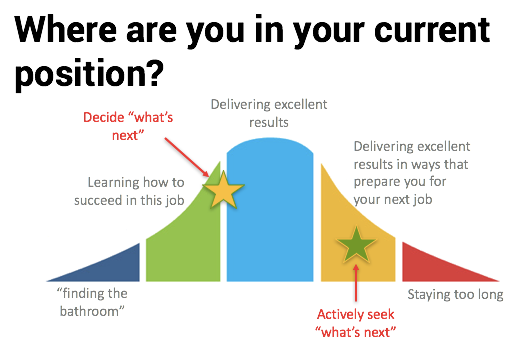
Jobs have a natural progression, illustrated in the graphic below, where we go through the process of learning how to succeed, and then accomplishing successes, and then building on your success to position you for your next big accomplishment. And if you don’t move on to your next thing within the job you have, you probably have stayed too long.
The key is for you to realize that in order to keep growing in your career, you have to notice the point at which you’ve accomplished a lot of what your current job offers you and then leverage your personal growth to accomplish new things. Sometimes your current job can adapt to allow you to grow into new capabilities and sometimes it can’t. This point may take a year or two or it may take decades, depending on you and your job. For many these days, it’s a shorter period of time (about 4 years in the private sector), which is why I encourage people to think about their career as fluid, and to focus on career health in addition to job satisfaction.
Yes, you can stay at your job too long. – Click To Tweet
It’s not your employer’s job to manage your personal growth
The problem for many of us is that we have unconsciously given the responsibility for our personal growth to our employers. We get a job and expect it (and our boss) to keep feeding our interests. It’s possible that this is what’s going on for you. You’re unconsciously bitter at your employer for not keeping your job interesting, when in fact it’s you that has grown to the point where you’re ready to learn new things.
What can you do to keep growing in your career if this job has gotten bored? Even though it’s obvious that you can look for another job, it’s not necessarily what I recommend as step one. Step one, is really for you to sit down and take stock of where you are in your life and career. Based on this, you can work on developing your ideas about your dream jobat this point in your life. Do this regularly because it will keep changing! We should all do this every year or two at least.
Armed with this information, you can take a fresh look at your current job and examine whether it has the potential to become your dream job if you make some tweaks here and there. Even if you believe your current job can’t become your dream job, it may be a good idea to talk to your boss. For all you know, she has ideas on how your job could change, or whether there are other opportunities at the company that might be well suited to your development path. But don’t give your boss an ultimatum unless you’re ready to leave your job if she can’t make you a better offer.
So how long should you stay at a job? That’s up to you and your job, but that’s the question you should be asking yourself on a very regular basis, and listen to the answer! We have lots of resources here in our Coaching Community to help you in this process. Use them!
There was recently a wonderful article at HBR.com about competence vs. confidence and how people respond to both. How does this relate to imposter syndrome? As defined by an article in the New York Times:
Two American psychologists, Pauline Clance and Suzanne Imes, gave it a name in 1978: the impostor syndrome. They described it as a feeling of “phoniness in people who believe that they are not intelligent, capable or creative despite evidence of high achievement.” While these people “are highly motivated to achieve,” they also “live in fear of being ‘found out’ or exposed as frauds.”
—Carl Richards, Learning to Deal With the Impostor Syndrome, New York Times
Imposter syndrome is that little voice in your head that tells you that you are a fraud, that you’ll be found out, that you aren’t good enough. If you hear it enough, it can impact your confidence. And that impacts how people perceive you.
What’s challenging about the fluid career is that you aren’t only making changes to your career or job on paper; you are also making changes that change you and your perception of yourself. You are changing how you define yourself too. If you are switching jobs every 3.7 years, you need to always be ready to make a move – networking and flowing. How does imposter syndrome stop that from happening?
You may decide that you need to have 100% of the qualifications rather than most before making the switch (read The Economist article for more information for how women have this challenge more than men). Or that you could never do the new job because you believe that you can barely do your current job. Or that work comes too easy for you versus other people.
We’ll be discussing:
Imposter syndrome and how it impacts you – especially with a fluid career
How a fluid career could magnify imposter syndrome
How to view your accomplishments in the world of fluid careers
Confidence vs. competence, imposter syndrome and fluid career
What’s a fluid career?
Dana Theus has been observing a new career trend – fluid careers. The average tenure of a job for professionals is 3.5 years. This means that someone could have up to 10-12 jobs in a lifetime and possibly 2-3+ careers. It is freeing, in that it gives people more control to design more work-life balance in their career over time, and anxiety-producing as it can feel less stable if one defines success as “a job that lasts at least 10 years.” This fluid employment trend takes into account the growth in both entrepreneurship and the Gig Economy, reductions in employee tenure, increases in employee dissatisfaction and increases in employee turnover.
About Vreneli Stadelmaier
Holding an MBA, registered coach, source of inspiration, speaker, entrepreneur, author, blogger and publisher. She owns the company SheConsult, which addresses imposter syndrome in women. You can get a copy of her book, Sure She Can to better understand her approach to overcome imposter syndrome. In 2015, winner of the prestigious Joke Smit Award for gender equality, awarded by the Dutch government. Divorced, married again (with another man), mother of three children and two bonus children.
She is working on a new book now, Yes She’s Smart. She wrote the book especially for new women graduates. They do well while at university, but after graduation lose their ambitions due to low self-confidence, not understanding what it means to be in a masculine organization, worries about combining a career and family, and other influences in their career choices.
FREE PDF Guide to Women in Leadership
Executive Coach Dana Theus shares her tried and true strategies to help women excel in higher levels of leadership and achieve their executive potential.
Welcome to “Dear Dana”, our weekly column to give you career and workplace advice/coaching. Please write in and tell me about a career challenge or frustration you’re facing at the office! – Dana Theus
Dear Dana, Thanks for the opportunity to seek your guidance and expertise for personal balance. At the present time I choose to work from home. Most of this is working very well and has even lead to some growth in clients, also allowing me to expand my offerings. As exciting as this is, I find myself lacking motivation. It’s like I want all the wealth and fame, but can’t seem to get up and get going to do it. I know what I should do, but I’m dragging my feet. What suggestions do you have for people working from home offices out of secluded locations? Relocation is not an option at this point. -Dragging my feet in Des Moines
Dear Dragging,
Thanks so much for your question. I really feel this one, as I also work at home and have gone through periods where I had just this challenge. Some of the advice I’m going to give you is stuff I’m still working on myself! (more…)
Welcome to “Dear Dana”, our weekly column to give you career and workplace advice/coaching. Please write in and tell me about a career challenge or frustration you’re facing at the office! – Dana Theus
Currently, I am working for a software company that makes software for the public sector. I have my bachelors degree in business administration with a concentration in management. I have been at this company for 3 and a half years, with 1 promotion since I’ve been here. I am currently thinking that it might be time to take the next step with my career, but not sure where to go. I like the technical aspect of my job, but being on the phone with clients all day, doing some of the same things over and over, is getting to be stressful. Would like to look for a more analytical role. The department I am in has little if any room for growth, and there are no openings in other departments. Have taken a test at the state with my names on a few lists, but no luck so far. Any insight into the next career move would be greatly appreciated. – Itchy in Ithaca
Hi Itchy!
It sounds to me like your current experience has been a good one and positions you well for your next step. The fact that you’re fairly clear on what it is about your current position that you like and don’t like is really good because it will help you focus on taking your next step. It’s also good that you’re not miserable and ready to “take anything that comes along.” This gives you time to plot out a move to your “perfect job,” which increases the likelihood you’ll really enjoy your next position. Getting clear on WHY you want to move on and WHAT you’re looking for will really help smooth the process.
Welcome to “Dear Dana”, our weekly column to give you career and workplace advice/coaching. Please write in and tell me about a career challenge or frustration you’re facing at the office! – Dana Theus
Dear Dana, I have found that all three websites I’ve used to apply for jobs have a requirement for applicants to provide their salary requirement/expectation. I found that surprising. I’m interested in knowing how common that is, and whether employers expect that there will still be negotiations or not. Also, if my salary is lower than the job, does that help me in the application process? Thanks, Curious in Columbus
Dear Curious,
I’m afraid it’s very common on web sites to ask for information on your previous/current salary. It’s less common in face-to-face interactions until they’re ready to offer you the job. Unless they ask, you’re under no obligation to give them salary information in the application or screening interviews, and I recommend that you don’t (with one exception, see below). The fact is that once they know your current salary, you’re at a disadvantage in potential salary negotiations, but this doesn’t mean you’ll lose. The goal is to put off the issue of salary as late into the interview process as possible so that by the time it comes up both of you know if you’re a good candidate for the job and they know why they want you so they are incentivized to give you a higher salary than what you’re currently making.
Having a well-placed, successful mentor can be the difference between success and failure on the leadership track – but it is definitely more an art than a science for the mentor and the mentee.
I recently started hosting a radio show interviewing CEOs of small-to-mid-sized companies. One question that male leaders love to answer is “tell us about your mentors?” It turns out that very few men make it to the top without mentors. For women, this experience is less consistent. I believe it’s because the “old girls club” works more like a sewing circle than a smoke-filled room and for better or worse, some women just don’t feel comfortable bringing up the next generation in a deliberately helpful manner. This is changing, of course, as more women succeed, but I find that women benefit more from “learning how” to mentor and be a mentee. It makes a difference for leadership mentors for women, although it’s not as culturally obvious to us how mentorship works and how we can use it to our advantage.
In her book, Lean In, Sheryl Sandberg devotes a whole chapter to the subject of mentorship and she calls it “Are You My Mentor?” because she observes that too many women go around looking for a mentor like they’re looking for a golden slipper. I love that chapter and if you haven’t read the book yet, do so and make sure you read this chapter.
Here is some of the wisdom about mentors combined from Sheryl and me. (more…)
Welcome to “Dear Dana”, our weekly column to give you career and workplace advice/coaching. Please write in and tell me about a career challenge or frustration you’re facing at the office! – Dana Theus
Dear Dana,
What am I missing in salary negotiations? I think I left more than a little bit on the table here. But how do you know what you should be getting paid versus what you are offered and if it is a good deal?
I was working in a consulting firm. At the time (about 10 years ago), I was making $80K/year + benefits + unlimited expense account. I had a Master’s degree and a good amount of work experience. I thought I was getting a decent deal at the time, especially since I negotiated up $20K from my previous position.
I was in a management role on the project, identifying staff we needed for better delivery, assisting with requirements as needed (we had teams to do that, but I was reviewing for gaps), managing deliverable timelines, writing proposals, helping communication between members occur – all of that.
A colleague who had an MBA was making 3x what I was – and her role was to lead a team for requirements gathering. That was it! She didn’t have more to manage or deliver. Needless to say, I was shocked and annoyed at the difference in our pay – and work expectations.
But what do you do in a situation like that? How do you ask for additional compensation? Do you wait for the next review cycle? How does that work? – Underpaid in Memphis
Dear Underpaid:
As I was reading your note, I was thinking, “Yeah, $80,000 is too low…” and then you hit me with the whopper of your colleague’s salary. She had an MBA, which will often put a bump into anyone’s package, but 3x is not all due to her degree!
Here’s the thing about salary: your employer has incentive to pay you as little as they can. Even when they want to be “fair,” they will more than likely look for the lowest “win-win” number they can when you’re negotiating. There are a lot of reasons for this, and this truth is not likely to change, so you have to do the changing and get into a smart salary negotiation mindset.
There’s a lot of confusion and anxiety running around the Internet these days, and it feels relentless, like we’re drowning in the next big thing every time a text alert comes in. When I started writing this, I was thinking of the Women’s March on Washington (and every other city center) that turned out 3 million marchers worldwide to stand up for women’s rights, but by the time I edited it a week later, pussy hats had fallen below the fold and Trump’s Immigration Ban was sucking the air out of the Internet. For the first time in my adult life I’ve found myself googling puppy videos just to find something non-alarmist to look at when I take a work break. (Think I’m kidding? Here’s a favorite my mom discovered.)
Even though the topic du jour seems to shift pretty quickly, one theme of my hyperventilating news feeds has been consistent for months, and that is the constant drumbeat of fear. All sides say they’re afraid — of outsiders, insiders and each other. One can argue that fear is never far from the headlines, but something else has been new lately, and that is a conversation about women’s issues and the things that come with it, discrimination, equal pay, misogyny, reproductive rights and the role men play in helping us or hurting us. One man in particular has caught the public eye for his treatment of women; our newest president, Donald Trump. And no one seems to understand how and why women react to him with such a wide variety of feelings, from fear to attraction. As I’ve puzzled on this, I keep circling around the question of Trump and women – should we be afraid of him?
After the election, I was having dinner with some friends and one of the men said, “What’s with Trump and women voters? Why did so many women vote for him?” He was referring to the fact that although only 42% of all women voted for Trump, 53% of white women did so, despite the pussy-grabbing video that saturated the news in the weeks before the election.
Welcome to “Dear Dana”, our weekly column to give you career and workplace advice/coaching. Please write in and tell me about a career challenge or frustration you’re facing at the office! – Dana Theus
Dear Dana,
For a number of years I had my own business. However, I decided to return to being an employee to expand my experience. I came onto the team as an individual contributor, and was told I would become a manager in a year or two. Colleagues already in line for a promotion made it to the next level, but I wasn’t stressed because I knew I was new.
Then there was a reorg. I was placed in a new team. I was also told that I wouldn’t be promoted for another 3-5 years. Also, I learned by accident from a peer who did get promoted that she was making +$50K/year more than I was. Sure, she had 15 years more on me in the company, but still. +$50K?
What should I have done differently when I went to work for that company?
— Shoulda-coulda been a Manager in Milwaukee
Dear Shoulda-coulda,
Hindsight is tricky. There are certainly lessons for you there, but it’s also too easy to beat yourself up unnecessarily. The key is to realize that all your previous experience—good and bad—has made you who you are today, and that you’re still learning and growing. Comparing yourself to others is never going to give you the insights you need to find the way to your highest potential as well as comparing yourself to your own highest aspirations for yourself.
That said, you did get some big lessons you can learn from going forward….

 Jeff is a freelance writer and works on the ethical considerations of economic development and cash aid programs around the world. He currently works in Honduras, supporting local community projects through micro-finance and holds two degrees in Philosophy and International Affairs. Follow Jeff’s blog Suddenly Human.