by Guest Author | Dec 19, 2013 | Career Development, Commentary, InPower Women Blog, Work-Life Blend
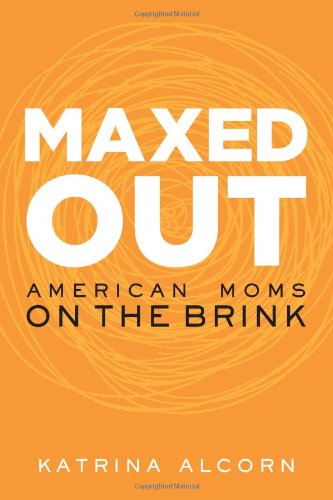
Moms know how much stress they’re under, but what does a non-mom work stress expert think? We really appreciate that Paula took a look at stress through a mother’s eyes in today’s post where she reviewed the new book by Katrina Alcorn, Maxed Out. Along the way, Paula teaches us all about stress management, whether we have kids or not. – InPower Editors
I wanted to read Maxed Out: American Moms On The Brink because it’s about one of my favorite subjects – burnout. As a recovering burnout sufferer and someone who now studies the topic for a living, I’m always eager to read new information that might help others prevent it and grow more resiliant. As a non-mom, I was also expecting to learn a little about motherhood, and I was surprised at how much I didn’t know about the difficulties of working and raising a family.
The author, Katrina Alcorn, is an engaging writer who puts the reader front and center in her quest to answer the question many women ask: “Can I raise a family and work too?” Most of my friends are going through the same thing, yet, I am often not privy to their struggles, likely because they assume they will bore me with their tales of soccer practice, doctor’s appointments, and breast feeding. I wish they would let me into their world more.
I teach professionals about the six sources of burnout and work stress that have been studied and researched by Drs. Michael Leiter and Christina Maslach. While these six sources have been studied with regard to their applicability at work, I am surprised at how well they translate to non-work. The six sources are as follows:
Lack of control: Your sense of control over what you do in undermined or limited, and you don’t have a lot of say in what’s going on.
Values conflict: There is a disconnect between your core values and the core values of “it” (“it” is work, according to the research, but could also be something bigger, like society or culture).
Insufficient reward: You feel taken for granted, not recognized and/or undercompensated (I think this describes most mom’s I’ve ever met).
Work overload: Work is too much, too complex, or too urgent.
Unfairness: You or others are treated unfairly, there is a culture of favoritism and assignments and promotions are made in an arbitrary fashion and discussed behind closed doors.
Breakdown of connection/community: You have to work with patronizing colleagues, there is no mechanism for conflict resolution, and feedback is non-existent.
Several of these sources are highlighted in Ms. Alcorn’s book. First, she distinguishes between “busy” and “Busy” when comparing her workload to non-parents. I was also struck by the research she references about productivity – for industrial workers, productivity dramatically decreases after eight hours a day; for knowledge workers, productivity decreases after just six.
Next, I was struck by the numerous examples of values conflict. Not only the conflict in values between Ms. Alcorn (“I need some flexibility) and her boss (“Flexibility to a point, then hey, I have a business to run”) but also more globally between working moms (“I’d like a private place to pump”) and Corporate America (“Try the broom closet; and p.s. I have a business to run”).
Finally, While Ms. Alcorn has a small support system in the Bay area, she mentions that her parents and family do not live nearby. My parents were fortunate to live in a cocoon of help when they raised my brother and me. One set of grandparents lived right across the street, and the other set was seven miles away. Living in a small town had its advantages as my parents knew and relied on most of their neighbors for help. When women choose to work and raise children, it really does take a village, and when they need the help of others most during this time, many are doing so with support systems that are too small.
I really enjoyed this book, and it opened my eyes to the reality many working moms face. I hope to read more about Ms. Alcorn’s world soon.
Take charge of your career development to get the job that supports your work and your life. Check out the tools and resources in the InPower Coaching Career Center.
by Guest Author | Dec 18, 2013 | Coaching Advice, Personal Mastery
A client and I recently strategized what I thought was an awesome move for her… and she emailed me back a few minutes after we hung up with this simple statement: “My boss said no.”
I was disappointed for her because the approach would really have positioned her well among her peers and superiors. But hey, the boss said no. I emailed back and told her to pretend it wasn’t about her.
This advice, she said, helped but she was confused about the boss’ response, so I encouraged her to talk to her boss more about it after some time had gone by. I spoke with her a week or so later and it turns out that, it seems that the boss was concerned with the way her proposal would have cluttered up some other proposals he had in the works. So, it wasn’t really about her, it was just poor timing for her to put that particular proposal on the table.
It’s Not (Always) About You
The fact is, sometimes is IS about you. However, going straight “there” and concluding that whatever the rejection, it’s your fault is really missing an important problem-solving opportunity.
And in fact, problem-solving is at the heart of business. However, most of us get fixated on our own problems and forget that everyone else – including the boss – has problems too.
If you want to reduce the amount of rejection you get, make sure you’re focused on the right problems, yours, your bosses and the company’s. This can mean that you focus on solving problems your boss has, or relating the problems you have to priorities you know the boss shares. Either way you reduce the chance of rejection when you’re focused on problems many people think are the ones that deserve attention.
How To Deal With Rejection – Emotionally
(more…)
by Guest Author | Dec 18, 2013 | Career Development, InPower Women Blog, Leadership
We all want to know how to be perfect – or do we? While many women struggle to show vulnerability, Andria shows us how this very skill is critical to becoming a trusted leader. We hope you enjoy Andria’s vision of “perfection” form women leaders. – InPower Editors
I’ve been gathering 360-assessment feedback on a new client I’m coaching and am thrilled with the candid input her peers and subordinates have been providing. During the feedback gathering process, I uncovered a consistent theme around the topic of perfectionism. I wanted to share this information because I find this is a common theme amongst women. I see it not only in women I coach who are new to their roles or in higher level positions but also as a general theme for most women. It seems we like to try to be perfect and do everything “just right”. We don’t want others to know when we’re struggling or allow ourselves the beauty of just being who we truly are – imperfect but wonderful women.
This particular individual I am currently coaching is new to a Vice President role in a $1B corporation. She was promoted a few months ago and, as with many I’ve coached in similar situations, she seems to be striving to be perfect. She is taking on more and more, refusing to say no, and delivering a lot of (perceived) “company lines” which are being received by her peers and subordinates with some uncertainty. Why? Because they cannot sense who she truly is, what she believes and what she is all about. Instead, they sense that she wants to know how to be perfect and live up to some “ideal corporate image” instead of being a real person, a leader who has flaws and doesn’t know it all. They are uneasy about a person who seems to be striving for perfectionism because they, (as most people) know, that is a recipe for failure – no one is perfect nor can they be.
Some of the specific feedback I received was, “I wish she’d just let us know what she’s struggling with so we can help her”, and, “I want to know what she thinks is best to do and what her desires are, separate from those set by the corporation”.
I love getting this type of feedback and giving it to the women I coach because it is always eye-opening for them. Although they know perfectionism is an unrealistic goal, hearing this type of feedback seems to give them permission to let go of that goal. They realize they don’t have to be perfect and they can be real people and be their true selves, even (and especially) in the workplace. They discover that is what their subordinates (and their peers, and yes, even their bosses) want. They want the real person.
Being the “real person” is what makes them true leaders; not trying to be perfect but simply being who they truly are. I know that I personally work on this all the time. I have to remind myself that being imperfect is part of being human. I have to remember that my clients, my colleagues, and those who work on my team respect me because of (and in spite of) my flaws. They make me real and allow me to connect with those in my life at a much more authentic level. So, the message is simple: stop trying to be perfect but instead just be you! It’s just like Oscar Wilde said, “Be yourself – everyone else is already taken.”
What do you do to battle the desire for perfectionism? How do you remind yourself that, despite your flaws, you are always enough? Do you really want to know how to be perfect, or just how to be YOU.
Take charge of your career development to get the job that supports your work and your life. Check out the tools and resources in the InPower Coaching Career Center.
by Guest Author | Dec 17, 2013 | Career Development, Coaching Advice
Women and men both find confidence a key success skill, and we all find it challenging to muster up sometimes too! We really like John’s practical advice for finding your inner confidence and hope you do too! – InPower Editors
A number of people I’ve worked with have told me that they struggle with confidence. That is natural, and a lot more common than they probably realize. Yet, many of them are givers — they truly care about others and go out of their way to help people. They are all about the team, not themselves.
Being a giver is a very special quality. It can be the support of our success and our happiness – and our inner confidence.
In business, as well as in life, it is so important to have a sense of inner confidence. I believe that inner confidence coupled with humility allows us to say to ourselves and to another, “Hey, I’m glad I am the way I am. Could I be better? Sure. Let’s face it, we all could be better
— and let’s all try to be our best selves.”
Allowing ourselves to be vulnerable in this way with another person is a gateway to developing trust in the relationship. If we can be ourselves, we invite others to be genuine, as well. This is when meaningful conversations occur, which inspire reflection and commitment to improvement. Inner confidence and humility also allow us to encourage and root for the other person, to want to see others succeed, and to help them.
So, how do we gain inner confidence? How do we feel good about ourselves and our abilities, and not constantly compete or compare ourselves with others?
As with so much in life, our attitude means so much, a positive attitude, positive energy.
Let’s not listen to our inner voice that says we’re not smart enough, or successful enough, or we’re not attractive and so on. We all have that inner voice, and it does not serve us well. Focusing on gratitude and appreciation is a strategy to ignore it. As a book title suggests, focus on the good stuff!
And know that a smile goes a long way.
Our positive energy includes the way we carry ourselves. Dress neatly. Walk like an athlete— purposefully, stand tall, head high, shoulders back, make comfortable eye contact, firm handshake, and a sense of “I own a share of the room”.
At a reception or other event, look for the person who is by her or himself, go up to that person and have a conversation. She or he will appreciate your initiative and you will have a new friend.
Different scenario: imagine you’re in an important meeting. There’s a problem being discussed and you’ve got some ideas but you’re reluctant to speak up. Concentrate on the solution and that fact that you’re helping the company. Now take a deep breath and go ahead and offer to fix it.
Or ask a powerful question, a question that gets people thinking.
Make things happen. Contribute your ideas. Don’t complain. Help your company grow by identifying potential new clients and services or products.
Find out what needs to be done and just do it.
My friend and former colleague, Christine LaSala, recently shared with me that early in her career, her strategy for feeling secure (at the time, in a male dominated environment) was to be the most prepared and most knowledgeable person in the room. That works, male or female, all the time!
Certainly, gaining confidence is a process. It’s our positive attitude coupled with our actions, taking small, simple steps that are the right things to think, say and do.
The path to feeling secure about ourselves can begin with little things, like holding a door open for others, letting in a car in front of you, folding your napkin in a restaurant, returning a shopping cart in a parking lot and being kind to strangers.
Yes, these are little things, yet they are the right things to do. It’s how we contribute to civility, how we show appreciation and respect for others.
Be truthful, kind, encouraging and unifying – this Zen principle is worth following.
Our qualities and actions are our essence and when we act with honesty and integrity, this helps us to be comfortable with ourselves and in our relationships.
Relationships are so important, and relationships are best established with conversations, not simply emails, when we listen to understand and learn. This leads to trust, and when we sense that people respect and trust us, our confidence is boosted.
Let’s remember to ask questions about the other person, be curious, and be a good and patient listener. What is the person saying, not saying, and feeling? Ask questions to show you genuinely care. These actions convey respect and humility, much more so than talking about ourselves.
Follow the principle of listening a lot more than speaking. Try listening 80% of the time. You’ll be respected and you will likely sense that and strengthen your inner confidence.
Remember that people with quiet confidence are focused on others.
There are good books, quick helpful reads with insight and wisdom. I’d be happy to give recommendations. Just email me.
The bottom line is to maintain a positive attitude, respect others, do the little and right things, carry yourself well, be there for others, and focus on appreciation and gratitude.
As a quote I read on the internet, Tumblr, says “Be-YOU-tiful!”
About The Author
John Keyser is the founder and principal of Common Sense Leadership, www.commonsenseleadership.com. He works with executives helping them develop organizational cultures that will produce outstanding financial results year after year, and a striving for continuous improvement, theirs and their team’s. His contact information is john@johnkeysercoach.com and 202-236-2800.
Take charge of your career development to get the job that supports your work and your life. Check out the tools and resources in the InPower Coaching Career Center.
by Guest Author | Dec 12, 2013 | Coaching Advice, Corporate Culture, Emotional Intelligence at Work, Work-Life Blend
More and more women are waking up to the fact that life in corporate America often isn’t a good fit with the life they want to lead. This is why women are starting small businesses at such a fast rate. In this post (the first in a series), Dana looks more deeply at the growing gaps between employees (not just women) and the organizations that hire them. – InPower Editors
There’s a quiet revolution happening in the cubicles and hallways of America’s companies. According to the Bureau of Labor Statistics, in 2012 about 2 million people a month walked off the job. These employees, many of whom have attained a level of professional achievement equated with happiness — a steady paycheck, benefits and a rung on the upwardly mobile ladder — are risking all that success in an uncertain job market to quit in numbers we haven’t seen since the last time the job market was booming. This isn’t terribly surprising considering 74% of corporate workers say they would leave if they could.
This Seventy four percent of the American workforce reports feeling undervalued and unempowered. What this means is that three quarters of our workforce is dissatisfied, and over half of them (the half that aren’t leaving but want to) feel out of alignment with their companies and held hostage to their job by fear and uncertainty.
Psychologists will tell you that anyone who feels compelled to do what they’re doing out of fear is ripe for change. These high rates of dissatisfaction, when combined with the prospects for declining costs of health care and the lowering costs technology needed to start a new business, could be a revolution in the making.
What would a modern worker’s revolution like? Unlike the protests and violence of the labor movements in past generations, today’s smart-phone wielding workers revolt by leaving big companies to start their own. And in fact, the number of people who intend to start their own business has grown by 50%. Workers – especially the best and brightest – are overcoming their fears and striking out on their own to build companies that reflect the values they want to live.
With seventy four percent of workers unhappy and fifty percent planning to take action, there’s a case to be made that the revolution is already rumbling down the halls of corporate America.
This post originally appeared on Switch & Shift.
Check out the resources in the InPower Coaching EQ at Work and Soft Skills Research Index.
by Guest Author | Dec 11, 2013 | Career Development, Coaching Advice
The story goes that women don’t negotiate for themselves well. But we can. Especially when it’s for something important to us. We love insight from Katherine with tips on negotiating for one of the things we often want most – flexibility. – InPower Editors
For the last decade+ I have thought about work flexibility six ways to Sunday—coaching hundreds of women as they prepare to approach their employers about a non-traditional work structure. You can never gather enough strategies and solutions—and I was happy to discover an excellent take-away from the 85 Broads “Jam Session” designed to help women “Get the Flexibility You Want”.
The discussion leader was Katie Donovan of Equal Pay Negotiations, who advises women to develop a strong case supporting their value to the company. Her nifty “NAARC” acronym is a well-crafted template for organizing the pitch to your employer:
Network: Emphasize your personal and professional network and how it adds value to your employer.
Alignment: Acknowledge the changes that are evolving at your company and how your experience and expertise will continue to be relevant and valuable.
Awards & Accolades: Remind your boss about all the professional praise you have received both within and outside your company.
Revenue Increase: Show how you’re focused on making the company more successful—and profitable.
Cost Decrease: Highlight the efficiencies and overall cost savings you initiate and how you contribute to the bottom line.
When you’re making the pitch for flexibility, it’s all about reminding your employer—in a respectful, non-confrontational and collegial way—that you’re too good to lose. Employers know that most women eventually leave when they don’t get the flexibility they want or need.
Katie pointed out, however, that you should approach a flexibility discussion as a routine negotiation (84% of managers expect employees to negotiate their employment packages—and there is the greatest wiggle room with salary, vacation and flexibility), not as a veiled or overt threat of departure.
The key is having your NAARC pitch ready, and also being sensitive to how a more flexible schedule will affect your boss. Hit all the key issues—work focus and productivity, daily schedule and routine meeting adjustments, client interaction, travel—and more politically charged issues like whether granting you flexibility sets a precedent for your department or the company overall.
Katie points out that 80% of flexibility requests are granted because the employee has done good research—especially within their own companies and at competitors. Armed with information about what works and what doesn’t, you can head off many uninformed objections. And as you talk to many different people, you’ll identify resources that you can pass on to your boss (like www.freeconferencecall.com, a resource that was news to me).
As with all good things in life, flexibility is not going to be handed to you on a silver platter. You have to raise your hand and ask for what you want—and know that you’re not asking for anything out of the normal business realm. According to Katie, 80% of employers now offer some form of flexibility, there has been a 13% increase in flexibility with the most recent recession, and many companies actually see it as a problem solver (less office space, heating, cooling, phones, etc.) and a possible cost savings (they are not required to offer benefits to employees who work less than 30 hours).
Perhaps the best golden nugget from Katie’s discussion was her reminder not to negotiate flexibility with HR. Very few companies have a carved-in-stone flexible work policy—and if it’s not in the company handbook, it’s too likely HR will say no. It’s much easier to work out a mutually beneficial deal with your boss.
The key is to innovate, not hesitate. Too many women assume they will never get flexibility or give up after asking a one-line question (For example, “Is it possible for me to work one day at home?), rather than a providing a detailed proposal designed to “work both ways”. As a result, women leave the workforce in droves—often unnecessarily. As I say in my webinar, “Look Before You Leap”, do everything you can to get the flexibility you want so that your ongoing income will provide the very long-term financial security you need. –KAS
This post originally on: 9 Lives for Women
Take charge of your career development to get the job that supports your work and your life. Check out the tools and resources in the InPower Coaching Career Center.
by Guest Author | Dec 10, 2013 | Career Development, Coaching Advice
Many of us face confusing times in our life when the career we chose isn’t what we want to keep doing. This happened to Steve Donahue when he faced a career crisis and his life as a motivational speaker ran out of gas. So he went in search of new meaning and discovered that all personal change requires us to create a new narrative. Enjoy his story and check out the movie he made about his journey! ~InPower Editors
Personal change is hard, even if you’re in the business of helping others change. I make my living telling stories. Recently I discovered that I’d gotten stuck in my own story. The only way out was to stop telling my old tale and live my new one.
It started when I realized that I hated my job as a motivational speaker. I could motivate everyone but myself. People would say to me after a speech; “Steve, your presentation has completely changed my life!” And I’d be thinking; “Then repeat it back to me! What part worked?”
My problem was that I’d told the same story – about my youthful adventure across the Sahara Desert — almost a thousand times. My career became Groundhog Day. Like Bill Murray in the classic comedy every day was the same. For an adventurous soul like me, that’s the definition of hell.
What do you do when your story gets stale? I went in search of a new one and a reason to tell it. I traveled 72,000 miles over three years. My journey resulted in two bestsellers, one documentary film and rock star status – in Asia, of all places.
Along the way, I learned how powerfully the stories we tell about ourselves shape our lives. I learned that if we want to change jobs, overcome a career crisis or just become happier doing what we’re doing, we have to look at the stories we tell and are told. This is true for us individually and for the culture we create in our families, offices and communities.
3 Ways To Get Out Of An Old Story
We all tell stories and hear them in the culture around us. One of my favorites is the story of the “glass ceiling,” which certainly exists though many find their way around it. Changing the stories we tell can change everything, including how the “glass ceiling” does or doesn’t affect us. Here are three things you can do to get a new story when you face a career crisis like me, or anything else
GIVE THE OLD STORY BACK.
People will tell you to “let go of your old story”. But you can’t actually do that because you don’t have the story, the story has you. You must actively break the spell.
My old story was about my early travels in North Africa. So I went to the middle of the Sahara Desert to give it back. It was a great story. I needed it to carve out my career. But in order to get a new story I gave it back to the same tribe of nomads where I’d gotten it. Literally – I went back to Africa to give it back. That doesn’t mean that I never tell the story anymore. It just doesn’t own or define me now.
This step requires identifying your story and where it came from. The act of giving it back, although symbolic, is very powerful. This step is also personal. For example, people around you tell a story about how the glass ceiling limits your options. You don’t have to eradicate the glass ceiling from all of society or even the organization you work for, to stop it from limiting YOU. You just have to symbolically give it back to wherever you personally think it originated. When you give the story back it no longer owns you. Then, a new story about your true opportunities can emerge.
2. PURSUE PLOT CHANGES.
Action drives a story forward. You are not just the writer of your new story. You are also the protagonist. That means you have to actively pursue a new storyline.
A few months ago I asked my girlfriend to marry me. This was not a new story as we have each been married twice. My fiancée is an ardent feminist who has raised three feminist daughters and two feminist sons. I’d like to think of myself as a feminist too. But I asked her to take my last name, and then ducked. While crouching behind the couch I said; “It just feels more married.”
She agreed! In that moment part of her feminist story changed. Now we have a plot twist that will help create our new story about marriage.
3. KEEP THE ENDING A SURPRISE.
The best thing that I did to change my career narrative was to make a documentary film about my dilemma as I was living it. The hardest part was remembering that I was the main character. And the protagonist never knows how the story is going to end until he or she gets there.
The stories we tell ourselves are so powerful that we have to respect the process of story-making. You and your story are collaborators. The ending must be unknown for you to make an honest journey. If the ending is predetermined then you will try and rig the storyline from the start and you won’t believe it when it’s over. For example, smashing the glass ceiling might have, much to your surprise, nothing to do with that promotion you so desire. It might be more about starting your own business, volunteering for a non-profit or going back to school.
I recently traveled to Asia to find out why a book I’d written that sold 200 copies in Canada had been purchased by over 100,000 Koreans. I wanted to discover the secret to my success in a country I knew nothing about. I believed that this knowledge would change my work and point me in a new direction, which it did. But the direction was a total surprise and so is the new story that I acquired. It’s a delightful story to tell audiences. But more importantly, I’ve got a new story to tell myself about myself and that’s what has transformed my career.
Live your new story until you get to the finish, until you’ve created a story you’re excited about living. You’ll know when you’re “there” because it feels just like you watched a great film or read a good book. Satisfaction in a story well-lived isn’t because the credits are rolling or you’ve run out of pages. You know it’s the end because the story is complete. You feel both surprised and at the same time that strange sense of satisfaction that it could only have ended this way.
Steve Donahue is a writer, speaker and filmmaker. His film, Take My Advice – I Can’t, can be viewed at https://vimeo.com/ondemand/motivationlost. Steve has worked with over 500 organizations around the world including IBM, Pepsico, Roche, UPS, Boeing and The World Bank. He is currently pursuing a graduate certificate in executive coaching at Royal Roads University. Email. Blog. Twitter.
Take charge of your career development to get the job that supports your work and your life. Check out the tools and resources in the InPower Coaching Career Center.
by Guest Author | Dec 9, 2013 | Gender Research, InPower Women Blog
When issues of family-friendly policies in the U.S. come up, it’s hard for us to understand what’s possible since we have little precedent in this country, historically. This infographic sheds light on what policies look like in other countries, countries without the wealth and resources we have in the U.S.

Parenthood in Central & Eastern Europe – An infographic by Accace outsourcing.
by Guest Author | Dec 4, 2013 | Commentary, InPower Women Blog
Stay-at-home-dads encounter all the stresses as stay-at-home moms, and maybe more. We really like Vincent O’Keefe’s take on the how he and his working wife rescued each other and his review of Stew Friedman’s new book, “Baby Bust: New Choices for Men and Women in Work and Family”. – InPower Editors
“What is the point of this again?”
That’s the question my thirteen-year-old recently asked on a gorgeous afternoon as she flew through the trees on a zip line about twenty feet above the ground. Teen daughter’s angst one, weary father’s plan zip (literally).
I had been trying to find an outdoorsy adventure to wow my two daughters. The trip thrilled my ten-year-old, but my teen’s surprising reaction led to a gentle accusation: “Dad, I think you wanted boys instead of girls.”
“That’s not true,” I assured her. Then I had to smile to myself about the long road to my daughters’ very existence. When my wife, Michele, and I met back in college, having children was not in our plans. Michele never saw herself with kids because she knew that as a physician she would never have the time to be the stay-at-home mom her mother had been. And I certainly did not see myself as a stay-at-home father at that time.
These thoughts reverberated as I read Stew Friedman’s new book, Baby Bust: New Choices for Men and Women in Work and Family. The book analyzes a survey of male and female graduates of the Wharton School at The University of Pennsylvania in 1992 and 2012. Among the striking conclusions is that in their sample, “the rate of college graduates who plan to have children has dropped by about half over the past 20 years.” The sample is rather privileged, but Friedman’s research is consistent with other studies documenting a “baby bust” for Millennials—both men and women.
There are several negative reasons for the bust, but two stand out: Millennials can expect to work about 14 more hours per week than Gen Xers did at their age (hello 24/7 “smart” phone access), and student debt continues to grow (hello soaring tuition and dwindling aid). On the other hand, a key positive reason for the baby bust is increasing gender role flexibility (goodbye pressure to equate parenthood with fulfillment, especially for women).
For Friedman, a related benefit of increasing gender flexibility is the emergence of the stay-at-home dad, which he likens to women’s “new knight in shining armor.” As a veteran at-home dad, I am flattered but also ambivalent. Like Friedman, I applaud the fact that Millennial men feel greater freedom to “provide” for their families via childcare and domestic work.
The word “knight,” however, implies that I somehow saved a “damsel” in distress (not to mention there’s no “knight” equivalent for at-home mothers). You might say a “knight in milk-stained pajamas” rescued a “damsel with multiple degrees,” but even that is riddled with contradictions.
“Sheryl Sandberg’s “lean in” language is probably more appropriate here, though I would say Michele and I have been leaning “on” each other for years to make our family and work lives, well, work.”
Sheryl Sandberg’s “lean in” language is probably more appropriate here, though I would say Michele and I have been leaning “on” each other for years to make our family and work lives, well, work. In this sense we have been Millennials in Gen Xers’ clothing, but we remain extremely grateful that we’ve had the luxury of the at-home option.
Ironically, much of our mutual rescue story involves plans gone astray. After college, Michele and I raced to terminal degrees and started working – she in a medical residency, me as a full-time Lecturer at the University of Michigan. Only a few years later did we think seriously about parenthood, and for a variety of reasons (mainly financial), I decided to become a stay-at-home dad.
My plunge into at-home parenting was more cannonball than graceful dive, but that’s another story. In fact, so much “Dad out of water” absurdity ensued, I recently finished a memoir about the journey that I hope to publish soon. A chapter on my firstborn’s colic is titled “Take This Onesie and Shove It.”
Though Michele and I gradually changed our initial “baby bust” mentality, the work/family balance problems facing Millennials need to be addressed, even for those couples who finally feel liberated to opt out of parenthood by choice. The reason is that childless (or “child-free”) couples are still likely to end up caregivers someday—for their aging parents.
Friedman offers helpful strategies to increase flexibility in work hours and decrease debt. I agree that flexibility is essential for meeting the inflexible needs of both babies and elderly parents. My at-home arrangement has been invaluable as siblings and I face a divorced mother in the early stages of Alzheimer’s disease and a widowed father-in-law who needs frequent long-recovery heart surgeries. (For decades, my father-in-law worked on a Ford assembly line in a world of fixed gender roles, so my comical caregiving scenes with him feel like an “Odd Couple” remake from different eras of masculinity.)
Such absurd gender moments always constitute a “first” for me, which brings me back to that zip line. Shortly after my teen’s “pointed” question from the trees, we saw a plaque in a nearby boutique that read: “When was the last time you did something for the first time?” I pounced and used it to justify the zip line; she smiled begrudgingly and continued texting. Weary parent ties game.
I realize now that as an at-home dad of two daughters, I do something for the first time virtually every day. (Recently I watched a full episode of “Say Yes to the Dress,” for example.) And I like to think all those little experiments are baby steps toward increasing gender role flexibility in the world my daughters will inherit—a cultural process that sometimes seems to move at the speed of Godot.
In similar terms, Friedman outlines a system of experimentation towards the end of his book, with the goal of furthering “the idea that men and women can and must have freedom of choice in how they live, work, and contribute to making the world better for the generations to come.” In my mind’s do-over, that’s what he and I yell to my dead-eyed teen as she zips through the trees.
This was originally posted on ShriverReport.org – a digital destination that inspires conversations about our modern realities, such as Stay at Home Dads and Chivalry and Equality.
by Guest Author | Dec 3, 2013 | Career Development, Coaching Advice
 Feeling “burned out” seems to be a normal part of working life, but like Laurie, we’ve found it really doesn’t have to be. Laurie’s advice really works to help you find your own kind of “balance,” that doesn’t require you to sacrifice yourself in order to achieve success! – InPower Editors
I look back at my early days in the workforce and am embarrassed by my hair-on-fire approach to deadlines and over-sized workloads. As I matured, instead of running around like a chicken with her head cut-off, I internalized the stress and anxiety of multiple and conflicting deadlines and obligations.
This way managing my time, coping with stress and trying to have it all contributed to me being diagnosed with a nasty auto-immune condition in 2009. I’m not saying you’ll get sick if you don’t stop your crazy busy ways. What I am saying is 70 to 90% of all doctor’s visits are related to stress. You do the math.
“Time management” has been my Achilles heel. It’s also the weak link for most people I meet. Today I want to help you clear your time scarcity and [gasp] have it all.
Time Is A Conversation
When I received that unfortunate diagnosis a few years ago, I knew that of all the things I needed to change, my relationship to time was at the top of the list. If you’re a high-achiever like me you’ve spent some time learning how to better manage your time. Some gurus will give you a system with a fancy planner. Some will tell you to create a “not to do” list. Still others will tell you to stop managing your time and start managing your energy.
They are all correct. But they all miss the point.
The thing about time management systems is they work great for the people who create them. But adopting someone else’s system is like using someone else’s gumbo recipe. It’s always going to taste better with your own touch.
I eventually created my own system that worked for me and my new self-care first life. The system worked brilliantly to keep me balanced, relaxed and productive. I even accomplished more.
Then I decided that becoming my own boss was the way out of my time conflict. (Ok, for those of you rolling on the floor laughing at my delusion, you can get up now). Life of course got more complicated. Each initiative and project added another layer of complexity to my life. Systems adjustments ensued and I got the job done, but often with a crazy busy-ness I wanted to avoid.
A few weeks ago I had an opportunity to deepen my relationship with others and myself by enrolling in a Gratitude Masterful Living leadership program. This was an opportunity to take my life (and others) from great to excellent. I almost didn’t enroll in the training because of the time commitment.
Wait – here I had an opportunity to create an excellent life and become a more effective leader and I was going to skip it because of the time commitment? That’s when I realized that while time management got me (and you) from good to great, no time management system would get me (or you) to excellent.
Excellence required a new conversation with time.
Bending Time
We are all strapped for time. Or so we think. In reality, we are strapped by our thinking about time. Our thoughts create our reality (i.e., “I don’t have enough time”). In fact, our thoughts are not our reality (i.e. we always have time for what’s important). The reality, as Einstein proved, is time is relative. It’s our thinking that expands or contracts time.
I recognize I may be blowing your mind right now. You may even think I’m smoking something. Bear with me. Have you ever noticed how when you have 15 minutes to do something that usually takes you 30 minutes you get it done? Change your thinking and you change your reality. Live with urgency, not panic and you can do anything.
As I have gone full force in this leadership training, while also conducting research on well-being and company growth AND running my business AND being a good wife AND taking care of myself I have learned the mantra that has changed my time conversation upside down – I get to have it all.
We Get To Have It All
Having it all is a divisive idea, especially amongst women. Whole books have been written making the case for having it all or not having it all. Many navigate the debate by saying you can have it all, but not at the same time. Honestly, that’s a cop out. Change your relationship with time and you do get to have it all. Click here to tweet that brain twister.
As I was struggling with this concept, the other day my coach suggested I look up wu wei. Wu wei is a Taoist concept meaning non-action or non-doing. For those type-A personalities like myself this seems blasphemous. But hear me out because this works every time.
Non-action or non-doing does not mean sitting around doing nothing. Non-action is really about effortless action. The example often given is a tree grows without trying to grow. Stated differently, a tree grows without effort.
When we try to have it all, as in being crazy busy, hair on fire, rising blood pressure trying, we are wasting both physical and mental energy. We are in effort and we are not leading. We get less done.
So how does non-action work?
Stop Trying Or Doing And Start Being
I’ll admit I’m relatively new to working with this concept (I’ve known it for years but without practice it’s been useless), but here is what I’ve discovered thus far. When you find yourself trying to do something, you are thinking about all that needs to get done or what didn’t get done. Here are some sample conversations:
“I don’t have enough time.”
“I can’t possibly get it all done.”
“I wish I had more time.”
“I have so much to do.”
“I have too much to do.”
When we are having this conversation about time, we are not present which means we aren’t taking action (with or without effort).
To live wu wei and excel in work and life, is to end that energy sucking conversation and just be. For example, if you need to be energized to do your work, be energized. If you need to be contemplative to start a project, be contemplative. When you aren’t being as you need to be, you instead spend time and energy being something else—worried, anxious, stressed, etc.
The result of being, living and working in wu wei is less stress, more happiness and greater productivity. How do you need to be today to accomplish your goals? Let us know in the comments below.
Originally posted on/Photo Credit: The Ignite Well Being Institute
Personal note from InPower founder, Dana Theus. The ideas in this article are mind-blowingly powerful when you put them into practice. Learning the skills to do this has so many happy side effects, including reduced stress, greater productivity and improved health. It doesn’t often happen over night, but it doesn’t have to take very long, either. If you’re interested in mastering these concepts in your daily life, let’s talk about coaching options in your budget that will give you access to lessons and support to help you master your time, your energy, your focus and your life. Set up a free coaching call with me here to discuss.