Meetings are the one thing today’s workforce loves to hate. And now, with many office workers still working remotely in the pandemic, there’s an added layer to the meeting pain: “Zoom burnout.” Initially a fun way to stay connected to colleagues during the early weeks of the pandemic, workers are now reporting fatigue with non-stop virtual meetings.
As social distancing measures move into their sixth month, we’re all missing the informal connections that crop up throughout our day. Social gatherings are seriously curtailed, workplaces are shuttered (or operating only with essential workers) and vulnerable populations are taking extra care to isolate. Even essential workers are discouraged from “hanging out” with each other on the job. Connection is a basic human need. Without it, we feel isolated, and such detachment can create a kind of “background” drain on your energy, like an unnoticed app running on your phone that’s depleting its battery life.
Are You Causing Zoom Burnout?
As a leader, you may even inadvertently contribute to Zoom burnout by calling unnecessary meetings. While it’s normal to want connection, both for human reasons and to keep your team accountable, feelings of isolation may drive you to call a Zoom meeting a little too often. It’s a natural impulse and one that’s rooted in good intentions. But let’s examine those motivations for a moment.
In a virtual teaming environment, you may feel like if you’re not holding a meeting, people will forget you’re leading them, but that’s not the case. This worry is what Dana Theus calls an “out of power” mindset that sometimes causes us to call a meeting. She points out that the mere act of calling a meeting isn’t leadership. Leadership shows up in a variety of ways beyond leading meetings.
So, instead of defaulting to “Let’s hop on a Zoom meeting to sort this out,” consider for a moment why you’re calling a meeting. Is it to gather information, check in with team members, share good news, collaborate on an idea? Of course, it’s natural to want to connect to your team members. And you should! But you don’t always need to do it en masse. Perhaps a quick text or phone call would be better. Consider this: if you have a team of six and you call a one-hour meeting, you’re using seven hours of human potential to “check in.” But when you become more intentional about the reason for the meeting, you may find a different way to create that connection, and avoid creating Zoom burnout for your team.
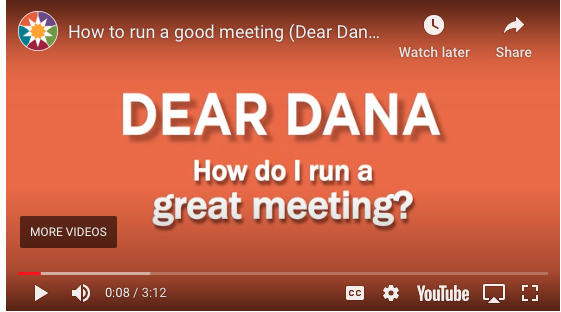
Want to know more about running an effective meeting — in person, or remotely? Check out InPower’s AMA video, “How Do I Run a Great Meeting?” in which Dana and I discuss five “out of power” mindsets that derail effective meeting leadership.
Avoiding Zoom Burnout for the Rest of Us
Of course we’re not all in charge of the meetings we feel we “have” to attend. So what do you do when your schedule is full of meetings other people schedule? Here are some quick tips to help you avoid meeting burnout for everyone else:
Know why you’re attending a meeting before confirming your attendance. Even if it’s a staff meeting, get clear with your boss on your role, what you’re contributing and whether there’s a portion of the meeting you can skip. Often just asking these questions helps the leader think more intentionally about structuring the meeting.
Use meetings to help shape your personal brand reputation. Show up with a clear idea of what you plan to contribute. Look for an opportunity to contribute in the first 15 minutes (when research says you’re most likely to be seen as an influencer.) Show up with a clear idea of what you want to take away. Engage proactively to ensure you get this result.
Try to schedule breaks for yourself and block your calendar so others can’t put you into back-to-back sitting marathons. The human body wasn’t meant for nonstop Zoom!
Battling Zoom burnout is a fact of the modern workday. Get proactive about fighting it! Everyone else struggling with the same challenge will thank you!
Ready to invest in yourself?
FREE Executive Coaching consultation with Dana Theus
One coach’s approach to becoming a better human being
I am profoundly uncomfortable.
I recently wrote an article for Smartbrief about how to lead in response to the protestsroiling our cities. While I stand by what I said, here is what I did not say in that article: I’m really not feeling like the expert right now. This is hard for a coach to admit, especially where clients and potential clients can see it. But there it is. Truth. Privilege, social justice and equity demand more of me now.
Despite having a personal intention to understand sexism and racism through the lens of privilege since Charlottesville in 2017, I’ve been largely unsuccessful engaging people who don’t look like me in a deeper dialog and on these topics. I’ve learned since beginning the journey that intention alone is not enough. Outreach is not enough. Even education is not enough, because this effort is not about me and solving my discomfort, but about me doing the work to get educated and be uncomfortable in order to begin to see things through a different lens. When I desire to “be educated by someone else” it means I’m still not understanding, or doing, or saying or thinking the thing that would help me become a better contributor in the healing process we as individuals and a society need right now. The fact is that I’m a middle class white woman, and this reality veils my eyes to degrees I’m still learning to see. It contributes to my own biases and struggles to clearly see the problems others feel in their bones. It makes it harder for me to contribute to solutions.
My clients (of all races, genders and nationalities) are also dealing with how to think and act in response to the issues which Black Lives Matter is pointing the spotlight on so effectively right now. So I feel compelled to be of service on this topic, despite my discomfort and inability to know the right way forward.
I am here to announce that I’m not looking for a solution, only a process by which I can grow. Anyone interested in growing with me is welcome on this ride. I welcome your experiences and opinions, if you feel compelled to share them. But this post is not about politics or rights and wrongs, only about the process I’m using to grow myself personally to be a stronger contributor to racial justice, equity and equal rights for all oppressed people. This is not global advice for everyone, or even all my clients. It’s just one coach’s approach to becoming a better human being.
Here are the key ways I’m challenging myself right now. I’m sure I’ll have more to say in the future.
Being Uncomfortable on the Ladder of Privilege and Inequity
When I coach and teach change leadership, I tell people that we succeed at change when we become comfortable in our discomfort, particularly when we encounter resistance. If the protests in the streets aren’t resistance, then nothing is, so I guess I’m taking my own advice by being uncomfortable thanks to them. Because I’m definitely uncomfortable, and not just about my non-expet feelings. It’s about being privileged and part of the problem.
Here’s how I’m thinking of privilege and inequity right now: as a ladder. Like most ladders, it’s narrow and can only hold one person at a time on any particular rung. Everyone has a place above or below the next person in line.
Even though I don’t like hierarchies and spend a lot of energy trying to exist outside them, it’s a simple fact of human nature that when people are in a group, they compare themselves to each other and start falling into subgroups, some of which have benefits and status, which is then denied others. Absent very intentional efforts to offset these natural human dynamics, these denied benefits become inequities that look like racial, sexual, gender, age and ability-related discrimination and harassment. I’m not going to unpack the why’s and wherefore’s of this further except to say that this unfair sorting is both caused by, and reinforcing to, unconscious bias.
Unfortunately, privilege and inequity shows up in ways that look like this in our society today:
Historically oppressed people are dying at alarming rates due to COVID-19, Blacks three times more often and Native Americans are suffering more than whites both economically and through health outcomes.
Upward mobility in the US has been stagnant for 40 years, and wealth on Wall Street is no longer a reliable indicator of economic health for the average American.)
Clearly, I could go on.
Whether we want them to or not, these hierarchies create a ladder and confer upon people on the different rungs various privileges, which then create inequities. These inequities are both external (e.g., money, influence, power) and internal (e.g., safety, confidence, aspiration). This complex view of privilege isn’t new either, as evidenced by the video below from 2015, but I would say most people haven’t really gone through an exercise like this, much less taken the opportunity to process it for themselves and with the other people they experience it with. I know I haven’t.
These ladders of privilege and inequity are found in all human societies, on the playground and in the halls of leadership. They show up in ways that are physically, mentally, emotionally and spiritually harmful to everyone, most detrimental to those denied the benefits that privileged people enjoy. This shouldn’t come as a surprise to anyone, but it bears repeating: the stress and other factors that accompany a lower position on the privilege hierarchy will literally kill you more often, even when no one points a gun at you.
In other words, black people have a right to be majorly pissed off, and have been for centuries. Native Americans do too. And poor people. And women. And LGBTQIA people. And, and, and…
Focusing on the present for a moment, I’m connecting the last few years of social discomfort to the ladder. Just like #metoo helped give women a voice long silenced in the ‘discussion’ on sexual violence, harassment and discrimination, Black Lives Matter has been, and is, fighting to raise the voice of people too long oppressed about the discussion of privilege. I’m grateful that they’ve kept it up so that everyone can hear, including people like me who unintentionally, but did, allow our own privilege to blind us to their deepest pain.
Just like we women ask men to listen to “us” women for gender rights, black people have the right to ask “us” white people to listen to them. And so I’m trying to shut up and listen.
Seeing Myself on the Ladder of Privilege
I don’t want there to be a ladder. Just as many middle class white women, led by Sheryl Sandberg, have tried to redefine the career ladder into a jungle gym, I’d like there to be a social equity play space that allows people to crawl around to where they’re most comfortable, without having to knock other people off. I will continue doing what I can to build a bigger ladder to make this possible, but I need to be less naive and present to the reality that I don’t personally have the power to build such a cultural space by myself. I have to live on the ladder society has conferred on me while I work to build a bigger playground.
By listening more deeply to the conversations around inequity I’m coming to understand that the ladder of privilege is much taller and more complex than I thought. And almost no one, myself included, actually sees ourselves on this ladder at all. Seeing the ladder is the first act of seeing privilege in many ways. We know who’s above us because we feel stepped on and it hurts. For myself I can say that until Charlottesville I was so busy looking up, I forget to look down and, more importantly, see that there are many rungs above and below me. When we don’t look down, we’re by definition failing to acknowledge the advantages that our rung gives us vis a vis all the other people on the ladder. And to the extent we can’t be as authentically proactive in taking action to help people experiencing inequity below us, we continue to be part of the problem. This means me. And you.
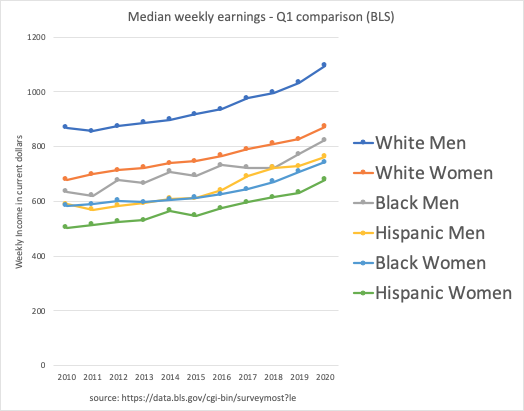
Here is the simplest and most quantifiable way I know to see the kind of harm our inaction creates in cold, hard cash, by looking at the gender and racial breakdown of the wage gap. The fact that “women earn less than men” has too often overshadowed the fact that white women are paid more than black and brown women. This deeper look at the wage gap represented below sadly mirrors other privilege ladders in health and mortality, police brutality, education, job opportunities and too many other aspects of what it takes to achieve health and happiness on this planet. And when white women cannot acknowledge the privilege our “status” on charts like this confers on us, we’re doing a deep disservice to our sisters who experience even less fair treatment than we do.
To be fair, the chart above is a poor representation of the entire privilege picture, since it leaves out other ethnicities, such as Asians, who report marginalization related to their race, and who earn more than the average white person. It also leaves out many other kinds of privilege, but the visual this chart offers is striking. When it comes to privilege, we’re not all on the same rung. But it is an excellent depiction of what pay INequity looks like in our society today..
This issue is not new. The inability for white women to understand and appreciate our privilege has been crystal clear to black women for a long time and black women have been trying to bring this to our attention since the days of bra burning and are still standing up with their truth.
So I’m working to be uncomfortable about my place on a ladder which I’m coming to see more clearly. I know what it’s like to feel unequal and unprivileged when I look “up” the ladder at men who don’t understand what it’s like to be in a female body. And I have to admit that I’m on that ladder in a place that confers upon me privileges others don’t have and leaves me without easy insight into issues this position creates for them.
I am open to learning more about the experiences of others on the ladder. Being open, I’m hearing more. And it is painful to listen to. Not just from a place of guilt but also from a place of compassion for those whose pain has been too long denied, gaslit and ignored. Here is an example I find particularly compelling. I have watched the video below many times and will continue to do so as Kimberly Latrice Jones taps into her well of knowledge, pain and anger to educate me, not only on the facts but on the emotions of the black experience in America.
What I’m learning is that like sexual discrimination I’ve experienced and helped female clients through, racism and privilege is a systemic inequity we all affect and are affected by. If you don’t believe me, watch this:
In addition to listening, opening and educating myself, I am learning to hold space for pain that is not mine, especially as it relates to my own privilege and using all this to choose who and how I want to be. I will share more on these strategies in future posts. For now, I’m interested in listening to your experience with privilege, racism, discrimination and inequity. Feel free to contact me at danatheus@inpowercoaching.com to share your thoughts and the questions and discomforts you’re sitting with. Together we’ll move forward one way or another. We always do.
FREE PDF Guide to Women in Leadership
Executive Coach Dana Theus shares her tried and true strategies to help women excel in higher levels of leadership and achieve their executive potential.
July 2021 update: Rereading this with the Delta variant running around and vaccination rates slow around the world, I’m amazed at our optimism almost a year ago. That said, the advice is still solid. – Dana
I had a terrific client call today about “the new normal” and how we both hope it’s NEW. It started when my client laughed while telling me that all the media popping up recently about turning the economy back on was giving her anxiety and stress. It turns out that five weeks in, she’s kind of getting used to working at home 100% of the time. She’s trained the kids when not to bug her and is spending more time with them than ever before. So she finds the idea of going back to “normal” literally terrifying!
While I’ve already waxed philosophical about what the future holds in the new normal, I enjoyed this client call because, while there are certainly stresses and strains in adjusting to working at home, many of my clients are discovering what I’ve enjoyed about working at home for almost two decades. Whether it’s the 10-yard commute, the ability to truly walk away from work to clear your head or simply the ability to spend more unstructured time with yourself and your family…. There are many benefits that come from a closer blend to work and life. And whether you’re finding yourself, like my client, enjoying the current normal, or missing the old one terribly, I encourage you to be thoughtful and intentional about how to ease elements of normal back into your life.
Even if “the new normal” will eventually rebalance itself once again between home and work in the months ahead, and even IF it could go back to being exactly as it was before (which it can’t and won’t), this long break is giving you a rare gift of choice.
One thing is clear listening to the news these days, whether we get back to normal sooner or later, “normal” won’t be normal for a while. Scott Gotlieb, former FDA Commissioner captured for me what to prepare for: the 80% economy. In the 80% Covid-19 economy, there will be no massively packed parades, sports events, conferences and entertainment gatherings. We’ll spend more time at home than any of us remember. What we used to spend on these things will go elsewhere.
So some INpower strategies to think about living and leading in the 80%, COVID-19 economy.
Getting Your Head Around the 80% COVID-19 Economy
The 80% economy, just like we’re experiencing today, will shift everything into a new balance. In the last few weeks, investments of money, time and energy of all kinds have flooded online and into isolation, sucking support from some activities and businesses and flooding it to others.
If you happen to be in a position of plenty for the moment, many of your colleagues, employees, customers and friends will not be. For some, their suffering will only grow, and their ability to contribute to you, with their focus, time and purchases will come under strain.
If you’re in one of the harder hit positions, your work, employees, customers and colleagues have already begun the response to the hard new reality. You may experience fear and anxiety and working to rebalance it with hope.
Many of us have instinctively adjusted to the reality of the rebalancing, but most of us are unconsciously acting as though this is a short-term constriction. We want normal to return so we imagine the future to look something like normal. It is not. Over months and even years, the rebalancing of the 80% COVID-19 economy will affect us in new, hard to predict, ways.
What this means for you, your family and your business, of course, is probably still becoming fuzzily clear to you, as it is for all of us. While I don’t know what the future really looks like, I know that when we adjust by aligning to the following principles, the future will be easier to live and lead in.
INNOVATION: Less Will Have to Be More
While this seems obvious on its face, we’ll only find our way in the 80% economy when we’ve truly accepted the principle that reaching our objectives isn’t possible by reducing or reallocating, we must reinvent. We must solve the puzzle of achieving our core objectives in dramatically new ways. We must imagine new ways to mobilize the resources we have to find the most executable path to where we want to be. If your mission is to:
True innovation is one part creativity and one part discipline. You must throw the box away. And you must demand realism and excellence in both conceiving of, and executing, a new path forward.
Not sure how to begin? Get a blank piece of paper. Put your core mission on the right. Put your actual resources and capabilities on the left. Draw a new line between them.
If your mission is only to make money–reconsider your mission. The world needs more from you. Find a way to make money and grow your soul at the same time. There’s always a way..
COMPASSION: Helping Others With Our Hearts and Minds
We’re used to helping each other in ways that usually boil down to action. What can we do for them? What can we give them? We pay our employees. We have one-on-ones and meetings with our customers and colleagues. We send things to our customers. We build a playground or deliver a meal for volunteer day. We contribute money to those in need. We buy our kids video games. In many ways, all these actions take on even greater significance in the 80% COVID-19 economy.
And we will take fewer actions like this than we did before. The reduction in social time, commuting and interaction will, whether we want it or not, give us a little time back in our days. And with that time, comes the possibility of more mental and emotional energy, if we allow it in. This is true whether you’re out of work, or slammed with even more work. It’s true whether you’re on the top or the bottom of the leadership ladder. It’s a new fact of life for all of us.
Being able to spend less physical energy with other people does not mean their need, or our own, is any smaller. It’s probably larger. Especially for people who live alone, or with children requiring more parental entertainment, the new balance brings new needs for relationship. And even so, without spending so much of our energy socially, we can reallocate some of that energy to acts of compassion and mindfulness. We can choose to spend it:
On ourselves and those we love.
Getting to know our customers better.
Coaching and mentoring our employees.
Rebalancing how we prioritize our stakeholders.
Learning the value of things we can give without doing anything at all.
Not sure what you have to give without doing anything? Ask your heart and let it guide you.
LETTING GO: Only What Matters, Matters
Making room for new ways of being and doing, like those outlined above, means dumping the leftover assets, investments, assumptions, beliefs and emotions that no longer promise a return in the 80% economy. This always sounds easier than it is, because we’ve all made huge investments of money, time, expectation and energy in the stuff we need to dump.
It’s like getting on the life raft with only what you can take with you. Especially when you have to dump closely-held dreams and numbers off your balance sheet, whether in the form of prospective income or sunk costs, this hurts. A lot.
And yet, dump them we must. No one will get away without dumping something. So prepare for the discomfort and pain. Accept and lean into it when it’s time comes. Bear your pain and help others bear theirs. Be prepared to dump:
Financial assets.
Future investments.
Travel plans.
Years of retirement.
Employees.
Dreams.
Busyness.
Excuses.
Dumping hurts. And choosing to let go so you can clear the path to what matters most is cleansing.
Choose the cleanse. Let go over whatever you must, without dumping that which matters most. Let it all go with compassion, for yourself and for everyone else affected. Do what you can to ease the pain for everyone along the way, and dump that which you can’t take forward.
Not sure how to let go? Give it to someone else, rather than letting it go to waste.
Succeed on your own terms.
Tap your most Authentic Feminine Leadership Style.
No butterfly ever came into being without a fuzzy little caterpillar dissolving into goo. I’m pretty sure that caterpillar wasn’t too happy about its future, and yet today it flies. And it does so by allowing its most core and life-giving DNA to do its job without resistance.
In our daily business life, this analogy will work on many levels. What is the most life-giving “DNA” in your job, your team, your company or yourself? How can you find it and give it room to grow into what it must become?
You begin by being willing to innovate and let go with compassion, but how do you actually DO the thing that will transform your life and your business? It starts by letting go, stripping it all bare and finding the bones of the thing. In your:
Self, the bones are in your purpose, passions and gifts.
Family and community, the bones are in the people and your love for, and commitment to, them.
Career, the bones are in your purpose, talents and skills.
Team, the bones are in your collective purpose, talents and skills.
Company, the bones are in your mission, culture and employees.
Focus on the bones and then build yourself and others around you back up in ways responsive to the new environment. Talk to others, your family, your employees and your customers, about what their needs will be in the 80% economy. Build yourself back up to provide that thing, even if it looks different than those other things you dumped and cleansed yourself of. Be ready to look different when you’re up and going.
There will be some point in the days ahead where the discomfort, anxiety, worry and fear part just enough to give you a glimpse of what could be in your future. When you see it, be prepared for your heart to lift. All you must do in that moment is let your heart lift. Allow yourself to imagine a positive future and become the person, the business, the leader it demands of you. That’s how you win the game of the 80% COVID-19 economy.
When I was 28, I discovered that my favorite day of the year was New Year’s Day. And every year since I’ve had my best year ever.
As a habit, I don’t overindulge in party mode on the Eve so the Day is mine to do with as I please. Especially before we all carried a world of possibilities in our pocket, New Year’s Day was simply the quietest day of the year. No one expected anything from me. When the kids came along, they were still busy with their presents, and it gave me the option to just BE.
One New Years Day early on I sat down and made a list of everything good that had happened the year before. Then I started with a blank sheet of paper and wrote down the things I wanted to accomplish in the coming year. I put the lists aside and pretty much forgot about them as January started up with a whoosh.
A year later, on the next New Years Day I remembered my list building exercise and pulled out that same notebook to write a new list. There was my old list. And dang if I hadn’t accomplished everything on that first list. Some things hadn’t turned out quite like I expected (e.g., a hoped-for promotion turned into a completely new job at a new company), but I was pretty much gobsmacked. My wishes had come true!
So I wrote my lists again. And again.
Year after year I’ve been putting my past behind me and envisioning success with intention. And year after year I have refined the process, taught it to my clients and used this essential method of managing my own focus to achieve pretty much everything I’ve wanted.
I’ve also learned that you don’t have to wait until January 1st to get a fresh start.(more…)
Dear Dana, I always thought I was an ok public speaker but my boss recently asked me to cover for him at a large conference, where I think there will be over 100 people in the room and I am suddenly losing sleep. The biggest group I’ve ever spoken to is 20 people! Can you give me some tips for good speech delivery? I know you’ll tell me to take a deep breath, but I’ve already done that and I’m still freaking out. Help! – Nervous in Nevada
Dear Nervous,
Congratulations! I know you’re uncomfortable, but this is actually a golden opportunity for you to take your personal brand up a notch! Not everyone has the chance to speak to larger groups like this and the confidence your boss is showing in you is not to be dismissed. If he believes you can do it, then you can too!
I find working with people on public speaking strategies awesome because it gives me a chance to help them bolster their internal voice of confidence, which pays off beyond the speaking opportunity itself. Here are the three tips I give my clients who aren’t content with “good” speech delivery and want to shoot for “great” speech delivery!(more…)
Personal branding has been a thing now for over a decade, yet too many people still feel invisible where they work. How can that be with a wash of social feeds broadcasting us 24/7? Before social media, people had personal brands and called them “professional reputations.” I think it’s because many people now think of building their reputations strictly in social media terms. This is a mistake that can leave them with no actual reputation in their companies. So here are some old fashioned, but highly useful, personal brandingtips for the modern age.
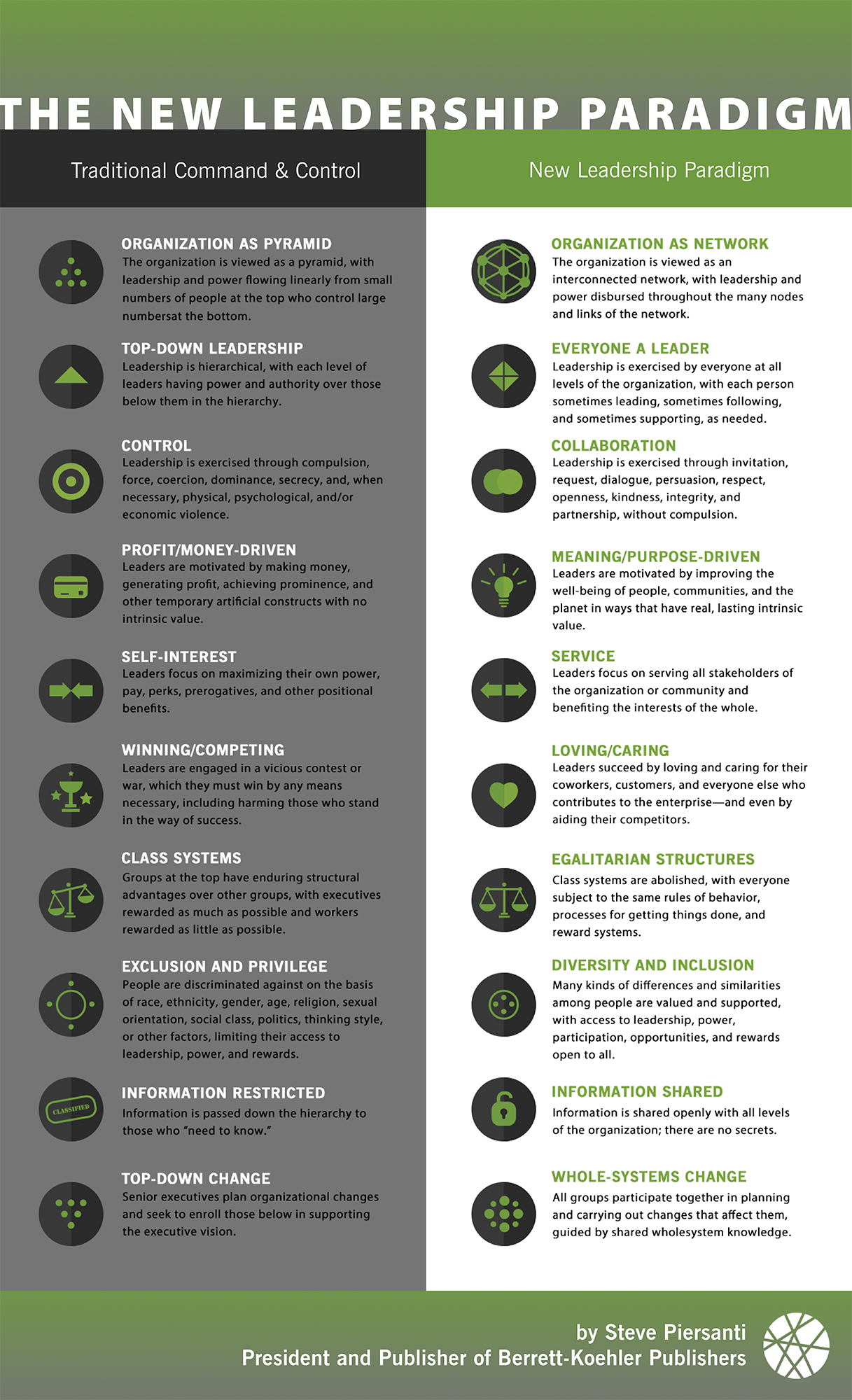
In many ways, now is the perfect time to focus on building your personal brand reputation outside of social media since organizations are evolving to make it easier than ever to succeed without positional powerand authority. I recently came across the infographic below which demonstrates many ways in which organizations are becoming more networked, less hierarchical and more driven by purpose. Click on the infographic below to learn more about modern organizational leadership cultures from BK Publishing:
In a more modern organization, it can be easier to align your personal brand with success, but you still need to be intentional if you’re going to end up with the reputation you want. And if your organization is still at the primitive end of the evolutionary scale, you’ll have to work harder to stand out as an evolved employee.
Personal brand tips inside organizations
There are two primary reasons to intentionally build your personal brand reputation where you work today: new opportunities and building relationships that can pay off in the future – even at other companies. (more…)
As a leader you’re not supposed to tell your employees what to do. Instead you’re supposed to “engage” them. You’re supposed to motivate them and empower them and create a work culture that plugs them in, contributing to the health of the business. But how do you do that? What are the best engagement ideas for employees?
Employee engagement has been all the rage in organizational development circles, ever since Gallup first reported that engagement was at a record low (26% in 2000 and at an all-time high of 34% in 2018!). Since low employee engagement is correlated with all kinds of negative outcomes for business, and high engagement relates to competitive advantage especially in growth companies, managers have been told to develop and implement engagement ideas for employees. If you’re a manager, you know this is easier said than done. The vast majority of employees are unengaged for a reason, and even though you’re “the boss,” you’re statistically likely to be unengaged too.
Recently, I’ve watched two of my clients – leaders of growing organizations – turn the employee engagement problem on its head, and they’ve done it in a surprising way. They made it about themselves and their employees, both. This sounds counter-intuitive so let me explain, and show you how you, too, can make the effort to engage employees more about yourself.(more…)
Dear Dana, What do they mean when they say I should be more “confident”? I recently had a boss tell me that if I want to get ahead I need to express “confidence leadership style.” I think I am confident but I keep getting this advice in order to further my career. My girlfriend says she gets the same advice, but I’m so much more confident than she is – I think:) I don’t get it. What should I do differently so people can see how confident I am? – Confidently Female in Connecticut
In all the years I’ve been coaching women on getting ahead, I’ve found the “confident leadership style” advice to women as perplexing as you. I think it’s because people who don’t know how to express more specific advice fall back on “confidence” to express what they observe as the differentiator between successful leaders and those who don’t fit the leadership stereotype. (more…)
Welcome to “Dear Dana”, my occasional column to give you career and workplace advice/coaching. Please write in and tell me about a career challenge or frustration you’re facing at the office! Today we’re answering a question about interviewing for a job you don’t want. – Dana Theus, Executive & Career Coach
Dear Dana, I’ve been thinking of looking for a job since I’ve been at my current employer for a while now and I don’t think my career is going anywhere here. But I haven’t updated my resume or really gotten serious about it. We’re pretty busy and it’s distracting. Anyway, a few people outside work know I’m not happy and one texted me about a possible job in her firm. I don’t think I want to work for the company, and the job isn’t exactly what I’m interested in, but maybe I should do it anyway? I keep thinking maybe it would help me get myself more serious about a job search so I’m tempted for that reason but my partner keeps telling me interviewing for a job you don’t want is a bad idea. What do you think? – Ambivalent in Denver
Dear Ambivalent,
You’re right to ask yourself if it’s a good idea to waste anyone’s time interviewing for a job don’t want. Preparing for a job interview takes some focus. Scheduling and participating in an interview also take time for everyone involved. As with many options to spend your time and energy, there can be pros and cons:(more…)