Work-life balance is evolving into work-life partnership. Many successful women are thriving not because they’ve mastered a solo juggle, but because they’ve built supportive partnerships—especially at home—with men who share the load, often in ways that reverse traditional roles.
Men are stepping up at home—and it matters. From dads managing the school run to husbands turning down promotions, the quiet revolution in domestic roles is fueling women’s rise in the workplace. It’s not about domination; it’s about teamwork.
Supportive men aren’t unicorns—they’re everywhere. From male mentors in the boardroom to full-time male nannies and partners who cheer us on, many women are climbing because men are holding the ladder. Let’s not pretend our progress has happened in a vacuum.
Blended leadership makes everyone smarter. Diverse perspectives—especially when women and men lead together—don’t just look good on paper. They actually boost group intelligence, drive innovation, and lead to better decisions. It’s not about women replacing men; it’s about rising together.
The Woman Effect is a team sport. If we want long-term success—for ourselves, our companies, and our world—it’s time to ditch the either/or thinking and embrace collaborative leadership. Let’s thank our male allies, keep building balanced teams, and stop playing tug-of-war on the leadership seesaw.
As you may know by now, I’ve been on a research quest to understand why The Woman Effect is helping organizations and economies succeed when there is significant presence of women in leadership. My fourth (and final for now) finding turned out to be a happy surprise. In our search for leadership roles and work-life balance, it’s not just about us.
Reason Number 4: Women and men are forming new partnerships. (more…)
Burning out isn’t a personal failing—it’s a cultural problem. We’ve been conditioned to see exhaustion as either a weakness or a badge of honor, when in reality it’s a red flag waving at a toxic, unsustainable system.
The “I’m so busy” mantra isn’t impressive—it’s costly. Overwork is often worn like a status symbol, but behind the humblebrag lies decreased productivity, costly mistakes, and real mental and physical consequences.
Self-care is not indulgent—it’s strategic. If you’re running on fumes, you’re not doing anyone (your employer, your kids, or yourself) any favors. Smart work starts with respecting your body and brain.
We all play a role in normalizing burnout. Whether you’re a working mom or a CEO, buying into the grind culture without question only perpetuates it. Change starts with how we talk, how we work, and how we set boundaries.
Well-being is not optional—it’s foundational. True productivity doesn’t come from 12-hour days and skipped meals; it comes from healthy, rested humans making clear-headed decisions. Let’s stop pretending otherwise.
I was shocked to read that only 9% of working mothers work 50 or more hours per week according to the American Community Survey. So why are so many of us feeling fried? Yes there is the issue that this study only measured paid work, and not the unpaid work of being a mother. But I suspect the issue goes deeper.
Consider this scenario.
It’s 8 pm. You are exhausted. You haven’t made a home cooked, from scratch meal in months. You haven’t gotten more than 5 hours sleep in weeks. Your to do list hasn’t dwindled all day. The gym? Date night with your husband? Who’s kidding whom? You’ve got homework to oversee, school lunches to prepare and still 2 more hours of work-work ahead of you.
Such is the life of a modern working mother.
A logical question arises anytime I step back and look at the corporate and billable hour landscape my clients work in or create. Why do people do this? (Note: I ask this as someone who worked similar to this for many years)
Why Are We Burning Out?
Because we don’t know any better.
I’ve written about how people mask burnout, fatigue and stress, unless of course it serves them to wear it as a badge of honor. Either way, living with burnout means we aren’t engaged employees and we aren’t giving our best as shown by the Towers Watson 2012 Global Workforce Study. That translates into slow company growth and slow job creation. As it turns out, burnout isn’t just personal, it’s an economic matter.
But why do we have this skewed relationship with overwork and self-care? We are operating under one of two myths.
Myth #1 Burning Out Is Weakness
Just as Brene Brown, in her book Daring Greatly, debunks the myth that vulnerability is weakness, I feel so compelled to argue the same about burnout. Indeed, burnout and vulnerability go hand in hand. To admit we are burnout is to be vulnerable as its not something you talk about and if you do, you are weak.
From law firms to start ups, everyone is crazy busy. In April, all accountants are working 16-hour days. As you approach product launch, it’s all-hands on deck.
As we falter under the weight of it all, when we want to raise our hand and scream “uncle”, we look around and watch everyone else – heads down, toiling away.
Then we think, “who am I to complain or protest?”
We believe if we speak up, everyone else doing exactly what we are doing will look down upon us. We hear their replies before we ever speak:
“What makes you so special?”
“If you can’t handle the heat, get out of the kitchen.”
“Maybe you aren’t cut out for this kind of work.”
We begin to believe the problem is us, not them. So we work harder. We burnout.
Burnout is not a sign of weakness, it’s the result of a de-humanizing work environment and following the herd. Be smart and break the pattern. – Click To Tweet
Myth #2 Burning Out Is Cool
On the flip side, burnout is used by some as an “I’m cooler and more important than you” tool. Hang out at the coffee machine and see how often you hear:
“I’m crazy busy. I can’t believe how much I have to do. I don’t know how I’ll get it all done.”
“I’ve got so much to do, I don’t know where to begin.”
“I’m going to have to pull an all-nighter.”
Do you think this person is cool? No, I don’t either. Yet I’ve said these things, and if you’ve ever worked a day in your life, you probably have as well.
We say these things to let off steam, but also because it makes us feel important. “Someone must think so highly of me that they gave me all work. I must be indispensable.”
Here’s the thing, if your boss really cared about you and your well-being, he or she would want to make sure you had a reasonable (as opposed to a super-human) workload so you don’t burnout. Right?
Unreasonable hours and workloads fueled on free pizza and sodas may (or may not) lead to more getting done. For sure, overwork and short deadlines will lead to mistakes, lost productivity and lost opportunity cost. Whether its coding errors, or missing $100,000 mistake in a contract, burnout is not cool and it’s expensive.
It’s A Matter Of Personal Responsibility And Strategy
I want to be clear that there is no one to blame here. Not the working mother, not the employer. We are all operating within a culture that abhors weakness and celebrates hard work. Combine these values with technology-fueled speed, and you have a recipe for burnout.
There will always be deadlines, emergencies and urgency to get to market before our competitors. So how do we bust the myths and create an environment where employees are authentic to their physical and mental needs and still get the job done?
It comes down to personal responsibility. We each need to take responsibility for our own needs – employees and managers alike.
Busting the myths comes down to the old saying: it’s not about working harder, it’s about working smarter. How smart are you on your 12th hour of work? Would you want to get on a flight with a pilot who had as little sleep as you? How would you like to undergo surgery with a surgeon who was working as many as hours and taking care of himself as poorly as the average stressed out worker?
Yeah, I didn’t think so.
Working smarter means more than finding a new productivity hack. Working smarter means taking regular breaks (every 90 minutes is ideal). Working smarter means eating real food, not processed junk. Working smarter means getting 8-hours sleep and daily exercise. Working smarter means setting boundaries.
Employee well-being matters. It matters for our health, our relationships and our economy. Well-being is not about fluff. It’s about personal and professional results.
Executive Coach Dana Theus shares her tried and true strategies to help women excel in higher levels of leadership and achieve their executive potential.
Subtle discrimination in the workplace often shows up as “office housework,” where women are expected to handle tedious, low-visibility tasks that don’t advance their careers—it’s time to name it and challenge it.
“Office housework” is real—and women are still doing more than their fair share. Despite progress in workplace equality, women continue to get stuck with the invisible labor: taking notes, organizing events, cleaning up. These lingering tasks may seem small, but they compound into real time and energy drains that can stall careers.
Over-functioning is a habit that backfires. Jumping in to handle tasks no one else wants—without being asked—might feel helpful in the moment, but it sets a precedent. Eventually, it breeds resentment, and worse, teaches others to under-function because someone else (you) always steps up.
Leadership support can help reset expectations. If you’re not in a leadership role, don’t be afraid to enlist someone who is. A respected voice in the room can shift norms by simply calling out the imbalance and encouraging shared responsibility.
Proactive boundary-setting makes a difference. Don’t wait to be asked to do the admin work—get ahead of it. Speak up before the meeting starts, rotate responsibilities, or politely remind others it’s someone else’s turn. It’s not confrontational; it’s strategic.
You don’t need a soapbox—you need a plan. Yes, it’s frustrating. But instead of venting, channel that energy into action. Set limits, advocate for yourself, and move toward work that grows your career—not just keeps the office running.
It’s a scene that’s probably familiar to many women who work in an office: a meeting convenes and a male in the group looks to a female and says, “Hey, Jane, how about if you take meeting notes today?” Worse yet, after the meeting adjourns, the majority of the meeting participants leave the room littered with cups and food wrappers, expecting that someone (“Mommy?”) will clean up after them. This is a subtle form of discrimination in the workplace, and too often we women buy into it.
The office, just like a home, needs tending. There are countless tasks – some of them administrative, most of them tedious – that require attention if an organization is to run smoothly. Unfortunately, it’s the women in the office who often pick up the “housekeeping” issues, whether it’s cleaning up workspaces or attending to what a former colleague calls “administrivia.” Historically, women in the workforce were assigned these tasks when they were primarily limited to secretarial roles. Although many women have long ago left the steno pool behind and ascended into upper echelons of leadership these niggly administrative tasks hang on with annoying tenacity.
Rosabeth Moss Kanter, Harvard Professor, coined the phrase “office housework” to describe the labor intensive, yet behind-the-scenes activities that happen in a workplace. Often seen as an element of collaboration, woman still typically shoulder this burden in disproportionate numbers.
Emotional intelligence isn’t about suppressing feelings—it’s about understanding them. EQ isn’t the absence of emotion; it’s the skill of recognizing emotions (yours and others’) and responding to them in a way that’s constructive, not reactive.
Strong emotions don’t mean someone’s falling apart. We often mistake visible emotion for weakness, especially in the workplace. But in reality, expressing emotions—yes, even crying in your car—is often a sign that someone is processing and managing their feelings effectively.
Empathy doesn’t mean you agree or approve. You can listen, acknowledge, and support someone without needing to fix, judge, or mirror their emotions. Real empathy holds space for someone else’s experience without making it about you.
Judgment isn’t helpful—but presence is. When someone’s having a hard time, offering unsolicited opinions or making their emotions about your own experience usually misses the mark. Just being present and listening with compassion is often enough.
Joy belongs at work too—if we let it. We’ve convinced ourselves that joy is too unruly for the office, but joy doesn’t have to be loud or disruptive. It can live in small wins, shared laughs, and moments of connection—if we bother to look for it.
It often surprises my executive coaching clients how important their emotions are to their workplace success. Most of us have been trained to keep our emotions out of the office, so we let lag an ongoing investment in our Emotional Intelligence (EQ). Part of the problem is that investing in developing Emotional Intelligence (EQ) is work that doesn’t always have an immediate payoff, and most of us are focused on results now! But part of the problem is a fundamental misunderstanding about what Emotional Intelligence is.
EQ is not having emotions, it’s understanding them, in ourselves and others and responding constructively.
We all have emotions, but most of us carry around errant assumptions and beliefs about them that cloud our ability to use them appropriately at work. Here are three common examples of misguided EQ that apply, whether it’s us or someone else who’s experiencing and/or expressing emotions.
Strong emotions = I can’t handle it. Muted emotions are easy to ignore if you’re not sure how to react to them. Strong emotions are hard to ignore. Instead of learning how to understand and respond to strong emotions in the workplace, many of us believe they have no place in the office and assume that if someone expresses strong emotions, they “can’t handle it.” This plays out often between men and women. Women are socialized to be more comfortable expressing emotions generally, and because they have more experience they often know that expressing emotions is an awesome strategy for “handling it.”
You don’t need a singular, lifelong “purpose” to live meaningfully. Let go of the pressure to find your one true calling and instead focus on what brings meaning to your life today—right now, in this moment.
Shift your mindset from “I” to “us.” Purpose doesn’t have to be grand or world-changing; even small, intentional acts that positively impact others can create deep fulfillment. Living “on purpose” means living with intention and care, not chasing a perfect vision.
Reframe the guilt and anxiety around not “figuring it all out.” You’re not failing if you don’t have a master plan. You’re evolving. Let curiosity guide you instead of fear, and be open to shaping your path as it unfolds.
Pay attention to what stirs your emotions—both pain and joy. Regrets and sadness from the past can offer clues to your values, while the present moments that bring laughter, gratitude, and peace are signposts toward a meaningful life.
Live lightly by releasing the weight of expectation. Instead of striving to “have it all,” ask yourself: “What makes me feel like I already do?” That subtle shift in perspective can bring more ease, grace, and satisfaction to your life journey.
At InPower Coaching we believe that having purpose is critical to both happiness and effectiveness at life – but what if you haven’t found your life’s calling? The thing you plan to devote every waking breath to forever? If you haven’t found a “life purpose” are you destined for unhappiness and uselessness? Of course not! We love how Marcia helps us understand “purpose” in ways that are realistic and achievable for everyone at every stage of life and work-life silliness. Enjoy her wisdom. – InPower Editors
Have you ever felt guilty, restless, disappointed, or lost because you couldn’t define your life purpose? Everywhere I turn, I read or am told I must find my purpose. I have colluded with this dogma and told thousands of people the same thing — you need to find your purpose to be happy.
What if you can’t find your purpose? Or maybe you had to give up pursuing what you thought was your purpose to survive. Are you a failure?
For decades, children have been raised with the message that they are special and self-help books decry the need for finding your True North. Instead of helping us realize our best self, could this push us to feeling that our lives are never good enough or worse, we are never good enough? Are those of us who haven’t heard our calling doomed to an incessant pursuit of unrealized potential? (more…)
Coaching vs. Mentoring: Key Differences: Coaches focus on personalized growth, offering tools and strategies for skill and leadership development, while mentors share their experience, providing industry-specific insights and helping expand professional networks.
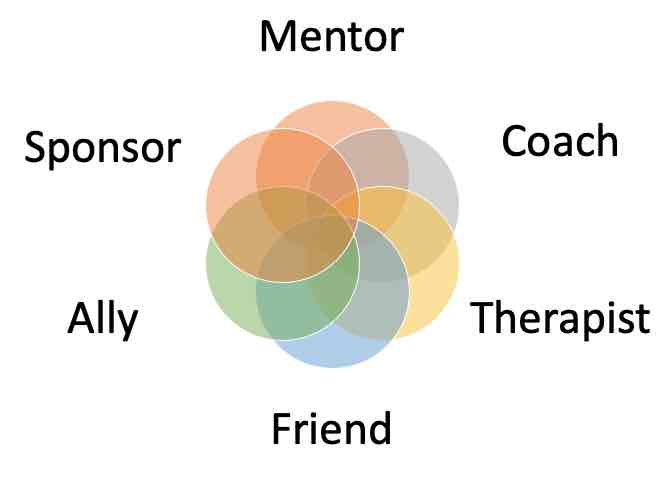
Diverse Career Support Options: Beyond coaches and mentors, career support can come from sponsors (who advocate for promotions), allies (mutual workplace support), therapists (emotional guidance), and friends (personal encouragement).
Structured vs. Informal Relationships: Mentoring can be informal, based on mutual agreement, or structured through programs targeting employee development. Coaching, as a profession, offers specialized types like executive, career, leadership, or life coaching.
Value of Both Coaching and Mentoring: Combining coaching’s tailored development approach with mentoring’s industry-specific expertise ensures comprehensive career and leadership growth.
Maximizing Relationships: To get the most out of coaching or mentoring, set clear goals, prepare for sessions, track progress, and maintain open communication while respecting boundaries and confidentiality.
There are many ways to get stuck in your career. You can find yourself feeling unmotivated, frustrated at a lack of progress, confused about what your goals should be, or uncertain about how to motivate your team, manage your workload or get your mojo back. When you hit a wall, it’s time to ask for help. But where should you turn? Should you consider coaching vs mentoring? What kinds of coaches and mentors would be a good fit? What other kinds of support might you find to help you out?
Who can help me when I am stuck in my career?
Friends are always a good first step, but when it comes to career and professional dilemmas, and growing into your personal and professional potential, it’s best to turn to people who have a broader view of career development, leadership development, and personal development, interpersonal skills, relationship building, and who can offer you valuable insights based on their experience and training. It’s also important to turn to those who can offer neutral and constructive feedback with an objectivity that your friends may not have.
Many people start exploring coaching vs mentoring for career advice, but I want to encourage you to expand your view of support to overcome challenges you encounter in the work world. While coaches and mentors will both offer the most direct advice and support, depending on how and why you’re stuck, you’ll find support and good ideas from a variety of other people. Use them all!
Here’s a quick primer on the key differences between the types of people who can help you when you’re facing a career dilemma.
Mentors
The best mentors have achieved some of the success you seek and can offer you insights into the organizational and industry waters you are swimming in and their own work experience is best if closely aligned with your career goals. If they’re familiar with your work situation they may also be able to give you domain expertise and skills enhancement ideas to for performance improvement, nurture your strategic thinking, download a knowledge transfer in specific situations, and offer valuable insights into how to work with specific individuals (e.g., a line manager or senior executives). They might also give you real-time observation and feedback as well as help you grow your professional network.
Coaches:
Good coaches will have relevant experience, but there are distinct differences in how they address your overall development. The best ones will put their own experience to the side to focus on you and your specific career, leadership and professional challenges. They will offer practical tools and strategies, often using both structured sessions and a creative process to help you gain the skills required to improve your job performance. They may also be able to give you behavioral alternatives that will help you develop a specific skill, or provide professional development tools (e.g., 360 assessments) to support your personal and professional development.
Sponsors:
A sponsor will open doors for you and create opportunities by putting their credibility on the line to support you for promotions and stretch assignments. Sometimes you may not even know they’re there as sponsorship often happens behind closed doors. Sometimes you know the person is sponsoring you, and sometimes they can be a mentor (rarely a coach), but you generally do not have a development focused relationship with a sponsor. They support you because you achieve the kinds of desired outcomes they value.
Allies:
People you can ally with have aligned goals and needs in your work environment. You can ally with people for both business and personal reasons, but such relationships do not focus on skill development or professional development as much as mentoring and coaching do. Their support is usually a two-way street, both of you offering each other some support to gain influence or access to specific stakeholders, information and resources.
Therapists:
Psychological counselors are solely focused on what’s going on inside you and will have less interest in, or insight into, your professional context, persona or success. Therapists tend to focus on core emotional issues that are common across your personal and professional lives. They will have few to no insights on common business challenges like career development, employee development, employee performance, employee engagement, skill enhancement, and professional growth opportunities.
Friends:
We all need friends and family who love us despite our career frustrations. In addition to allowing us to vent and feel seen and heard, friends can be great referral sources for mentors, coaches and therapists.
There’s no one-size-fits all support person for your career challenges. Make sure to surround yourself with a team of people who can give you different perspectives and kinds of support.
How are coaching and mentoring similar?
Both coaching and mentoring provide the two most important types of leadership development and long term career development support you can get. The reason their support is so instrumental to your success is because both coaching and mentoring focus their efforts solely on YOU. Both mentoring and coaching are there for you and your benefit. They offer the gifts of their knowledge, wisdom and expertise, in service to you and your goals.
In this sense both mentoring and coaching can offer you:
General and specific career and leadership advice
Knowledge transfer about career development and leadership
Insights on how to navigate organizational dynamics
Guidance and tools for developing key skills, including leadership skills
Support in pursuing personal growth and thinking through your career goals and career path
Support in developing a plan to reach your goals
Perhaps the place where coaching and mentoring are most similar is in the area of career coaching. A good mentor and an effective coach can both help a mentee navigate challenges in deciding what career goals to pursue and how to take steps or acquire a specific skill to achieve your long term career development objectives.
How are coaching and mentoring different?
When you sit down to do the coaching and mentoring analysis and decide what kind of help you need right now, it’s really useful to look at what differentiates the support you’ll get from coaching and mentoring, and what your takeaways from each may be.
A lot of people ask me, “What is the biggest difference between coaching and mentoring?” In practice, often, a mentor will share their own experiences hoping you’ll find it relevant, while a coach who is professionally trained will center on your experience and goals, working to help you grow into your higher potential. A mentor who knows your work situation or who shares your expertise can offer you tailored insights into your particular organization, discipline or relationship dynamics. An organizational coach might be able to do the same, but in all case a coach will listen more deeply to understand what you’re missing and then offer up the information, advice or tools that can support you with your particular challenge. In this sense, coaching is usually a more customized and time-efficient way for you grow, but a mentor might be able to help you expand your professional network and technical understanding.
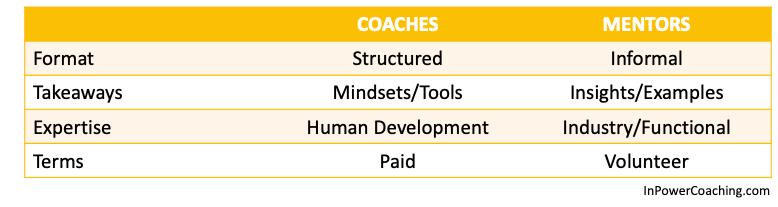
There are some other differences. Coaches are generally better trained in helping you pursue personal and professional development goals (or holistic development objectives) while mentors are trained at what they do for a living. This may mean they can help you develop specific skills as well as broader development goals you have. You’ll come out of a coaching engagement with new mindsets, more assignments and practical tools and strategies to apply. Unlike coaching, mentors will be more likely to give you more information specific to your industry, job track or company. Usually, you’re more likely to grow, change and develop through a coaching engagement, since that’s what coaches are trained to help you do, though in the right mentor mentee relationship, all that can happen and more. Keep in mind that while many mentors are often very interested in helping you grow, they may or may not be skilled at it.
Here’s a typical way of comparing coaching and mentoring, which you may find in an individual coaching relationship or mentoring relationships:
What kind of mentoring relationship can you pursue?
There are two primary types of mentoring relationship:
Informal mentoring
Informal mentoring occurs when two people decide to engage in mentoring. Sometimes this is a stated goal of the relationship, but often it simply happens because the mentor offers advice (or the mentee asks) and the mentee (or protégé) acts on the advice and then follows up with the mentor, asking for more advice. It can be that simple.
Structured mentoring through mentoring programs
Mentoring programs offer more structure. A good mentoring program focuses on employee development/employee engagement, specific skills development and work through program administrators to engage multiple mentors and mentees and who can build programs or maintain existing programs to ensure a quality experience for participants.
What kind of coaching relationship might help you?
Because coaching is a profession, there are several different kinds of coaches you may want to consider hiring. Bear in mind that the best coaches can offer you support in more than one area, especially if their work experience is similiar to yours, though they usually have a core competence and expertise.
Executive coaching
Executive coaches have generally held executive positions (Vice President and above) and can help you operate effectively as a senior leader (e.g., VP, EVP, SVP, CXO), communicate effectively with senior leaders, gain credibility with senior leaders, navigate corporate politics, position yourself for a promotion, manage up, and lead large and diverse teams.
Career Coaching
Career coaches specialize in helping you research and articulate your career aspirations, explore various career paths, commit to career plans, and navigate challenging career transitions, including a change of career. Some career coaches are focused on your personal growth while others deploy a more focus coaching approach to develop your resume, LinkedIn profile, and networking plan.
Leadership Coaching
Leadership coaches have a specific focus on helping you build the skills to manage, inspire and lead people. They tend to be experts in interpersonal skills development and be familiar with many leadership models, techniques, and tools. They also tend to have deep knowledge of various management philosophies and approaches.
Business Coaching
A business coach (or business mentor) will typically help you develop strategies for business growth in your specific industry and/or function. They typical have personal experience creating business success and know your industry and/or function very well. You’re usually working with them for their technical and business expertise more than their ability to hep you grow as a professional.
Performance Coaching and Sales Coaching
Similar to business coaches, performance coaches are generally experts in a particular function and can help you increase your personal performance to achieve your personal and professional potential. Often a sales coach has been a top performer and will show you how they did it.
Life Coaching
Life coaches tend to put less focus on your professional goals and focus more on helping you find goals and mindsets to find more fulfillment and meaning in your life. The closest they usually get to career or business topics are in helping you build personal systems for navigating work-life balance conflicts and challenges.
Keep in mind that good coaching can occur informally as well as formally, through structured coaching sessions or even a structured coaching program.
Coaching vs Mentoring: You Need Both
Do you need coaching and mentoring? Most likely, yes. As a human on a career path, you need a coach to help you navigate your personal career and leadership journey most efficiently, but you also need the insights and knowledge of someone who’s walked the path ahead of you and who knows the kinds of technical or organizational challenges your facing due to your industry or function, which mentors can do.
A coach acts to help you look out for the general challenges and opportunities that lie ahead, giving you tools to succeed in the moment and in the future, regardless of which path you choose. A good mentor will point at specific obstacles and choices in the path you’re on, discuss the pros and cons with you and help you decide how to keep moving.
How can you get the most out of your time with a coach or mentor?
The best way to get a coach or mentor talking, quickly giving you the most specific and helpful suggestions, is to share your goals and aspirations with them. Ask them for help refining your objectives and figuring out the next steps to take to reach them. Even if you’re not sure what goals you want to focus on, or what questions to ask, give them a nugget of what you do want for your future. The best coaches and mentors will quickly pick up on this and start asking you questions that make you think more deeply. They’ll ask you if you’ve tried certain strategies and help you sort out which ones are worth pursuing right now.
Here are some other tips for making the most of your relationship for coaching relationships:
Come on time, set aside distractions
Keep a journal or notebook with notes from your sessions to refer back to and track your thoughts and experiences related to each conversation
Set aside time between sessions to review your notes, decide how to put your coaches advice into practice and reflect on what’s going well and what is challenging you so you can discuss what you learned with your coach
Prepare for each session and be open with an overview of your progress and obstacles since your last discussion and areas you’d like to focus on in the current discussion
Here are some other tips for making the most of your relationship for mentoring relationships:
Come on time, set aside distractions
Check In regularly, especially in remote/hybrid work environments
Agree that the mentee/protégé will set the agenda, manage scheduling logistics and come prepared to brief the mentor on progress and challenges since the last conversation
Agree on goals and duration of mentor relationship
Agree on allowed/not allowed confidentiality topics and communication protocols (specifically, text and phone, which are more intrusive)
Follow Up in integrity on any commitments made to each other
What you should definitely not ask a coach or mentor is for them to do any of this work for you or tell you what you should want or do. Coaches and mentors are not mind-readers. They don’t know what’s best for you; only you know that. Their greatest gift to you is in spurring your thinking, revealing paths and strategies for you to consider and supporting you and guiding you as you move forward.
Most mentors and coaches know that they need to foster trust with you, and will treat what you discuss with them confidentially. Coaches in particular are ethically conscious of their obligation to treat what you say to them as confidential. That said, both coaches and mentors are human and, especially if they’re not aware of the sensitivity of what you share, may mention something to others you may wish they hadn’t.
For these reasons, it’s always good to discuss confidentiality early in your relationship. And even if you’ve agreed to hold information in confidence, before sharing anything particularly private, it’s a good idea to ask that it be held in total confidentiality.Here are two specific challenges to watch out for:
Coaching confidentiality challenge: If your coach is hired by your company and has an independent line of communication with your boss it’s likely they will be asked, or want to offer, information that can help your boss manage you more successfully. While you can presume your coach would only have your best interests in mind, when you want their advice on something you or your boss would consider sensitive, call it out to your coach with a request for confidentiality. For example, in a situation where you don’t trust your boss, you can ask that everything be held in confidence. If the trust problem is of dangerous proportions, you may want to consider hiring a coach that you pay for yourself and who has no relationship or access to your boss at all.
Mentoring confidentiality challenge: If your mentor is part of your network, and has connections with friends and colleagues in your company or industry you have to remain aware of this fact. Especially in informal relationships (as opposed to structured mentoring programs with which mentors and mentees may have contractual relationships) you must remember your mentor is a free agent with their own goals unrelated to you. Generally, you cannot assume that they will treat what you tell them with complete confidentiality, so it’s always important to flag specific things and ask them to keep your thoughts private.
How Can You Help Others?: Mentor vs. Sponsor vs. Ally
Especially when you develop experience with coaches and mentors who have helped you, please pay it forward and find ways to help others, passing on what you’ve learned.
Of course you can mentor others, but consider also using your influence within your industry or organization to sponsor others. Look for opportunities to help talented younger employees gain visibility and access to opportunities, especially among underrepresented leaders such as women, people of color, and underrepresented groups more generally. This makes you a talent scout and allows you to open doors for people, who otherwise may not get the opportunity.
You can also become an ally for people who have aligned interests. This is particularly valuable for underrepresented leaders who may not have the natural cultural alliances that come from common race and gender demographics.
Just like coaching vs mentoring is not really an either/or choice, neither is deciding how to give back to others. Never stop learning and never stop passing on what you’ve learned–in all forms. This is how we all grow.derrepresented leaders who may not have the natural cultural alliances that come from common race and gender demographics.
Women often build great networks but hesitate to use them—and that hesitation comes from deep, gendered wiring. Many women feel “icky” about leveraging relationships for professional gain, confusing authenticity with self-sacrifice. It’s time to rewrite that internal script and own the value we bring to the table.
Celebrate rejection—it’s not personal, it’s directional. Shifting your mindset from “rejection equals failure” to “rejection equals clarity” frees up energy and emotion to keep moving toward what works. Detach from the outcome and trust the process.
Specificity is your superpower. Vague asks like “help me find a job” rarely go anywhere. But asking for a quick intro, industry insight, or vendor referral? That’s doable—and it builds confidence while reinforcing your network’s ability to support you.
Give to grow, but not until you burn out. Building network karma means being generous, yes—but not at the cost of your own time, energy, or goals. Give authentically, and learn to say “no” when a “yes” isn’t aligned.
Networking is a bundle of skills—not just one. From setting boundaries to asking clearly to managing emotional triggers, effective networking is layered. Women succeed when we work through all those layers—honestly, imperfectly, and on our own terms.
There is simply no career development strategy–whether you work for someone else or for yourself-that rivals an expanded personal network. This means you need to learn how to build your network in order to find the kind of career satisfaction you want today–and into the future. But that doesn’t mean it’s easy, especially for women. I’ve puzzled over this phenomenon for a long time because, even though I have an extensive personal and professional network–and I love meeting people!–my network hasn’t always been as helpful to me as some men I know. So what’s going on? Why do women network in ways that don’t always help them professionally?
As a coach, I’ve looked this even more deeply. I used to wonder: Is there something I’m doing wrong that makes my network less useful? Am I meeting the wrong people? For a few years I felt like a fraud teaching people how to network in my workshops and yet not feeling that accomplished at it myself. Then one day I put two and two together and started implementing some of my own advice more intensely and bam! I connected the dots and my network started to perform more reliable. Here’s the essence of what I’ve learned in the process. (more…)
Authentic leadership isn’t about sticking to a fixed identity—it’s about aligning with your core and adapting in service of something bigger. Henna Inam’s definition of authenticity goes beyond “just be yourself”; it’s about being present, honest, and willing to evolve moment by moment to lead with purpose.
Facing discomfort—your “dragon”—is part of the journey. Whether it’s setting boundaries, shifting careers, or just speaking up when it’s hard, real leadership means choosing courage over comfort to stay true to your values.
Self-awareness is the foundation. The book’s 7 practices—from “Befriend Your Body” to “Dance with the Dream”—aren’t abstract concepts, they’re tools for noticing, unlearning, and growing into the leader you’re becoming.
We sabotage ourselves more than we realize. Hiding emotions, chasing perfection, doubting decisions—Henna names the quiet traps we fall into and offers practical ways to break free so we can show up fully and authentically.
To lead others well, start with yourself. The connection to Agile practices—transparency, reflection, adaptability—runs deep. Strong, authentic teams are built by leaders who are first willing to do their own inner work.
The chapter “Face the Dragon” in Henna Inam’s book, Wired for Authenticity, Seven Practices to Inspire, Adapt, and Lead resonated with me.
Generally, I have no problem speaking up and sharing my thoughts. However, I hate disappointing others, so it can be difficult for me to set boundaries or speak my truth when I know it will upset someone else. I’m working on improving this, but standing up for myself can be difficult.
I think this is why I was excited to read Henna’s book. Being an authentic leader and speaking my truth is something I strive for in my work everyday – in fact, it is the basis of it.
I usually work with product teams that practice Agile methodologies. Agile is an approach to making software, guided by 12 principles addressing teamwork, collaboration, flexibility, and achieving results.
The Agile community frequently discusses transparency, honesty, serving a team, adapting to change, and setting goals. We talk about being authentic. A lot. And the approach is becoming mainstream because it’s a more efficient and effective way to work.
Given all that my colleagues and I discuss regularly, I was curious how she approached authenticity and leadership.
Henna opens her book by clearly defining authenticity:
“Authenticity is not deciding who you are and then rigidly applying this to every leadership situation. Instead, authentic leadership is leading adaptively from your core, choosing who you need to be to serve the greatest good in this moment.”
–page 1
In our individual journeys, I think we all ask ourselves, who is the “real me?” I know I am a work in process, constantly testing and refining my identity and boundaries. With that said, it takes a while to learn the truth about we really are, what we want, and what we value. It’s hard. And sometimes it’s hard to make the right decisions to express yourself and what you need because it’s not the comfortable path.
Henna continues defining authenticity as it not only come from being honest with yourself – each of us needs to slow down, get centered, be present, go beyond our “hardwiring” and experience, to really listen to that inner self and learn what inspires us. According to Henna, we tend to hide – and hiding doesn’t contribute to great leadership.
“Authentic leadership is the full expression of “me” for the benefit of “we.”
–page 7
What stops us? Often self-sabotage. It happens for men and women, similar yet different. It’s about not speaking up, replaying and questioning actions and decisions, compartmentalization, protecting the ego, hiding emotions, and more.
To get beyond these and be truly authentic, she presents 7 practices:
Befriend your body – 93% of our communication is non-verbal – our body exhibits what we are feeling, consciously or unconsciously. To be authentic– mean what we say and say what we mean – we need to be connected to our body and aware of what we are feeling. Henna provides excellent guidance on how to get there.
Stay curious – Being curious helps us constantly learn and grow. She encourages the reader to ask questions about everything and challenge every view. Know what drives you.
Let go – She identifies 9 ways we hold ourselves back from being ourselves and achieving our highest good. She also coaches us how to move past trying to control what we can’t control (other people, situations) rather than what we can control (our emotions, actions and decisions).
Give yourself an A – Accept yourself – even your “inner loser.” She guides us how to rewire our neural pathways to maintain high self-worth regardless of circumstances.
Choose Be before Do – “We can’t solve problems by using the same kind of thinking we used when we created them.” (p.111) This is one of my favorite sections. We live in a “doing” culture, believing that we need to take action to get anything done. At times, the best way to get anything done is to let life unfold, be in the moment, and reflect upon what you want.
Face the Dragon – My favorite example is how a baby learns to walk. A baby needs courage to try, fall down, and try again until he succeeds. We need to bring this courage into our daily lives – to try, to fail, to keep going. Courage is hard!
Dance with the Dream – Passion is important. We need to put our passions into our work to make our dreams come alive. Living your passions is the only way to be true to yourself.
She structures each practice into sections:
An overview providing guidance and sharing stories
An exercise to find your ally, or inner persona that reflects that trait
Summary of 3 big ideas from the practice
Questions to ask yourself for self-work
Activities to change yourself
Before she describes how to lead an authentic team, she encourages you to go to her Web site and complete an evaluation to help you learn about your own authenticity – strengths and weaknesses. It’s only when you are aware of yourself that you can lead a team to authenticity.
The sections about leading authentic teams reminded me of those Agile methodology discussions –honesty, transparency, team/self awareness, openness. She described how you can apply the 7 practices to your teams, and I learned a few ways I can bring this to Agile teams I work with to make them stronger.
Henna’s book is a hands-on manual that will change you.
How did I change? I need to grow my own business and make time available for additional clients and other work. Her book influenced me to take the plunge and shift my 40 hrs/week contract gig to 20 hrs/week. It’s a difficult switch – knowing where money is coming from to some uncertainty – but it’s a switch I need to take to do what’s best in the long-term. I’m now “facing the dragon” and standing with courage to make my dreams real. I look forward to re-reading Henna’s book and experiencing another shift to become the leader I am meant to be.
Authentic Feminine Leadership
Reimagine feminine success
FREE NEWSLETTER unlock your authentic relationship with power
Jerks at work are energy vampires—don’t let them drain you. They’re out there slamming doors and yelling, but your power lies in how you respond, not react.
Don’t take it personally (yes, really). Their behavior is about them, not you—and when you stop buying into their opinions, you stop giving them control over your mindset and your day.
Breathe—literally. A few deep, belly-filling breaths can snap you out of stress mode and flip the switch back to focus and calm. Fast, free, and effective.
Handle it like a pro: respond with facts, not gossip. If it needs to be reported, keep it clear and drama-free—your credibility (and sanity) will thank you.
Find your “productivity vortex” and get back to your peak. Whether it’s a stretch, a quote, or a five-minute meme break—do what it takes to reset and show up like the pro you are.
There is nothing that will ruin your day or drain your energy faster than having to deal with a jerk at work. You know whom I’m talking about.
The guy who slams a door in your face.
The gal who yells.
The guy who throws a temper tantrum when you disagree with him.
Yes, it would be great if this kind of thing didn’t happen. Yet it happens all too often (I worked with someone who did all of these things and more for 8 years) and without human resources coming to the rescue. Even if HR intervenes, dealing with a jerk at work takes a lot of energy and suppresses your productivity and creativity.
They call these jerks “vampires” for a reason. They suck you dry of energy and creativity. Until the difficult person gets sent packing and even if they don’t, you have to deal with him or her. Here are some practical tips for navigating jerk-ism and sailing through your day with a smile on your face and your energy and productivity in tact.
Don’t Take It Personally
I know it’s hard when someone yells at you or slams a door in your face to not take it personally. It is, however, essential. If you want to get on your with your day and create excellent results, you must let it go and not take it personally.
When you take things personally, then you feel offended, and your reaction is to defend your beliefs and create conflicts.
When we take someone’s behavior personally we wallow in self-doubt, anger, fear, or a myriad of other streams of thought that take us away from the task at hand. We wonder when HR will reprimand her. We think about revenge. We do everything but focus on performing in excellence.
How do you not take things personally? You recognize that none of what the jerk says is true. Their opinion of you is not true because opinions are not true. They are simply that person’s opinions.
You may think, “but that person will spread those opinions to others and ruin my reputation.” This is where we open the door for fear to enter. We believe that person will ruin my career. We must stop them. These seem like valid concerns.
Before you yourself travel the bunny trail of worry STOP. Don’t react. Instead respond if necessary to clear up the facts. Then get back to work. The facts are in your performance. This is great news because it’s the only thing you can control.
Now that you are not take this person’s behavior personally, let’s dive into some practical strategies to get back on track and moving forward.
Reclaim Your Power and Pose With These Easy Steps
A confrontation with a jerky colleague is disruptive. The key to igniting your productivity and performance is to get back on track quickly. Here are 3 easy steps to get your day back on track.
1. Re-center yourself with deep breathing. When dealing with a jerk, your blood pressure rises, your body releases cortisol and your heart beats faster. This is your fight or flight response in action. The key to getting back to work is switching back into your rest, relaxation and healing mode where you can focus and get some real work done. (No this does not mean get a cocktail and put your feet up, I have a faster solution). Breathing is your body’s reset button.
Take a deep breath in through your nose so it’s nice and slow. Fill up your belly first. Hold for 2 seconds, and then slowly exhale. Do this 3-5 times.
2. Respond appropriately and with the facts. Sometimes our encounters with the workplace jerk are something that needs to be escalated. The person’s behavior isn’t just an annoyance to you but truly harms the workplace. In that case, respond appropriately.
That means not engaging in gossip with all your other co-workers. Don’t rehash what happened with everyone in your life. That won’t heal the matter.
Instead, talk to someone who can address the matter. Whether that is human resources or your boss, tell them what happened. Stick to the facts and you’ll have more credibility. Be brief. Be clear. You want them to get what happened and why it shouldn’t be tolerated. Anything else is a distraction.
3. Get into the productivity vortex. Before you sit back down to get to work, step into your productivity vortex. We all have a zone where we are operating at peak. Like any star athlete, you likely have a routine to get into that zone. If you aren’t aware of one, start to observe what things help you get back into peak performance. Some great options are: stretching, going for a walk, drinking a class of water, reading inspirational quotes, watching funny videos or playing a video game for 5 minutes. Experiment and find what works for you.
Work is no fun when there is a jerk around. However, they don’t have to ruin your day or make you skip a beat in your project. Remember to start with not taking it personally.
How will you address the jerk in your office today?
Originally on: The Ignite Wellbeing Institute
Break Free from Emotional Triggers
Free eCourse
When you’re emotionally triggered, your reactions to stressful situations (and people) feel out of control. All the stress reduction in the world can’t help you if your emotional triggers are in charge. These 3 lessons will get you back in the driver’s seat.
Leadership isn’t reserved for the C-suite—it’s a daily, personal choice to stand in your power and be a force for positive change, wherever you are.
We’ve let go of our dreams and power too easily—traded in our passion for the illusion of security, and it’s time to wake that sleeping leader within.
Success must be redefined beyond profits and promotions to include purpose, people, and the planet—because narrow goals lead to squandered power and lost opportunity.
We tolerate too much dysfunction in the name of results; true leaders challenge the status quo instead of enabling it with silence or fear.
It’s not too late—reclaim your voice, your vision, and your responsibility to lead now, not when it’s convenient or safe, but because the world needs you in the game.
I’m updating my site and found this oldie but goodie – literally like the first blog I wrote in 2011. Reading it, I still believe it. So I’m leaving it up for whatever wisdom it has to offer you. – Dana Theus, Arlington, VA 20025
When did we give up trying to change the world? When did our dreams of making more people’s lives better go to sleep within us? When did we stop believing that we could “beat The System”? When did we allow the jerks and tyrants to run the world simply because we offered no alternative?
These questions are as old as time and as young as the last time any one of us turned the other cheek to let ourselves or one of our employees get away with toxic behavior because they “got the job done;” smashed our head on the glass ceiling and refused to pay the glass-cutter (or paid and regretted it); missed our kids’ championship game to attend one too many project review meetings; or just let inertia carry us through another year of the status quo when our heart wasn’t in it or fear drove us away from our dreams.
Leadership isn’t just about making money or managing legions, it’s about getting up each day determined to cause positive change and living in integrity to do so. Good leaders are people who stand in their own power and set the intention for themselves, their employees, their bosses, their clients and others they influence to make the world a better place. They create organizations and conditions that cause the world to change. Great leaders are willing to move beyond their own limitations, to transform themselves in advance of – and alongside – the world they impact. They define success for themselves and invite the world to show up in new and positive ways. Inevitably it does.
Why now?
Why not? Our world needs us, and I don’t just mean the people and places we see in the news (though of course, they do too.) Every office. Every store. Every .com. Every .org. Every school. Every government. Every platoon. Every meeting. Every team. Every _____ needs good leaders who can stand in their power, and just as importantly, everyone is a potential leader able to stand in their power. When we give up the “requirements” that externally bestowed wealth and the authority to coerce others into action make us leaders, opportunities to lead and impact the world appear at every gathering and email exchange. The world swamps good leaders with opportunity to stand in their power and be the cause of change and transformation in the world around them. What are we waiting for?
Reclaiming Our Power To Lead
I have come to believe that good leadership isn’t always what the Bschools and corporate trainings say it is. I’ve sat through – and run, sadly – too many strategic planning, budget and project meetings with highly trained leadership experts who play off the Bschool notebook and I’ve watched them completely squander their power. I’ve squandered my own power using these methods. Nothing changes and everyone just becomes more cynical.
Narrow definitions of success are part of the problem. My measure of success now is broader than profits or low employee turnover, starting with the triple bottom line (people, planet, profits) and ending with the higher purpose achieved. I hold this high standard because it’s clear that achieving only narrow success metrics is dangerous, leaving the organization and its leader’s vulnerable, and wasting too much opportunity.
Too many of the leaders and organizations that wield great financial and influential power in service of the too-narrow goals give away their power on a regular basis. They accept the golden handcuffs and stick themselves to the quarterly profit tar baby. They adapt to dysfunctional cultures and foster them into the future. And all too often of late, they suffer the public disgrace of greed revealed and the quiet despair of opportunity lost. The world complains – in the news, on the blogs, around the BBQ – but we tolerate it. Why do we – as leaders able to stand in our own power – put up with it? Why don’t we make the few, small, highly powerful choices that unleash waves of change in our economy and world for the better? Why don’t we reverse the tide?
Because we’ve given up. We’ve drunk the cool-aid. We’re too attached. We’re afraid. We replace intention with expectation. We’ve forgotten how to imagine it better. We’ve given away our power.
Time to take back the promise of leadership. Time to own our wounded hero and free ourselves from the fear. Time to reclaim the power that lies within each of us in the jobs we hold today and aspire to tomorrow, not the false power-mask bestowed by the boss, the board or the shareholders, who can just as easily take it away. Frankly, when we succeed, many of them will be happy, because down deep they want a better world too.
Time to lead. Time to change the world through the work we do in it, not in our “spare time” when we’re exhausted and spent.
Join me. Reclaim your leadership potential. If you’ve claimed it, share it far and wide. Stand in your power and cause the world to change for the better, simply because you’re in it. It’s easier than it sounds, and it’s never too late.
A Pragmatic Footnote
The status quo is real. Change for the better is not guaranteed, or even always desired by those who say they crave it. Compromise and dilemma abound. Not every leader is ready to stand in their power and not every organization is meant to survive even when they do.
And that’s ok.
We who are ready; we who remember how to imagine; we who are not afraid to free ourselves of fear; we who are in our power; we will lead the way.
Dana Theus Arlington, VA April 25, 2011
If this got a reaction out of you – good!
Ready to invest in yourself?
FREE Executive Coaching consultation with Dana Theus