Every single one of my coaching clients face challenges with executive communications in one form or another. The most common contexts in which these issues come up include these two dimensions of personal branding and executive presence:
Communicating in an executive fashion to be seen as a potential executive (i.e., ready for a promotion)
Communicating with executive colleagues to earn credibility and influence decisions in senior leadership conversations
But what does good executive communication really look like in action? Most of the time, it starts with the bottom line.
What is Executive Communications?
Executive Communications Stems from Executive Thinking. There’s a reason the frontal lobe of the brain is called the home of the brain’s “executive function.” Executive mental functions such as communications, analysis and decision-making fundamentally relies on our brain’s ability to prioritize and sift through huge amounts of data and information served up by the rest of our brain in order to produce an outcome. These outcomes look like decisions, requests and actions.
Similarly, acting as a sort of “frontal lobe of the organization”, executives in companies lead most effectively and efficiently when they are focused on the outcomes (i.e., decisions, requests and actions), not the sifting and prioritizing necessary to inform the outcome. This is why most executives usually like to start with the end state of an analysis or recommendation and work backwards until they understand what they need to know to move to the outcome. In a perfect world, the executive trusts those who produce the information so much that they spend little time reanalyzing data and get right to the outcome.
If you’ve ever found an executive impatient with sorting through the details, it’s because they want to spend their time on outcomes.
Why is Executive Communications Difficult?
Of course, getting a recommendation ready for decision making never starts with the outcome. It starts with a clear understanding of the problem and moves linearly through gathering information, analyzing/running scenarios and – finally – a conclusion that produces the bottom line recommended outcome. Too many times, those tasked with the non-executive tasks of developing the recommendation stumble at the end and struggle to get to a bottom line where the executive outcome can be more easily decided. There are many reasons this final step, the step the executive cares most about, is difficult at the end of the analysis, because the analyzers:
exhaust themselves doing the work and run out of time or brain cells when it comes time to boil it down to a bottom line
get so lost in the weeds that they lose the perspective necessary (if they ever had it) to see the bottom line that can drive the outcome
inexperienced with achieving outcomes (i.e., decisions, requests and actions), their recommendation doesn’t provide the necessary rigor or information necessary for an executive to drive the outcome
How to Start with the Bottom Line When Communicating with Executives
So what should you do if you’re determined to avoid these challenges and become a good executive communicator? Here are three steps you can take to switch up your analysis and recommendation style to deliver the bottom line effectively in an executive manner:
1. Be very clear at the outset on the executive perspective of the problem AND the type of outcome your analysis should support
Do you know the cost of the problem and the potential return of a solution?
Do you know what decisions can and cannot be driven by your work?
2. Do your analysis in the traditional linear order
Think through the problem, data, analysis, scenarios, potential outcomes, solution/recommendation)
Come to your recommendation by telling your story in a linear fashion, to yourself and then others who will help you with a “dry run”
3. Develop an executive communication package: put your linear story above into an Appendix and deliver a short (5-10 slide) presentation structured to start with the bottom line
your description of the problem
your recommendation
the top 3 reasons you’re making this recommendation and then
the Appendix.
When you deliver executive communications as number three outlines above, you give the executive listener the essential information she needs to either move directly to the outcome or take you back into your Appendix to discuss the specific pieces most important to her before moving to the outcome. Even if you have to retrace every step in discussion, which is less likely with this approach, your initial overview will usually lead to a more efficient executive interaction and a greater probability of an outcome.
You may note that the above approach feels at some level inherently inefficient, requiring you to prepare up front more carefully and do the analysis twice — once forward in the thinking and once backward in the communicating. If you’re only looking at efficiency through the lens of time spent, than this approach is less efficient than simply doing the analysis and sharing it. And once you go through the “inefficient process” of analyzing it forward and communicating it backwards, you’ll be able to quickly and efficiently represent the most important aspects of your ideas in any format, powerpoint, narrative memos, elevator conversations and more.
However, I can guarantee you that in the last step, (number three – leading with your high level recommended outcome and putting the details at the back of your presentation) you will do the executive synthesis that is at the heart of high quality executive communications. And the executives you’re communicating with will appreciate your effort. They’ll see that you’re capable of joining them in the frontal lobe of the organization. If you’re not there already, they may just ask you to join them.
There’s more to getting noticed than giving presentations. Check out our career and personal branding content to start proactively developing your reputation.
FREE EBOOK
Coaching Tips: How to Avoid the Most Common Career Mistakes
Reframing Change Management: Change management models often fail to account for the internal change needed within individuals for successful implementation.
Creating the Right Conditions: Successful change management requires preparing, including, and empowering people to participate actively in the change process.
Safety and Emotional Intelligence: Creating a safe environment where people can manage their emotions is crucial for successful change management, requiring both personal and organizational efforts in emotional intelligence development.
Previously I wrote an article on this blog called Reframing Change Management Theory as an Act of Creation, which summarizes how I’ve come to apply a change management model in my capacity as a coach and leadership consultant. Having helped people and organizations through change all my working life, I’ve come to see the holes in many of the current paradigms. There’s actually nothing wrong with the existing change management models as they are. They work fine if the conditions among and within the human beings using them are right. The problem is that these conditions, which require emotional intelligence, are so rarely right.
And many of these change models take an ‘outside-in’ approach to change. People come in from the outside to decide what needs to be changed and ‘do change to’ the people inside the system. This outside perspective can be very valuable, but it often fails to recognize the power, and necessity, for people to change on the inside in order for change to stick. Achieving this change from the inside out is an art, not a science.
A New Change Management Model
Most change management models work well, when conditions are right. The problem is that conditions are so rarely right.– @DanaTheus <==CLICK TO TWEET
When a change effort goes awry, the change management model is often pinpointed as the problem. The next most blamed element? The people who “resisted” the change. As I discussed in my previous article, it’s my experience that when people are invited into change, rather than having it thrust upon them, they are more apt to accept it and, when the conditions are right, embrace and support it. Most “resistance” they offer is often simply a request to be more involved.
Most serious change efforts these days do try to invite people into the change process to some degree. They get feedback up front, hold charrettes and other creative thinking sessions to involve people and try to communicate to all affected throughout–and at the end–of the process. Agile development processes can also be effective in bringing people into a change process fluidly, on an as-needed basis. However, in my experience, while we’re fairly good at designing processes to bring people into change, we’re not very good at preparing people to participate in these processes, and thus we end up right back where we started, encountering resistance.
Preparing People: Creating the “Right” Conditions for Change
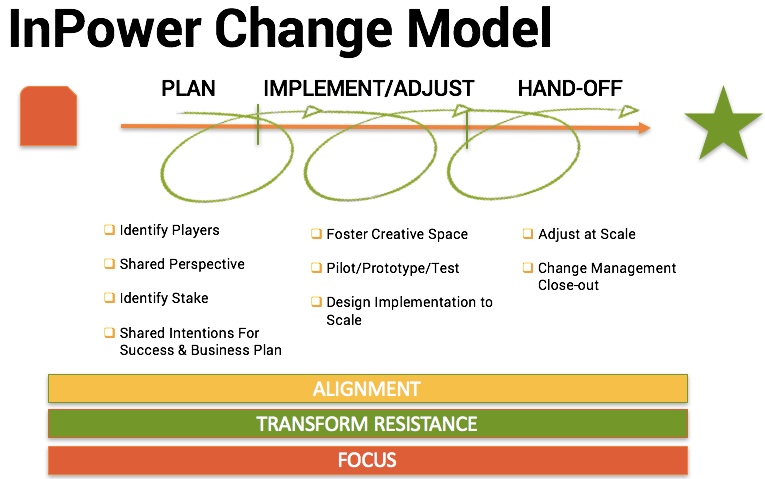
Creating the right conditions for change to take hold means being aware of, and investing in, a process that prepares, includes and empowers people to participate in change at the same time we’re planning to create, test and launch systems and systemic agents of change (e.g., new software systems, new organizational structures and new things designed to replace old things of any kind.) After decades of increasing rates of change we’re pretty good at developing change models that are linear and take us from start (i.e., the As Is beginning state) to finish (i.e., the To Be end state). A lot of these processes look like this InPower Coaching Change Model:
However, preparing people to participate in change requires that we understand how people engage in change successfully. Unlike a fair amount of “common sense” change wisdom, I don’t believe that people always experience change as loss, meaning they have to “grieve” the old thing in order to move on and accept the new thing.
Do you miss your rotary phone? Me either. So why do we say “people hate change”? <– @DanaTheus —CLICK TO TWEET
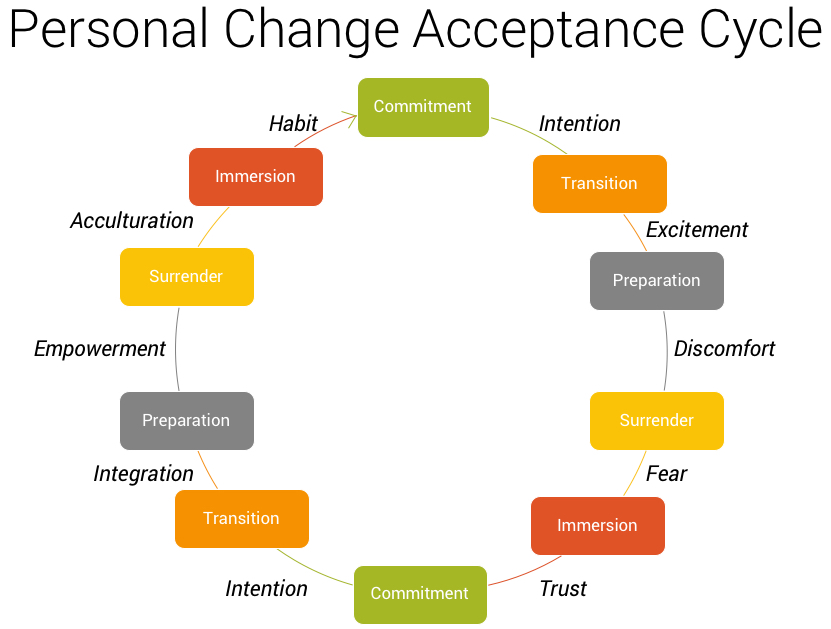
I do believe that people go through an outside-in-inside-out process of change, however, that enables them to internalize the change being asked of them, make sense of it in their personal context and then participate in it in the way that works for them. How they make it work for themselves is a very personal process, reflecting their worldview, life experience and intentions. In general, it follows the following process for each person.
If you’re an organization or a team leader, what’s the appropriate way to guide people through this very personal process using some kind of cookie cutter change management model? I mean, your goal is to create revenue and business impact, right? Not run therapy groups. The answer looks different in every situation, but it doesn’t require therapy groups. It does, however, involve grooming your managers with the emotional intelligence skills so they can create one key component required to help people navigate the process above: Safety.
Let’s start talking about “change acceptance” and “change empowerment” instead of “change resistance” – @DanaTheus <== CLICK TO TWEET
Safety is the Key to Change Management
It’s true that change is uncomfortable and that people don’t like discomfort. That’s not the same as saying “people don’t like change.” What they don’t like is the discomfort.
Q: So how do we help them become comfortable with change?
A: We learn how to make it okay for them to be uncomfortable as they work through their discomfort and find their way back to comfort (see circle cycle above).
What’s happening during this critical process? What does a safe environment for change and disruption enable? During this adjustment process people are doing the following, at a minimum, and often unconsciously.
Understanding the new things being asked of them
Figuring out what will change in their own, personal, sphere at a detail level
Deciding how they feel about the change, including how they feel about the process of change/how they’re treated
Dealing with those feelings
Analyzing alternative behaviors and ways of being in the changed world
Deciding how they feel about this, and dealing with those feelings
Imagining their new logistics and orienting to this
Deciding how they feel about this, and dealing with those feelings
Envisioning a new definition of personal success for themselves (and their team if they’re a leader)
Deciding how they feel about this, and dealing with those feelings
Doing the work to detail what they must do to comply in the changed world (for many, this is significant as it can include revising all their current processes)
Deciding how they feel about this, and dealing with those feelings
Doing the work and running into unforeseen challenges
Deciding how they feel about this, and dealing with those feelings
Addressing the unforeseen challenges
Deciding how they feel about this, and dealing with those feelings
Moving into a “new normal”
Deciding how they feel about this, and dealing with those feelings
Deciding to stick with the new normal or move on
Deciding how they feel about this, and dealing with those feelings
See the pattern? At every step in people’s adjustment to the new order, they will have new feelings, and those feelings must be managed. Actually, using the word “deciding” is probably incorrect. If they’re emotionally intelligent they can notice their feelings and adjust and manage them. Those without emotional intelligence, and who are managed by non emotionally intelligent leaders, rarely even investigate their feelings to decide how to respond. Instead they simply react to them. As a result, many of their feelings won’t be well understood, much less well-expressed.
Normally, these off-the-top feelings and expressions just get blurted out into the space between people, causing unexpected, unconscious and unforeseen feelings in others. When all these feelings start setting off triggers, things can get ugly.
It’s true that change is uncomfortable and that people don’t like discomfort. That’s not the same as saying “people don’t like change.” What they don’t like is the discomfort. – @DanaTheus <=Click to Tweet
Creating safety, to allow these very natural human feelings to exist and be processed without kicking up a dust storm of triggered interactions that simply cascade through the organization, is key but seldom accomplished. Giving people the skills to manage these feelings (including their triggers) is step one, and for that to work there must be a minimal level of safety in the organization so people don’t experience the kind of shame and blame that will shut them down, drive them to resistance and threaten the entire project. How do you create safety? Ah, that is more an art than a science, however, I can boil it down to these basic recommendations, which is what I work with my clients individually and organizationally to achieve.
Personally:
Learn to detrigger so that you can remain emotionally calm when offering or receiving resistance to change
Become skilled at exploring resistance with active listening in yourself and others to understand the positive contributions it brings to the process of change
Organizationally:
Ensure your leaders have higher levels of these emotional intelligence skills and are trained in how to seek and use resistance in developing better change outcomes
Build basic emotional intelligence skills and vocabulary into the broader team culture: Self-Awareness, Emotional Regulation, Interpersonal Communication and Conflict Management
Equip executives and senior leaders with how to see and manage the culture to become change resilient and welcoming (which means they must personally learn these lessons so they can model them for others. Want to know why so many change efforts fail? Yup. This.)
Change Management is a Journey
The most successful change management programs work to embed change resilience and related skills into their cultures, and culture shift is a journey. It doesn’t have to take a long time, but it does take time and focus on the part of leaders throughout the organization.
This process is easier when the larger change processes embrace the need for safety, emotional intelligence and employee inclusion and empowerment. To help leaders reframe their preconceptions about Change Management and think about change in ways that allow for safety and space for personal change, I’ve created a White Paper to go deeper than a blog post can really do, which introduced the InPower Change Management Model.
Download a copy of the white paper Creating Space for Change: An InPower Approach to Change Management.
Ready to invest in yourself?
FREE Executive Coaching consultation with Dana Theus
Hurt is hurt, no matter how small the words that carry the offense.
Choose to speak powerfully, as though everything you say matters. Because it does. This is how we roll back the negative impact of microagression in our society.
You can’t often tell what impact your words have on people around you. Leaders and other people “in power” are notoriously bad at estimating how others around and “below” them respond to what they say. So choose to speak from a place of compassion and your impact is more likely to be useful, even when you’re disagreeing with someone or speaking about something negative.
This is good news, really. I mean, you want to have an impact, right? Well, by opening your mouth you are! Just because you can’t always see the impact right away doesn’t mean it’s not important. If a tree falls in the forest does it make a sound? The answer is yes.
Speak as though everything you say matters and your impact is guaranteed. – Click To Tweet
Wise men talk because they have something to say; fools, because they have to say something. – Plato
But why should we pay attention to our little words and phrases. Why does a microaggression deserve the same attention as a macroagression? Because microaggressions matter as much or more as the big stuff on a daily basis. And learning to speak as intentionally about the small things and the big things, all, as though they matter can actually change your life and give all your relationships a major upgrade. It works in the same way that taking on the mantle of integrity does when you commit to integrity in everything you do, not just the “big stuff.”
Speak your values in the big stuff and little stuff alike
Most of us fall into the habit of applying prioritization incorrectly to our values and words. We confuse and conflate living our values with prioritizing our time and attention. We have to prioritize our time and attention but we shouldn’t prioritize our values with the same flexibility. When we do, we start down the slippery slope of unintentional and unconscious impact.
And the point is to live our values with conscious intentionality when we communicate to bring people together instead of drive them apart.
Of course we have to choose when and how to speak and act in accordance with our values. Should we tell someone who’s being insensitive that their words are hurtful? Not always. Sometimes they figure it out on their own or someone else takes the risk to draw their attention to the impact of their disregard. But at other times, our words make the difference.
Our words can help us defend the defenseless or paint us into the shoes of a bystander to emotional violence.
It may seem like a small thing, the microagressions we don’t know we’re communicating. When we label a mild-mannered man’s action “girly,” we know we’re irritating the object of our attention, but we don’t realize that all the women within earshot tense up a bit, too, feeling derided by association. Or perhaps on its surface a flattering phrase, “what beautiful skin you have,” sounds kind, but in a racial context equates a person with their anatomy with little other value of note.
These things are so tiny. Not anywhere near the physical assault, overt discrimination or angry slander plastered in the headlines. How can our little words hurt those around us?
Even with an intent to honor others, to acknowledge or flatter their lovely features, for example, we can hurt others by not honoring their deeper humanity and value.
Our fractured culture may not be our fault, but it is our problem if by our lack of awareness or outright intent we’re building divides between people instead of tearing them down.
This is my problem and I’m trying to learn how my words have the power to drive divides or create bridges. My biggest lesson so far is that the size of the words, or the hurt, doesn’t matter all all. Microagression and macroaggressions matter equally. Hurt is hurt and healing is healing. My hope is that if I’m open to realizing the impact of my words and learning new ways of speaking to bring us together, no matter the scale, I’ll be part of the solution.
Join me?
Feel triggered, because you feel like your walking on eggshells, when you think about trying not to offend? Detrigger yourself and you will navigate the eggshells just fine.
InPower Women’s Mastermind
We don’t Mastermind your business. We Mastermind YOU!
One of the most important things women can do to accelerate their career is develop authentic confidence. But it’s not always easy. Dana decodes leadership presence for women in this post based on her experience helping women adapt to a male business culture. – InPower Editors
Decoding Leadership Presence: 3 Steps to Confidence
Does someone with leadership presence always make a good leader? Can someone without presence lead effectively?
Many career gurus will say leadership presence is essential to becoming a good, and ladder-climbing, leader. In my experience, however, many good leaders get ahead with only a mild ability to be noticed when they enter the room, depending on the company’s leadership culture. In addition, research shows that confidence and presence often help you get ahead even if you don’t deserve it. Leaders who get ahead on confidence alone flame out and fall prey to the Peter Principle before they get to the top.
Bottom Line: There’s more to being a good leader than just confidence and presence.
That said, when presence and confidence are added to talent and skill, they can absolutely grease the wheels of your upward career trajectory.
How do you get leadership presence? I’ve spent a lot of time decoding presence because I coach many women who struggle to project confidence. Their struggle is founded in the disconnect between what they feel authentically within them and what they believe it should look like outside them. Most confident role models in business are men because statistically business leaders are mostly men and historically, the archetypal ones we think of are all men (e.g., think any dead U.S. President in the biography section of the bookstore). However, authentic confidence looks different for a woman than it does for a man. It’s not enough to say to a woman, “watch the male CEO’s presence and do that.” As research confirms, most women just can’t get away with what the male CEO can get away with.
So my clients and I have had to become more creative in decoding what presence is and, more importantly, where it comes from authentically.
Here’s the short answer:
Confidence and presence come from a place of authentic strength of conviction and knowing what you believe about a situation, absent the confusing veil of self-doubt.
It comes from a place where failure and uncertainty are comfortable companions to success, clarity, and learning.
It comes from knowing why you’re doing the thing you’re asking others to do.
It comes from a place of purpose and willingness to be disagreed with – where you’re willing to change your own approach with grace and without shame – in pursuit of that higher goal.
How can you walk with presence?
STEP 1: Get clear on why you’re doing something, and why it’s important.
STEP 2: Become accountable to yourself for doing your best to make it happen, refusing to give voice to the self-doubt we all have in favor of becoming a voice for possibility.
STEP 3: Believe that you can be successful.
This is the kind of Leadership Presence that comes from deep within.
I’m often asked whether it matters how we stand, how we dress and the tone of our voice. Yes, it matters, but all the external accouterments are powerless to lead without the inner beacon of true presence. Start on the inside and you amplify any external investments you make on the outside. This is how some people make a $400 suit look like a million bucks.
You made it! Now what? Multiply your impact and not your stress.
Do you ask for help when you need it? Why? Why not? At least as important ask asking for help is knowing when you need it, and when you don’t because you can rely on your strengths. Sometimes you can ask for help to figure out whether you need it or not! Great leaders are always looking to grow. Be one of them! – InPower Editors
Do you find it easy to ask for help? I’ll admit this doesn’t come easy for me. I’m getting better at it but still have a long way to go. I consider myself to be pretty independent so asking for help is definitely not something that comes naturally to me. There are many times I’d rather go it alone than admit I’m in need of assistance. I think this comes from, somewhere along the way something told me (or someone told me or society told me) that asking for help equated to weakness or dependence. What I’ve discovered is that it’s anything but that. It’s one of my great strengths to not only admit that I am in need of help but also to accept help from others. Why is it a sign of strength? Because it takes a strong person to be self-aware of their own limitations and admit to them. It takes a strong person to solicit the support of others and then actually accept that help.
Sometimes you can ask for help to figure out whether you need it or not! Great leaders are always looking to grow. – Click To Tweet
Female Martyrs
I often see this behavior in female leaders I coach. They sometimes act like martyrs because they feel if they admit to not knowing something or needing help in some specific area at work, it will undermine their authority or others will see them as weak and/or incapable of fulfilling their job responsibilities. These thoughts are typically just stories they’ve told themselves or picked up from other people who had those beliefs.
Leaders who ask for help are typically the best ones out there because they know they cannot be good at everything; they acknowledge their limitations. They leverage their strengths and seek out those who supplement their skills in areas they are not experts. They surround themselves with good people, which, in turn, make them better leaders.
It’s the same thing in any area of your life. When you’ve got a lot going on and/or are going through a tough time, what makes you stronger is admitting you need support and surrounding yourself with the people who can provide that to you. What makes you weaker is trying to do it all on your own and/or not admitting you need help. What typically happens when you don’t ask for assistance is you end up crumbling under the stress of what you’re trying to deal with because you’re dealing with it alone.
Admitting you need help and asking for it is what keeps you strong and helps you rise up to whatever challenge you are facing.
Accepting the support of others not only eases your burden and strengthens you further but also reveals your authenticity and vulnerability to others. This makes you real.
Yes, we all would like to be Wonder Woman or Superman but truth is, even they needed support. And, we are real people, not superheroes. Asking for help, admitting our limitations and being willing to be vulnerable makes us real and allows others the space to be real around us too. And this ends up making us all much stronger in the long run.
Free Advice for Mentoring Women
Tropes and truths to help mentors and proteges navigate workplace biases and outdated advice.
In the early 1980’s Robert Levering, a journalist, and his writing partner Milt Moskowitz set out on a three-year tour to travel the United States. They interviewed employees across the country to find out what made for a really good work environment. They asked two questions: “What makes this a great place to work?” and “What would make this a better place to work?” Levering was skeptical that he could find more than a handful of employees who would talk in glowing terms about what made their companies “great.”
Much to their surprise, Levering and Moskowitz uncovered scads of employees willing to talk; they had a lot of positive things to say about their companies. What resulted was the New York Times best-selling book, “The 100 Best Companies to Work for in America,” published in 1984. The book was the launching point for an annual tradition of creating the “Top 100” list, which Fortune magazine now produces in tandem with the Great Place to Work Institute (“GPTW”) which Levering co-founded in 1991.
Fast-forward three decades. Company leaders now routinely talk about the importance of “organizational culture” to their business success. In fact, in the white paper “Transitioning to the Future of Work and the Workplace” by Deloitte Consulting, more than two-thirds of executives surveyed reported that organizational culture has a “critically important impact” on their company’s ability to achieve its mission and vision. (more…)
Do you ever wonder what the “best practices” are for LinkedIn, whether you’re looking for a job or not? Check out this wonderful post by Henna on common LinkedIn mistakes most of us make for some good advice. We’ve already done a little LinkedIn profile update after reading her suggestions! ~InPower Editors
I was at a speaking engagement about creating our personal brands and asked the participants how many had a Linked In profile. About 50% raised their hands. I asked how many felt really good about their Linked In profile. About 3 people kept their hand up. If you’re in business, the people you want to connect with are checking you out on Linked In. Here are the ten biggest mistakes many of us make on Linked In. Do any of these apply to you?
Ten Biggest Mistakes on Linked In
I sat down with social media strategist and Linked In expert Diane Crompton to understand what are the biggest mistakes she has seen people make. Use this as a check-list to make sure you’re leveraging Linked In like a pro.
Assume Linked In is only for job seekers
People assume “if I’m not currently searching for a job, I don’t need to have a Linked In profile”. I often meet leaders who find themselves out of a job and they scramble to create a Linked in profile and create a network. It takes a few months to do this. Some are concerned their colleagues will think they’re looking for a job. There are lots of reasons to be on Linked In other than for a job search (see below).
Be Unclear about your Linked In goals
Get clear about your goals on Linked In. They should frame the amount of time and effort you put into Linked In. A strong Linked In profile can help you in lots of ways: recruit members for your team by letting your network know you’re looking for talent, connect others and build your influence as a connector, build your professional brand by sharing relevant articles, keep up with people in your professional network and build it. Start with the end in mind!
Have an amateur photo
A picture speaks a thousand words. Your photo should not be from ten years ago, one you put on your Match.com profile, or something a prospective employer will look at and immediately want to check out your FBI record. What do you want your picture to convey about you to your professional network?
Be unclear in your message
Your Linked In summary should be clear about what you stand for. What’s your personal brand? How do you stand out and create value for others? How would you like to be known? What’s the sense of leadership purpose that drives you? These are the key questions your profile should answer. I recommend my executive coaching clients take several assessments including the Strengthsfinder 2.0 and Standout. They are helpful in articulating your personal brand.
10 Biggest LinkedIn Mistakes Most of Us Make. – Click To Tweet
Be Impersonal
My recommendation is to write your profile in first person. It makes you more friendly and approachable (unless you belong to the mafia and want to make sure you’re not appearing friendly and approachable). Here’s President Obama’s profile. Even the President is friendly and approachable. Let them see the real person behind the profile. Here’s Bill Gates’ profile. It shares his interests: “Voracious reader, avid traveler”. It should pass the “if I were stuck in an elevator with this person, would I survive that?” test.
Be hesitant about recommendations
A lot of us have mindsets that prevent us from asking for recommendations and favors. Think of it this way. If you have trouble tooting your own horn (and we do know that it’s important for others to know how you add value), let someone else toot your horn for you. If someone has done a great job, be generous in giving out recommendations too. It’s positive Linked In karma.
Ignore keywords
If we want to be found on Linked In we need to use the right keywords in our Headline, Summary, Skills and Expertise, and Professional Experience. Recruiters are now exclusively doing their searches on Linked In. If you have a business and want to be found by potential customers, make sure you use the right keywords for your expertise or business.
Sell first
Many people make the mistake of connecting to sell immediately. In my opinion that doesn’t work. If I don’t really know you, why would I buy from you? What’s in it for me? Instead my recommendation is to adopt a “slow burn” approach by building rapport, helping others first, and consistently sharing good content. The huge benefit of online channels is access. I’ve connected with people on Linked In where we have common interests and we have built these into mutually productive connections offline.
Send invites to people you don’t know
We all get invites from people we haven’t met and don’t know. Linked-In discourages that but it happens. If you do send an invite to someone you don’t know, be courteous and let them know why you’d like to connect with them. Explain what’s in it for them or areas of common interest. At the least feed their ego: “I’m a big fan of your work, Mr. Gates!”
Forget to make updates
Keep your profile updated to avoid these LinkedIn mistakes. Your professional brand changes and your objectives may change over time as well. Use regular LinkedIn updates as a good opportunity to update your professional narrative and keep your network aware of what’s keeping you engaged and interested so they know what opportunities to bring your way.
The “dress for success” concept has evolved to be about using appearance as a tool for authentic self-expression, not conformity.
True power for women stems from inner resources like mindfulness and emotional intelligence, not just external appearance.
Authentic leadership cultivates both inner and outer power; how you present yourself should reflect your genuine self and confidence.
Cultural icons like Barbie, even in modern portrayals, can perpetuate narrow beauty standards that impact women’s self-perception and professional confidence.
Developing an “authentic presence” involves aligning your inner sense of self with your outward expression, resisting external pressures and owning your unique power inside and out.
Key Takeaways
From “Dress for Success” Skepticism to an INpowered View
“You’re going to write a women’s blog? You mean more ‘dress for success’ stuff?”
Gah! No! That was my reaction years ago. I wanted to move beyond surface-level tips. We named it INpower Women to emphasize an inside-out perspective. This focus felt crucial because genuine power often starts internally for women who weren’t necessarily raised feeling powerful.
Developing inner resources like mindfulness, emotional intelligence, and clarity on personal values builds resilience. This inner strength helps women navigate the challenges of achieving and managing external power (InPower Coaching). When you have inner power, you’re better equipped to survive success in demanding roles.
Initially, “dress for success” felt like the antithesis of inner power. Doesn’t relying on clothes suggest a lack of confidence underneath? It sets up an “either/or” dynamic: you have inner power or you focus on outward appearance.
Embracing the “Both/And”: Appearance as Authentic Expression
An INpowered mindset embraces “both/and.” Coaching hundreds of professional women has shown me that impactful leaders, regardless of gender, integrate both inner and outer power. They consciously craft a leadership identity that feels authentic and communicate that authenticity effectively to others. This includes how they dress and present themselves.
The key is to “own it.” When your external presentation—your clothing, style, overall presence—aligns with and expresses your authentic self, it signals self-awareness and confidence. It’s not about conforming to a dictated standard, but about using appearance as another tool to communicate who you are and the power you hold.
Putting on clothes that reflect your genuine self shows the world you own who you are, including how you look. It completes the picture of wholeness you present.
Battling Barbie: Old Ghosts and New Critiques
I admit, my own relationship with fashion and style is complicated. Like many women, I grew up with the impossibly thin, blond Barbie as the visual shorthand for female success. My mother often measured success, hers and mine, by thinness and conventional beauty. Unsurprisingly, my earliest vision of a successful woman looked a lot like Barbie – and not the more diverse versions Mattel later introduced (CNN, 2016).
To this day, I wrestle with the fact that the woman in my mirror doesn’t match that ingrained ideal. Real women juggling careers, families, and ambitions often look more like me than like the original Barbie. Women in the public eye, particularly in business and politics, are slowly forging new visuals for feminine leadership, but the fashion industry largely remains part of the double bind women face.
Then came the Barbie movie. I found it insightful and sharp in its critique of patriarchy and its exploration of feminist themes. It opened important conversations. However, I found it less helpful regarding body image. While celebrating imperfection and challenging some stereotypes, the film’s portrayal of “different” Barbies still largely featured conventionally thin, healthy-looking actors (Jessica DeFino Substack, 2023).
The Missed Opportunity on Body Diversity
The movie touched on body image issues, like the infamous cellulite scene, but often framed these “imperfections” as problems to be overcome rather than natural variations (Jessica DeFino Substack, 2023). While aiming for diversity, the representation felt surface-level. The main characters grappling with being “not perfect” didn’t showcase a true range of body types seen in the real world (One Woman Project, 2024).
This matters because media representation significantly impacts professional women. Constantly seeing narrow, often unrealistic, body ideals reinforced, even in supposedly progressive films, affects self-perception and confidence (PMC, 2024). It subtly reinforces the idea that a woman’s value and competence are still tied to meeting specific appearance standards, a bias that persists in many workplaces (Tara Rivera).
While the Barbie movie initiated valuable feminist discussions, its limitations on body diversity highlight how deeply ingrained these narrow ideals are. It didn’t fully dispel the image of Barbie as a physically unattainable figure, reminding us that even well-intentioned media can fall short.
Cultivating Authentic Presence Beyond the Mold
The challenge of dressing to visualize our inner power, especially when battling ingrained ideals like the Barbie myth, is part of the journey of claiming that power. True leadership presence isn’t about conforming to an external mold, whether it’s a classic “power suit” or a specific body type. It’s about aligning your inner sense of self with your outward expression.
How do you want to show up? What visual choices make you feel most authentically powerful and aligned with your values? Answering these questions allows you to use appearance strategically, not as a mask, but as a genuine reflection of your inner strength. This requires self-awareness and the courage to resist pressures, even subtle ones from popular culture.
Authentic self-presentation is crucial for women leaders navigating complex expectations (Frontiers in Psychology, 2015). When your external choices resonate with your internal compass, you project confidence and credibility that transcends fleeting trends or unrealistic ideals.
Conclusion: Own Your Power, Inside and Out
The conversation around “dress for success” has evolved. It’s not about adopting a uniform, but about consciously choosing how to present ourselves in a way that reflects our authentic inner power. While external appearance alone doesn’t grant power, it is a vital component of how we communicate our leadership presence to the world.
The Barbie movie served as a potent reminder of both progress and persistent challenges. It celebrated female agency while simultaneously falling short on fully challenging narrow beauty standards. This complexity underscores the need for women leaders to cultivate a strong inner sense of self, enabling them to make conscious, authentic choices about their external presentation, resisting unrealistic pressures. Ultimately, true power comes from within, but expressing it effectively involves owning all aspects of who you are – inside and out.
If you’re looking to strengthen your inner power and develop an authentic leadership presence that aligns with your values, explore InPower Coaching’s executive coaching services. Let’s work together to help you own your unique power and achieve your highest potential.
Executive Coach Dana Theus shares her tried and true strategies to help women excel in higher levels of leadership and achieve their executive potential.
One of the cool things about modern discussions of leadership is that we now recognize that “leadership” is available to everyone, at every level of every kind of organization – or no organization at all. Anyone can lead and can even start a movement, simply by influencing the person next to them to influence someone else. We believe that to lead is to make an impact on the world around you. And anyone can do this. The patriarchal stereotype of leader-as-king-with-army is making room for the reality of idea-gal-with-smartphone.
But there’s a difference between influencing the person next to you and “leading.” What is it?
How You Can Turn Thinking into Thought Leadership
I believe that much of the power of influential leadership lies more specifically in thought leadership, but not as we’ve traditionally defined it.
Traditionally, thought leaders have been authors, researchers and industry trend makers. You know, people with public relations firms in their stables. Think of Mark Benioff, CEO of Salesforce.com, and his decade+ championing of what’s now called cloud computing. Or Tom Peters. These idea-guys manage to get above the fray of an entire section of the economy, see a trend, articulate it and influence others by applying their ideas widely and diligently. Hip hip for them. They are surely thought leaders and thank goodness they are because that is how revolutions in thinking are made.
But we can all think. We can all see things that others don’t. We can all share our views and opinions with those around us to influence their perspectives and actions, and most of us do share our thoughts. When we choose to use our thoughts to lead, however, we give our personal brand a boost at the same time.
When do our ideas shift from opinions, to influence, to leadership? (more…)
There are many kinds of leadership and power and I choose to focus on personal power for myself and with my clients – I call it InPower. InPower is that special ability leaders can develop to free themselves from the culture around them so they can choose where and how they place their energy in service to the world and themselves including, and especially, intentionally shaping the very culture they have freed themselves from. I choose to focus on InPower because:
it is useful in all aspects of life, not just business;
it tends to be infectious and helps bring the best out of everyone around you; and
no one can take it away from you.
Personal power is hard to see
It’s easy to comprehend external power. External power builds buildings and fights wars. Many of those wielding external power do have InPower, but not all, and it’s certainly not a prerequisite.
InPower is a life-long journey requiring wisdom and the courage to explore dimensions of power that many around you don’t see and don’t know how to appreciate until you do. This is the call of leaders, to push out ahead of others, find the treasure and bring its gifts back to the tribe.
Our dominant culture doesn’t train us to see InPower. For every Obi-Wan Jedi Knight, there are a thousand Luke Skywalkers in our media (and even Luke’s media story ended when he attained InPower and became a Jedi.) But Obi-Wan was right to cover Luke’s eyes to help him tap into the InPower within him. Because as hard as InPower is to see…
InPower is easy to feel
InPower is characterized by a sense of freedom to act in choice and at cause to the world around us. But what does freedom feel like? Many of us react to that question financially and we think when we have enough money not to have to work “for the man,” then we are free. But many people with money are not free – quite the opposite. While money can free us from some things, it can bind us to others (especially itself). No, freedom is an internal state and lucky for us it does not require riches to be attained.
Freedom actually feels like balance. If you’ve ever done yoga or a martial art, you know the sense of balance where you are – often for only a moment – effortless and can easily react to the world around you with choice and control – or choose not to act. No reaction is required to maintain balance but the choice to act is always there. Balance takes effort to develop and focus to maintain, but it is a powerful state of being. InPower is the same way.