Many women think they are not leading, and yet they are. Why? Because they are setting their intentions, achieving them and making the world better as a result. We’d like more women to know how to be bold at work. Not to get the credit (though, you should take credit that’s due you!) but because when you’re being bold, you’re living at your edge and developing greater capacity to make a difference. Read this inspirational post about bold leadership from Dana, and choose to lead boldly. – InPower Editors
We often give advice to leaders, “Be bold!”
Why?
Here are the typical reasons for being bold that I hear:
You’ll get noticed
You’ll move faster forward (failing and succeeding both)
You’ll get outside the box
All good reasons!
But here’s why I want you to be bold: you’ll develop the habit of stretching yourself.
Being bold will help you be more intentional
Most of us move forward in our lives in a rather jerky fashion. We make a change (intentionally or otherwise) and then spend a lot of time dealing what just happened.
If you’re going to lead something, however, jerkiness will backfire on you – personally and with those who choose to follow you (and yes, it’s always a choice in the end.) Jerkiness leads to exhaustion, more miscommunications and more unintended consequences.
Yes, there is an ebb and flow that we need to create when we spawn new initiatives and then absorb the change and keep moving. However, when being bold is your habit; you are living on the edge of what is new and what is old; what you understand and what you don’t; what works and what-you-don’t know-if-it-works yet.
And to do these things successfully, you learn to think more precisely about what you want to create before moving forward to make it happen. Such intentionality is a core success factor for every leader. And better yet, being intentional can reduce your stress. How? You decide ahead of time what you can and can’t do, you commit to less in order to make more happen.
Being bold isn’t about being brash, it’s about thinking about what matters and moving with intention and focus to make it happen.
When you’re bold, you learn how to be comfortable with discomfort
When you learn how to be bold at work and live on the edge of your experience, you need to learn to master discomfort and fear. Why? Because being bold brings the bravest of us into our stretch zone, which is by definition out of out comfort zones.
Operating more often and more comfortably in your stretch zone, you learn to respect the warning bells without letting them stop you. You learn how they sound when they’re right to hold you back and when they’re baseless. We humans are never perfect interpreters of those clanging bells, either personally or organizationally, but as leaders we must be better than most at learning when to heed their guidance. And when not to.
When you’re living on the edge of bold, you’re stretching yourself and getting to know yourself better all the time. And most importantly, you’re expanding and moving closer to your highest potential.
Great leaders are expansive. Their leadership is a result, not necessarily of what they’ve experienced, but of what they learned from what they experienced.
Are you learning everyday?
Are you taking risks right on the edge of your comfort zone and watching what happens with a critical eye, determined to do it better next time?
Are you constantly creating “next time” opportunities?
Are you interpreting your experience so that others around you can learn as you learn?
If so, you might just be leading. Learn how to be bold at work and then keep it up!
Examples of being bold at work
Sometimes we imagine being bold to look a lot like bragging. Throwing ourselves out in front of everyone and saying “look at me!” It can, but it does’t have to. Being bold is just:
doing something that is important
something that will make a difference
something that makes you uncomfortable because you’re learning something that will help you make an even bigger impact in the future.
This can look like:
putting your ideas on the table earlier in the meeting, instead of at the end when most things have been decided
choosing to accept people’s criticism when it’s well founded and making changes to your ideas or yourself
putting a new idea no one has mentioned up for discussion
going for a job that you feel you’re not ready for, but you’re excited about and willing to learn to do
challenging people, respectfully, about their ideas that you believe you can make better
Being bold at work isn’t always what we think it is. Explore and expand yourself by trying new ways to be bold and teach others how to be bold at work, too.
FREE PDF Guide to Women in Leadership
Executive Coach Dana Theus shares her tried and true strategies to help women excel in higher levels of leadership and achieve their executive potential.
We welcome Dr. Marcia Reynolds back to the site to provide insight into ways of understanding and releasing your emotional triggers. Learn about Marcia’s book, The Discomfort Zone and how to turn discomfort into a leadership asset. – InPower Editors
How to Tame Your Emotional Triggers
No matter how friendly and caring a person you want to be, your brain has you doing and saying things that aren’t so kind when your emotions are triggered. The brain responds to stimuli long before your conscious brain can choose. Your immediate reactions often produce bad results and then instead of trying to undo what happened, you quickly find reasons to justify your behavior.
For example, you get very angry because you can’t find a report you were working on. You blame the company for giving you insufficient space, the cleaners for moving things around on your desk, or your boss for giving you a stupid task or deadline. You ignore the reasons you are tired, why your patience is thin, and why you misplaced the report in the first place.
“The ingenuity of self-deception is inexhaustible,” wrote essayist Hannah Moore in 1881. The act of rationalizing is so quick, the best you can do is to recognize when it occurs and choose to consider what else could be causing your reaction.
Managers can read books, get trained, practice and plan, and still your employee may toss you something you don’t anticipate. But you can handle it. The key is asking good questions and really listening.
When you give feedback, you are a role model. They will eventually hear you in their head, and ask good questions of themselves.
We Are Responsible For Our Reactions and Actions.
I overheard a conversation at a cafe. One man was complaining to another how a dating relationship had fallen apart.
He said, “I was trying to be mature about it but then she said ____, and I told her off. I mean, what did she expect?”
It sounded as if he thought her reaction gave him permission to go off. My question is, “What do you expect of yourself?”
Ask a Reflective Question.
We as humans can be so tempted to be drawn into drama. Have you ever heard someone excuse his or her actions by saying:
What else could I do?
How was I supposed to react?
What choice did he/she leave me?
They speak as if they are painted in a corner. They had given no choice but to go on the defensive. They needed to lay down some truth. We get it. We’ve been there.
Is It About Them Or You?
I remember a lengthy talk, long ago with a manager about his habit of verbally abusing his co-workers or subordinates for making mistakes. He would humiliate them to the point of saying things like, “I can’t believe you are that stupid.”
We talked about the purpose that served. Were they hearing him? Was it having the desired effect?
He kept bringing the conversation back to how important it was that they know they made the mistake. He literally thought he had no choice but to point it out to them, in his way. The more “stupid” the mistake or oversight, the more he thought he was entitled to ramp up the humiliation.
He knew it was not in his best interest from a career standpoint. He still felt very righteous in his choice of response. I think we get in a rut sometimes.
Ask Another Question.
I distinctly remember the moment I asked him these questions. What do you want to think of yourself in this situation? Who do you want to be?
He was silent for a good 30 seconds. He said he had never thought of that before. This doesn’t happen very often, but I saw a light bulb go off over his head.
I want to be clear that I’m not criticizing this person. I do want to be clear how easy this question is to overlook, particularly when we are pumped up.
He and I discussed at length what the answer to this question could mean for him. We talked about dignity, respect and integrity. He did not connect his purported values to these types of situations. After all, what choice did these people leave him?
What he came to was realizing there were choices that were his to make. We went so far as for him to visualize looking in a mirror and asking, “Who do I want to be in this situation? What do I want to think of myself?”
We talked through how his values applied in these recurring situations. We had to talk it through because this was so new to him. He was not in the habit of looking for his choice points in these situations.
“We can not solve our problems with the same level of thinking that created them”
~ Albert Einstein
It Takes Practice.
He needed to practice making conscious decisions in these situations. I’d love to report that his career life was rosy from that point on. I know he continued to struggle for the few months we continued to talk, but I appreciated the fact that he let me guide him into learning to ask himself a new set of questions.
We can influence others to be their own coaches. We can be our own coaches. What I also know is that continuing to ask the question, “Who do I want to be?” serves all of us who aspire to be leaders.
Updated. Original posted in August 2016
Break Free from Emotional Triggers
Free eCourse
When you’re emotionally triggered, your reactions to stressful situations (and people) feel out of control. All the stress reduction in the world can’t help you if your emotional triggers are in charge. These 3 lessons will get you back in the driver’s seat.
I had lunch recently with a career coach who works for one of those big outplacement firms. She told me something that really opened my eyes. Whereas until about five years ago, many companies would include “career development” in their definition of employee development, they don’t do that anymore. Why? The average time people stay at their jobs these days is between three and four years. So companies just felt that in helping people with their careers, they were helping them leave the company.
I think this may be the wrong way for companies to think about this topic (which I’ll address in another post soon), but what it means for the employees is that no one’s looking out for your career… but you. Even if your boss is the helpful coaching type who’s open to helping you develop your career skills, they’re doing it out of the goodness of their hearts. More often than not, no one in your organization is incented to help you think about how you’re developing yourself for your next career move… which leads me to a BIG QUESTION…. (drumroll)
Who do you work for REALLY?
Of course you work for the people paying you right now, but when Mary Brodie and I were discussing this topic, and what it meant for our readers and clients, she dropped the big bomb… If you don’t believe you’re also working for yourself, then you won’t have the kind of perspective on your current job—and future ones—to lead you to the smartest career moves.
Since entire career is going to be a series of jobs you decide to accept, then in the end, you’re really working for yourself, aren’t you?
Think of yourself as a Free Agent
This is hard for many people – who aren’t interested in entrepreneurship or contract work – to wrap their minds around. Many of these people have other focuses in their life (family, fun etc.) and they want to go to work to do a job, get paid well and go back to the fun stuff. Others are more aggressive in their career goals, but want to focus on the work they do, not all the business marketing and management stuff that comes along with running a company or constantly looking for their next gig.
But the “gig economy” is a reality; even the Bureau of Labor Statistics said so! Not only is the average tenure in a single job now under five years, but more and more people are chucking “the full time employer” for a series of “gigs” at different employers to string together an income. This is similar to the way professional athletes string together a series of teams they play for. They give their all for the team they’re on, until they’re traded or negotiate a new deal with a new team. That’s when they say good-bye to a lot of their teammates, fans and even city of residence and move over to the new team and give their all for the new team. They move from contract to contract, but are not “contractors.”
So how can this analogy serve you if you’re working for a company, but thinking that the job you’re in has a limited lifespan?
Get into a Free Agent Career Mindset
Just like a sports star who’s giving your employer your “all” right now, imagine that the agreement you have with your employer is a contract. If you don’t have a termination date on your actual contract, then imagine it says, “this job will terminate when the employee (me) has gotten most of value I can get, and has given all the value I want to give to this (i.e., about 2-4 years after I start).” At that point, you can nullify the contract and move to another opportunity, either at this firm or at another. (Note, if you do have a written contract there may be other provisions you agreed to when you signed on, so you should revisit it to be sure.)
In this scenario, it’s up to you to decide if you’ve reached a “value ratio” that is no longer giving you as much as you need from this particular employment relationship. And if it’s not, it’s time for you to take action and start developing your career for your next step. Why? Because no one else is going to do it for you. If you want help getting a good deal, you can explore career coaching, but it’s got to be to your own initiative, or you’ll wait too long and start to be frustrated. Don’t wait that long. You don’t want to take a frustrated attitude into your job search!
On the other hand, when you take a Free Agent Career Mindset, you just might find yourself staying more up to speed on what else is out there and valuing yourself more in your current job until you’re ready to switch teams.
The point is that if you think of your career as a series of contractual agreements with various employers and clients over several decades, you might manage it differently than if you think of a your career as the thing you do when you’re not doing other stuff. You might plan for it differently and set different goals that helped you find more satisfaction along the way.
What do you think about switching your career mindset to that of a free agent? Does this make sense to you? Is it uncomfortable? Been doing it for a long time and have some advice to offer? Share your thoughts in comments below.
FREE EBOOK
Coaching Tips: How to Avoid the Most Common Career Mistakes
For better or worse, the gender pay gap (currently at $0.77 per dollar) is now a fact of life we all seem to accept, sadly, as each equal pay day for different gender and racial demographics passes throughout the year. Given that our paychecks are not only necessary to our survival day-to-day, but also to our personal sense of worth in a culture that so heavily values money, it’s appropriate that equal pay day be noticed and recognized. However, the perpetual focus on pay inequity masks a deeper and more meaningful issue, the gender wealth gap, to which the pay gap contributes.
Wealth is typically measured in two ways:
Financial cushion, available to address unexpected costs (e.g., medical bills, family emergencies, disability, extended retirement etc.)
Discretionary funds available for non-essential spending and investment
Women bear the burdens of greater financial pressure than men
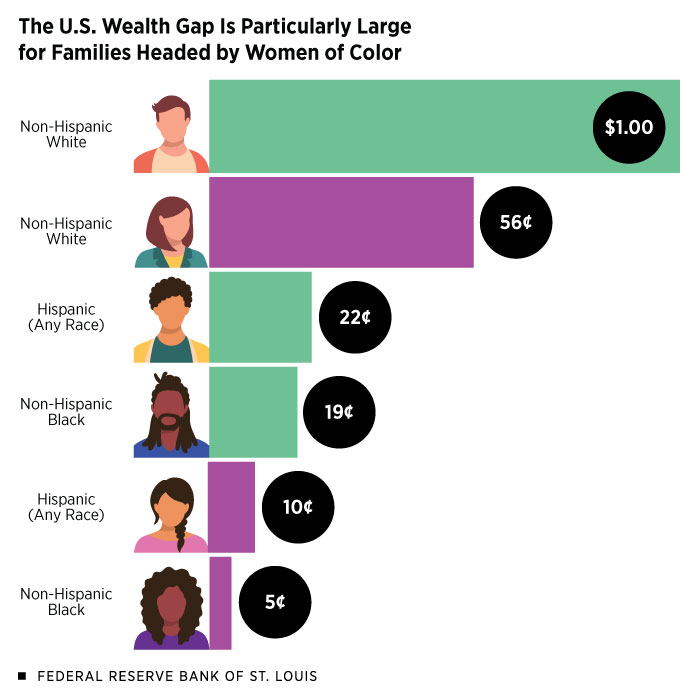
It turns out that, women’s wealth is generally from $0.34 to $0.96 to one dollar for a man in the U.S., depending on how it’s calculated, and about $0.74 globally.
And while a pay gap affects individual women and people of color primarily, the wealth gap is both more cumulative and socially entrenched than the pay gap. Reasons behind the wealth gap include the cumulative, lifetime effects of at least these factors:
The gender and racial pay gap
Career gaps and time out of the workforce for caregiving
More time spent while they’re working on family matters
Higher debt and higher interest rates
Higher costs on women’s products (aka, the Pink Tax)
Exacerbating these dilemmas are the factors creating worklife inequities within families and communities.
Who pays what cost?
The cost to this reduced wealth and income is not just borne by women. Men and children, especially those in female breadwinner families, suffer. Society at large pays a financial cost as well in the form of a lower GDP that cannot reflect the full earning potential of all its citizens across both racial and gender dimensions. For example, California could claim an additional $460B a year in GDP, growing by almost 50% if it fully realized the earnings potential of its people.
But let’s not forget that wealth is not really all about the money.
Quality of life, and the ability to experience qualitative richness throughout your life is of course a factor. While it’s hard to put price tags on the joy of spending time with children, taking a luxurious vacation or taking time to reflect and rejuvenate, these things do matter. Anecdotal evidence points to the fact that women take a more holistic approach to thinking about lifetime wealth, leaving them in a different headspace and heartspace when it comes to planning for, and living in retirement. Specifically, women are more likely to work longer, for both financial and worklife quality reasons. In some cases they choose to, and in many cases they have no choice.
When it comes down to it, “wealth” really means many things, and different things to many people. So although there is clearly a financial gender wealth gap, the solution may or may not look like complete equality for many individuals and families.
An InPowered way to consider the gender wealth gap
When we look at national and global statistics like this, this kind of analysis can be inherently disempowering. After all, there are so many variables here that we as mere individual humans do not control. What is an individual to do?
Well, I will admit I’m coming at this question from a personal deficit of knowledge. Despite thinking I understood wealth planning at least at a cursory level, this research has made me question many decisions I’ve made over time and given me some new things to think about.
Because financial issues are so inherently personal, there’s no true solution that fits all. However, getting smarter will help you manage your own situation much more effectively. Also, working with professional advisors who can guide you to understand how some of the gender and demographically related trends might be impacting you, and the true options you should consider, is also a good idea. Here are a few practical steps you can take:
Read the links on this article for a better understanding of the trends and how you may/may not fit into them
Follow some female-focused financial information resources, like Ellevest
Map out a couple of scenarios for your life, given what you know about the possible timing of children, elder care, need for personal breaks without income, goals, retirement etc. (Having a map is not a promise that this will be your future but it can be a planning framework.)
Talk to your partner and close family members who are affected by your financial decisions and collaborate on these scenarios
Give the scenarios to a financial advisor who will work with you on the intricacies of it, particularly those that don’t fit the “work 40 years and retire” scenario.
Adjust your plan every year or two
On its face, these items don’t seem that daunting, but actually they are. There really is no formula for doing it right. The most important thing is to be sure to go into this with your eyes open on the trends. It may change some of your planning and scenario assumptions.
The emotional aspects of money for women
I’ve been considering why this is such a difficult issue for so many people, women and men alike, and why women seem to struggle more as a group to build wealth systematically. I know there are books and seminars galore on this, but I think it’s worth reflecting briefly on the way that money and wealth relate to our personal power.
Money in all its forms is one of the purest distillations of power we have in our society. Further, in developed capitalist-based economies, the power of money has been taken to its extreme, elevating wealth to become a proxy for almost all forms of power.
Women, and racial minorities generally, have been historically so systematically separated from all forms of social power—especially money where women have only had the legal right to control their own money for about 50 years—that it’s no surprise that we don’t have a culturally-supported and sophisticated relationship with financial power.
And as much as I’d like for inner, personal power to be more important than social and economic power (since personal power is available to everyone, for free), it simply isn’t for most of us. Unless you triangulate your definition of success within a community of people who collectively value other things over money, or eschew community status altogether, there is just no escaping the fact that you will be judged, and judge yourself, based to some extent on your apparent wealth. To some extent your self-esteem will be tied to it. To some extent, your wealth will be a factor in how secure and powerful you feel in the world, and how successful you feel yourself to be.
For these reasons, it’s worth taking responsibility for whatever wealth you have. Be honest with yourself about what you have, what you need and how to manage them both. Take on the hard conversations with others to try to plan in alignment with them. Get educated and make the best decisions you can.
And, beware that just like crises of confidence on any topic, the elusive “it’s never enough,” mindset will haunt you. I believe this is true even for people many would consider “very wealthy.”
In a true sense, no amount of money (or influence, or credibility or success….) is enough. This is because when it comes to power, security and managing risks, fear and uncertainty are always right around the corner, as is the next disaster no one can predict.
Luckily for those of us on the INpower journey, fear and uncertainty ARE the inner, personal power game. So I think the lesson here is to play both the inner and outer games of power simultaneously. You need both, financial resources and a personal sense of non-financially based power to find any form of success that will sustain you.
I know I’m going to be thinking about the topic of wealth a little differently now that I’ve pieced all this together. I hope you will too! And please share with other women in your life who can benefit.
InPower Women’s Mastermind
We don’t Mastermind your business. We Mastermind YOU!
Sometimes the simple things are the most powerful. How often do you simply talk to the people you work with? How often are you human with them and invite their humanity out? John reminds us why leadership conversations are so important. – InPower Editors
Two weeks ago, I had the privilege of facilitating a discussion for a webinar for alumni of Georgetown University titled, “Conversations are the Work of a Leader”.
In spite of my limitations as a presenter, there was a lot of appreciative feedback about the messages conveyed: that as senior managers and leaders we need to be connected with our people, and not just through email, newsletters and town hall meetings. We need to get out of our offices, off our executive floors and speak with the people who are doing the work of our companies.
There were poignant comments and questions during and after the webinar, such as, “I wish my boss was listening. He doesn’t get it.” And, “How do we get this message to our senior managers? They spend most of their time talking to each other, not to us.”
There were many similar comments and questions. Clearly this subject sparked interest, people feel strongly that conversations are vitally important. We need to understand that conversations truly are the work of a leader.
There is the adage, “Managers focus on results; leaders focus on people.” That really should be “leaders focus on results and people”, as in today’s hyper-competitive business environment, we must hit our financial goals or we may not keep our jobs. But how are we going to keep our good people energized and engaged if we don’t invest the time to know them as our team members and what is important to them?
“Every business is a people business. via @JohnKeyserCoach on #InPower #Women” – Click to Tweet
Every business is a people business. Our relationships with our clients are essential to our success – with our external clients and, equally important, with our internal clients, our people. Yes, we must think of our people as our internal clients. They are the ones doing the work of our companies and they deserve our attention and respect. And the better the quality of our relationships, the better we’ll do as leaders and in our businesses.
Here’s compelling background. Morale in business today is low, witness that 40% of the workforce does not feel appreciated and 70% of the workforce does not feel fully engaged!
In my leadership consulting and coaching work, I repeatedly hear comments like, “I see our top people occasionally – in the lobby of our building. They seldom come out of the executive wing.”
Senior managers spend up to 50% of their time in meetings, and much of their remaining time speaking with each other, on calls, and in front of their computers. Most of their communication is through emails and or is delegated to those who report to them.
We have to free ourselves up. We have to make our meetings shorter, more efficient and more productive, and then take the time for conversations with our people.
Read the book, The 100/0 Principle: The Secret to Relationships by Al Ritter. Al tells his story about how he lost his team members. They didn’t want to work for him any longer because he was driving them hard without relating to them as people.
Our people need to feel they are:
Appreciated and valued
Heard, and their ideas matter
An important member of a team
Learning, growing and advancing
Everyone wants to be successful, and their professional development is our responsibility as well as theirs.
Servant leadership is worth studying, as it is a philosophy that can help us be most effective with our leadership responsibilities. It is about serving first, serving those with whom we work, and that is more important than the power and perhaps material possessions that result from our position.
A test of our being a servant leader is whether or not our people feel they are learning, growing and succeeding.
The way we help our people learn, grow and succeed is by being there with them – mentoring, teaching, encouraging, coaching them, helping them feel appreciated, inspired and empowered.
There is a wonderful quotation, “To be a truly great leader, we must stand with our people, not above them.”
Let’s think of how we use our time and energy as an investment, and that we need to invest in our two top priorities, which are our results and our relationships.
Successful people with whom I work have friendly, productive conversations that lead to new clients and assignments and improve morale. They drop by people’s desks and they pick up the phone rather than emailing, and ask how they are doing. They say “Good job,” and “Thank you,” and “What can we do for you? What are your ideas for our company?”
A short, good quality conversation is better than no conversation. So even when traveling, we can make calls from taxis and airports, check in with our people, let them know we are thinking about them and that they are valued.
Of course there are difficult conversations that we must have, and that many of us avoid. I could write a whole new article about the art of difficult conversations. Rather, I recommend that you read the book “Fierce Conversations” by Susan Scott. It is a gem, so many helpful ideas. Susan Scott really gets it. She writes, “The conversation is the relationship,” and “Treat each conversation as the most important conversation we will ever have with that person, as it may well be,” and “Conversations are the work of a leader”.
Let’s remember that good conversations mean we ask questions, do only 20% of the talking, and we listen to understand and learn.
I hope this paper is helpful, as I know the practice of leadership through conversations will absolutely serve us and our businesses well.
InPower Women’s Mastermind
We don’t Mastermind your business. We Mastermind YOU!
There’s an old stereotype about female bosses, which is that they can be really mean, and for some reason women are often the ones to perpetuate this story about female leaders. Personally, I don’t think this is particularly more common – or more important – to think about a female vs male bully boss. Jerks are jerks and it doesn’t matter what gender they are. I don’t believe that looking for reasons and excuses that somehow explain and try to justify their behavior is a good use of our time.
How to deal with a bully boss
Working for, or with, tough people is – tough. You can feel stuck between a rock and a hard place, trying to decide if you are being victimized, gaslit, complicit or backsliding on your career stuck under someone’s thumb. Working for a toxic boss can really make you feel triggered, helpless and like you’re in a no-win situation. And the worst part is that you know others are watching and may be assessing your potential based on how you handle the situation. So lesson one is: learn to handle it well!
Here are some strategies to help you out. The most important thing to do is to notice what’s happening and make conscious choices about how you’ll act. Unconscious reactions are the most effective technique a bully boss has for keeping you off balance.
1. Make sure you’re not enjoying and contributing to the fight.
Are you part of the problem? Have you caught the virus? Are you being too sensitive? Are you being part of the bully brigade – even unconsciously? Ask the question in the mirror and decide for yourself what to do. If the answer is yes, don’t waste time beating yourself up, just resolve not to play that game anymore. When the boss reaches out looking to play the game, give yourself a moment to compose yourself (walk the long way to their office, breathe deeply before returning their call etc.) and start to explore other behaviors and responses when they lash out. (Hint: Detriggering is the best place to start.)
2. Take a hard look at yourself and whether you’re projecting your stuff on them.
This can be particularly challenging if your boss is the same gender as you. Does she remind you of a parent or sibling you’re still struggling with? Is she just doing her job with a little less sensitivity than you’d like? Is she fighting dragons you’ve never fought and can’t appreciate? Do you need to find someone to blame and because she’s not a “sister” and confidant, she seems blamable?
If you’ve never been in her shoes, consider stepping back and assuming that she must have something to teach you and become determined to figure out what it is. That will help you reorient yourself to her and ignore BS behavior in order to find the nuggets of wisdom and perspective you can learn from her experience.
3. Establish emotional distance.
This can be really, really, really, really hard, But honestly, it’s a skill that will come in handy the rest of your career (and life) for bully bosses and everyone else that gets under your skin. It’s almost impossible to learn this working for a nice boss, so if you find yourself working for a meanie, buckle down and learn to detrigger (and then practice it on other meanies in your life).
How to do this? Just KNOW that whatever crap she’s yelling at you or whatever passive-aggressive behavior you’re tripping over is NOT ABOUT YOU. This can be pretty hard to believe, but practice imagining what else it might be if it’s not about you. If she embarrasses you in front of your team, imagine what mania might be in her head that makes her do that to protect herself from a debilitating fear that everyone will see that she isn’t ____ enough. This doesn’t make it right, but if it really isn’t about you (and it’s not if she’s being emotionally abusive) then when you get upset, it means you’re the one making it about you. Imagine other people looking at you wondering how you’ll react and know that if you react, then they might believe that your boss is right. But if you don’t react, they can literally SEE that it’s about her. Also, learn release techniques to get rid of anger, fear and guilt, which threaten to build up and stick to you when you’re with people trying to make you feel angry, afraid and guilty.
4. If you find yourself working for a bully boss, you should ask yourself what you’re getting out of the situation and what more you can learn.
If you think I’m being too extreme to suggest exploring if you’re getting enough out of the work relationship to stay, actually, I’m not (see below). You should always ask yourself this, even if you’re working for a great boss. Quite often we undermine our careers by staying too long when we’re comfortable, or bolting too fast if it’s tough. If you’re working in a culture that puts up with mean girls (or boys), you’re quite possibly compromising your integrity and values by surviving in that environment, not standing up for yourself often enough, looking the other way when others get screwed, participating in the gossip and undermining behavior so the boss thinks you’re “on her side”, and in the process you’re becoming more like her.
If you are getting something out of it – a career experience, expertise or connections – make your decision to stay consciously for those reasons. However do a double check on how you’re acting while you’re there. When you’re complicit in creating or maintaining in a toxic culture, you are often burning bridges you can’t see. By contrast, when you choose to act in integrity in a toxic environment when others behave immaturely, you’re building bridges, some of which will help get you out of there when the time comes. So look at what you can learn by staying and improving yourself as much as possible before moving on.
5. Don’t succumb to fear as the reason to stay.
When I was working for bully bosses I figured I was gaining experience (I was!), bosses were all like this (they weren’t!) and I didn’t deserve any better (I did!). Then one day I decided I did deserve better. I was accosted by debilitating anxiety as I prepared to leave, discomfort I’d never get another job, fear I’d get a bad name – anxiety, sleepless nights, the whole shebang. But finally I decided it just wasn’t worth it to stay. I just hated myself for putting up with mean bosses too much. And you know what? Once I made that decision (well, twice I had to learn this lesson actually), I started working for good people, people who valued me, people who helped me because they were good people. I wished I’d had the guts to quit much earlier. If fear is what holds you there, let it go, know you deserve better and you’ll soon learn that you do.
6. Don’t bitch, whine or complain about the boss who’s making your life miserable.
It’s one way you catch the virus.
You’ll notice a pattern in the strategies above that will help you find your personal power, which is that you need to stop reacting and believe that you have choices in how to respond and react to your terrible boss.
Choice is power and the moment you start making more choices is the moment you become more powerful. – Click To Tweet
7. Get out.
Update your LinkedIn (before you mess with your resume). Look at job postings. Network with people that might know about other jobs. Take the time to sketch out your dream job. Make your “top 10 list” for things you’d do right away if you got laid off or quit.
This can be tough, but if you give yourself the option to consider leaving the job, you will immediately start to feel better and more in control. You’ll begin to perceive new options. See them and use them. Even if you don’t end up leaving your bully boss, know and act as though you have the choice and you’ll be in a stronger position to manage the difficult relationships. And you do have a choice, always.
Updated. Original publication date: 2012
FREE EBOOK
Coaching Tips: How to Avoid the Most Common Career Mistakes
How much energy do you spend trying to push back reality? Many of us deplete ourselves unconsciously by fighting reality with vision, and then we wonder why the heck we’re so tired. What insight can we draw from this cycle?
I know I can fall into this pit, even with the most noble of goals: to exceed expectations, to improve myself or simply to change the world for the better.
Insight: Reality Matters
Striving for a better outcome is worthy of your time and energy, but don’t fall into the trap of getting so caught up in your vision of how things could be better that you fight against what exists.
Stop and accept what is. Acknowledge that it is real, and that it is driving you and others to do things “the way they are.”
Don’t bother explaining it. Half the time you can’t explain it and the other half of the time you get stuck to it when you try.
BE with this acceptance. Let yourself rest with the knowledge that it is what it is, without fault or blame. Notice how much energy you gain back by simply accepting its current existence.
NOW begin to imagine how this reality could change.
Revisit your vision with the energy you just regained. Include in your vision the knowledge that it must evolve from, or replace, what exists in this moment.
Take ownership of your desire to effect this change, including the risk that you might fail.
Accept reality, own your desire for change and move forward with all the energy this knowledge gives you.
Succeed on your own terms.
Tap your most Authentic Feminine Leadership Style.
What is power? I love this discussion because it calls out everyone’s beliefs, assumptions, fears and attractions to this complex concept. It turns out that power means different things to different people, and really is only tangentially related to actual leadership, but in almost all cases power is related to the use of resources and the ability to change the world. Here are the typical definitions of power that I have picked up in having this discussion online over the last few months:
Authoritarian Ownership: ownership of resources and the ability to decide on how they are used, including telling others what they should do if they want access to the resources.
Authoritarian Positional: the authorities granted to those who hold certain positions and can make decisions that allows them to manipulate resources and tell others what to do as long as they are in that position (but not once they leave).
Influence: a person’s credibility whose opinions strongly affect those with Authoritarian and Positional power.
I call these powers “external” because whether or not a person has this kind of power depends on external circumstances such as the presence or absence of wealth, authority or other’s reactions.
Abuse of power
In my discussions about power, I have noticed that much of the energy that goes into talking about it is really focused on abuses of external power. “Absolute power corrupts absolutely,” is quoted often, and others report aversion to power because their primary association with power appears to have been an abusive one. At first I wondered if this would be more true for women than men, but after many discussions I don’t really think it is. Abuse of power is gender neutral.
I find it disturbing that there is so little positive association with the idea of power.
Another approach to power
There are two other types of “internal” power that are referenced less often, but I believe are even more important in today’s business environment, where authority tends to be more distributed and the challenges we face more complex. It’s important to note that those internal powers can easily (and powerfully) coexist with external power.
Personal: freedom from external power that allows a person to choose how they use their own resources and energy and who use their very freedom to cause change. I call this InPower.
Group: the dynamic of many people acting in cohesion to manage resources in multiple areas simultaneously. Group power is the only power that simply can’t function without leadership.
Not all those with power are leaders
… but all leaders have power. At least this is my belief. Having power does not by definition make you a leader. There are plenty of people who have power – especially ownership and positional power – that show little to no leadership interest in leaving the world and the people affected by their efforts better off.
By contrast there are people who get up every morning determined to make the world better and who cause others around them to think and act accordingly and these people are clearly leaders.
I believe the best leader is one who intends the world to be better as a result of their efforts and leverages personal, group, and whatever external power they can achieve, to accomplish it. – Click To Tweet
Personally, I’m most interested in personal and group power because, while they are the subtlest and least understood, they are also arguably the most important to true leadership. I am beginning a series of blog posts on the ways we typically “give away” our internal power and how to take it back to be a more effective leader.
FREE PDF Guide to Women in Leadership
Executive Coach Dana Theus shares her tried and true strategies to help women excel in higher levels of leadership and achieve their executive potential.
Mentors are a true career asset, whether they are “officially” part of a formal mentoring relationship (often matched through a mentoring program) or unofficially informal relationships that grow organically. Regardless of how you enter a mentoring relationship it’s important to be intentional about the questions to ask a mentor so you receive the full value from the relationship.
If you’re in an informal relationship that arises out of natural connection, you may find yourself asking questions very naturally, as a part of dialog and connection. This is great, but it’s also a good idea to think about what you’re asking to be sure you’re getting information that really moves your own career aspirations forward. If placed into an official “mentoring relationship,” you may actually experience tinges of anxiety, thinking: what should I talk to them about?
You may also find yourself in mentoring situations you didn’t really plan for. Some events incorporate a “speed mentoring” component intentionally, but there are many opportunities to seek the advice of people with experience and knowledge you could use.
That’s why it’s a good idea to develop questions like these, even if you’re not in an actual “mentoring relationship.” You’ll have some hip-pocket, go-to topics to ask anyone, any time you spot an opportunity to get some mentoring advice.
Where to start your mentoring relationship
While mentoring is most successful when part of a good personal relationship, the actual career value comes when the insight and advice you get from your mentor is highly aligned with your own career aspirations and curiosity.
You probably have some fuzzy ideas of things to discuss with your mentor, but I encourage you to sharpen it up with a focus on your career goals and strategies to get around obstacles in your path. Once you’re as clear as you can be on this, you’ll come up with really pointed and valuable questions to ask a mentor.
Getting clear on your goals:
Summarize your own career goals
You’ll want to share whatever you know about your goals with your mentor. This will help them think of questions you don’t even know to ask, as well as help them focus their advice. If you’re not totally clear on your goals, this is okay! Part of what your mentor is there to help you with is sharpening up your understanding of what’s possible so you can make choices. In some cases, they may give you information you can’t choose from yet, but they can help guide you to learn more so you can make choices.
A key to sharing whatever clarity you have with them is to describe your goals in positive terms. This means saying, “I do want _________,” or “I may want __________.” The key is not to focus very long on what you don’t want. Although you may have to share things you don’t want, don’t dwell on it. They will be much more effective in helping you to the extent they’re clear on what you’re looking for, instead of what you’re looking to avoid.
Part of this strategy is to remain future-focused. You can certainly share past experiences with them, but direct their attention to ideas you have about the future and don’t get stuck in the past.
Identify 2-3 (maximum) challenges you have in taking your next step towards your goals
Once you’re as clear as you can be on your goals, identify some things that you know prevent you from reaching them right now. These obstacles may change by job focus and industry, but they often fall into categories like:
Lack of information and advice
Confusion or lack of understanding
Inability to decide based on what you know
Lack of experience, skills, connections
Lack of confidence
If these are problems for you, don’t worry about it. These are exactly the kind of things mentors can, and want to, help you with. Take this clarity on your challenges and turn into questions to ask a mentor.
Research them to find points of connection between their accomplishments and your own interests
As soon as you realize you’re in a mentoring relationship, it’s a good idea to do some research on your mentor. Learn what you can about their background and current responsibilities. Come up with some questions about their career experience as well as their points of view. Just follow your natural curiosity. They will appreciate the fact that you did some homework and will find it easier to get into a discussion with you since you’re not asking them to start from scratch in introducing themselves to you.
Questions to ask a mentor
Now you’ve got an agenda! You are showing up prepared to equip your mentor to help you. Once they have a clear understanding of what you are interested in achieving and the challenges you experience today, their advice will flow more readily and more naturally. You’ll also feel more intentional and directed, which will help you come across well.
You’ll want to kick off with some starter questions, designed to get the conversation going once you’ve shared your goals. Here are a few examples:
Tell me about how you managed your career when you were at the same point I’m at now: what worked and what didn’t?
How would you suggest I refine my goals to increase my chances of success?
If you were me, which of my challenges would you tackle first? Why?
What do you think is a reasonable form of success for me in the next 6-12 months? What’s unreasonable?
What was your biggest #career success and why did it work?
What has been your biggest career disappointment to date and what did you learn from it?
Once you’re into the conversation or relationship, it’s appropriate to go deeper. You’ll want to think about what might happen if you take some of the advice you’ve been given by your mentor (or others) and anticipate the kinds of questions you may have in the future. Or you may want to imagine you make a certain choice and follow it through. What kind of questions might you encounter if you pursue that particular path? Here are some ways to think about deepening a conversation with your mentor.
If I take your advice to ________, what do you think are the two most likely outcomes? What options might I have if I do this, vs. doing something else?
If I want to develop skills/get experiences like _________, what are the most effective ways of doing this?
What do you think are the biggest pros and cons to following path A vs. path B? What would be reasons to pick one path over another?
Given that I want to do _______, what are the most important technical skills I should develop? What about soft skills? Why are these thing important?
I’ve had challenges with these kinds of people and situations in the past, how am I likely to encounter them in the future we’re discussing? What’s your advice for using these challenges to handle them more easily?
How to ask great questions (of anyone)
You can see that there are any number of ways to explore the advice and insight your mentor gives you. Learning to start and continue a conversation with your questions is a good life and career skill. Here are a few tips to help you use your mentoring relationship (or any relationship!) to build this important skill.
Learn to ask open ended questions and try not to ask Yes/No questions. This will help you and others get into a flowing dialog more quickly
Engage your natural curiosity and think about “what if?” to help you imagine different things you’d like to learn about.
Fall back often on the question “Tell me more.” Don’t assume that their answers to a question is all they have to say. When you invite people to elaborate on their thoughts they will often come up with surprising and interesting answers to share with you.
Sometimes it seems hard to figure out how to ask good questions, of a mentor or anyone. So here’s a little trick. Make a commitment to spend the next week starting every conversation (or as many as you can) with five minutes of questions before you give an opinion or tell someone what you think.
At first it will seem awkward, but after a day or two you’ll realize you’re listening more carefully to people, looking for things to ask about at the start of the conversation. You’ll also find yourself getting into more interesting and meaningful conversations, which is awesome.
Asking people questions, whether in a mentoring relationship or not, makes them feel that you value and respect them. They’ll tend to open up more and share more information about themselves and the things you’re interested in, more readily.
Try these strategies when you think about questions to ask a mentor, and give yourself the one week challenge to become more curious in all your conversations. See what happens!